





Key takeaways
- Multifunctional landscapes deliver food, income, and environmental gains together. Across four sites in northwestern Tunisia, treating land, water, agriculture, and ecosystems as one system improved soil, water, biodiversity, productivity, and incomes at once.
- There is no single template for success—many models work. Farmer-led innovation, community action, public forest management, and public-private partnership each succeed; choosing the right one depends on local land tenure and governance.
- Evidence drives adoption—yet the full value of these landscapes has yet to be documented. Measurement converts skeptics into investors. An IFPRI-ICARDA effort to evaluate ecosystem services across these sites aims to close that gap.
In Tunisia’s northwest, the land tells two stories at once. There are the olive groves, cereal fields, forested ridgelines, and grazing lands that have sustained livelihoods for generations. Meanwhile, a more troubling tale runs below the surface: soils thinning under the plow, rainwater running off across bare lands washing away soil and degrading landscapes, and reservoirs silting up faster than they can be replaced.
Water erosion, Tunisia’s dominant form of land degradation, affects some 3 million hectares of the 10.4 million used for agriculture—1.5 million of them severely—while 46% of crops grow on soils of limited fertility. In Kef and Siliana governorates (provinces) in northwestern Tunisia, where smallholdings dominate and cereal-livestock systems press against the fragile, sloping terrain of the Tunisian Dorsal, the squeeze is acute: soil losses in the semi-arid region average 14.5 metric tons per hectare a year, and the hillside reservoirs built to capture runoff last only about 14 years before they are filled with sediments. Climate change is expected to further worsen these pressures.
These are nexus problems: land, water, agriculture, and ecosystems are so tightly coupled that a fix aimed at one in isolation tends to fail. Hence the need for a multifunctional landscape approach—treating a landscape as one interconnected system and seeking food, income, biodiversity, and resilience together rather than trading one against another.
From June 8-10, a team from IFPRI and the International Center for Agricultural Research in the Dry Areas (ICARDA) visited four sites spanning the full range of land tenure and governance in northwestern Tunisia, from a private farm to a public-private partnership on state land, to lay the groundwork for an economic valuation of the ecosystem services generated by conservation and restoration landscape investments. The visits offer lessons on how landscape approaches provide nature-based solutions to reverse degraded natural environments.
The four cases, and their lessons, follow.
Adnen Abdrabbou’s farm: Where conservation agriculture in Tunisia began
In 1999, Adnen Abdrabbou made a decision with important consequences for farming in Tunisia: he stopped plowing his land in El Krib, Siliana, altogether, adopting the three pillars of conservation agriculture (CA): minimum soil disturbance, permanent soil cover, and crop rotation. Tillage had been drying and eroding his soil, and fertilizer had grown punishingly expensive. He opened his fields as a trial site for ICARDA and national institutions, becoming the first Tunisian farmer to pioneer conservation agriculture. One trial has run for nearly two decades and today is the most well-documented on-farm CA experiment in North Africa.
By 2006, he was seeing better soil fertility, water retention, biodiversity, and yields—enough to buy his first no-till seeder. Today his entire 140-hectare farm is under CA and agroforestry, rotating five or six crops—cereals with legumes such as fava beans, alfalfa, and vetch—and integrating livestock, so sheep graze while residues stay as soil cover. This crop-livestock integration solved the obstacle that long held CA back in Tunisia: farmers would not leave residues in the field when they needed the biomass for summer feed—forage mixtures gave them both.
Abdrabbou’s farm is a nature-based solution on the scale of a mid-sized farm, and a training hub: he now trains other farmers and helped found Tunisia’s sustainable agriculture association (APAD). ICARDA’s engagement, through on-farm trials, no-till mechanization, and crop-livestock innovations, supported by the IFAD-funded Crop-Livestock Conservation Agriculture (CLCA) project, turned one farmer’s conviction into a reference model.
GDA ‘Fadj Lehdoum’: Conservation agriculture as collective action
A few kilometers away, in the semi-arid landscape of Hammam Biadha South in the same district, a group of farmers is tackling the same challenges. The Agricultural Development Group (Groupement de Développement Agricole, GDA, a form of community-based farmer organization) Fadj Lehdoum was formed in 2017 by 35 smallholders, with support from the regional agricultural development authority (CRDA Siliana) and, from 2018, the north-west sylvo-pastoral development office (ODSYPANO). Members now combine olives, almonds, cereals, forages, livestock, and beekeeping across roughly 2,000 hectares split between upland and lowland.
What makes Fadj Lehdoum distinctive is that it has organized CA at the landscape scale through upstream-downstream cooperation. Recognizing that erosion and water problems ignore field boundaries, farmers have organized collectively to adopt CA practices—intercropping, rotation, and forage mixtures across the catchment, not plot by plot. Intercropping olives with vetch pays a double dividend: it maintains soil fertility and provides nutritious feed that farmers say lifts milk yields. Input use is strikingly low—around 1.5 kg of phosphate (vs. over 50 kg/ha phosphate fertilizer in a high input scenario) and 25 kg of manure per hectare in the olive system.
The site anchors the Tunisian Agroecology Living Lab and the El Krib Landscape Living Lab, under the European Union-funded NATAE project and the CGIAR Agroecology Initiative. Here, ICARDA co-designs and tests agroecological innovations with GDA members: composting olive-mill byproducts and oil-mill wastewater; forage legumes intercropped (vetch, Narbonne vetch, sulla, and mixtures) with olives; carob as a drought-tolerant multipurpose tree that sequesters carbon, shades livestock, and yields nutritious pods; and a community nursery. This collective model aligns individual incentives with landscape outcomes.
But the field visit also surfaced two policy tensions worth watching. First, fertilizer subsidies and guaranteed cereal purchase prices send a signal that can pull farmers back toward high-input cereal monocultures, potentially undermining the more sustainable CA system over the medium term. Second, the durability of collective action hinges on equitable benefit-sharing: any perceived unfairness between upstream and downstream members could fracture the cooperation the whole model rests on.
Mountain forest: Restoring a burned public landscape
Not all degradation is gradual. In 2021, fire tore through 1,200 hectares of state forest managed by Tunisia’s General Directorate of Forests (DGF) in the Hammam Biadha area. Fire on fragile slopes is doubly damaging, stripping the vegetation that anchors thin soils and exposing hillsides to erosion.
The response shows how public forest management can be combined with research and civil society. Under the CGIAR Agroecology Initiative and now the Multifunctional Landscapes program, ICARDA—with the Alliance of Bioversity International and CIAT—partnered with the DGF and the national NGO Les Amis de CAPTE Tunisie (LACT) to rehabilitate the land. A 40-hectare pilot has been reforested with native, multipurpose species—carob and Atlas pistachio—chosen to yield ecosystem functions like fodder and food, not just green cover.
The project’s significance is as much institutional as ecological and addresses a national bottleneck: reforestation has long been constrained by the difficulty of propagating carob, whose grafting success often falls below 20%. ICARDA’s work on simplified vegetative propagation—drawing on national research and CIRAD—has trained DGF staff across five governorates, enabling investment that turns a 40-hectare success into a national program.
The El Chahda agro-silvopastoral lighthouse: A public-private restoration model
The fourth site, in Zaghouan, is where ICARDA’s role is most central and the multifunctional logic carried furthest. The El Chahda “lighthouse” model demonstration site spans roughly 1,500 hectares of state land managed by the DGF that is open to GDA Chahda members for grazing under contract—a genuine public-private partnership. With only 350–400 mm of rain a year and erosion-prone slopes, it is an unforgiving test of restoration.
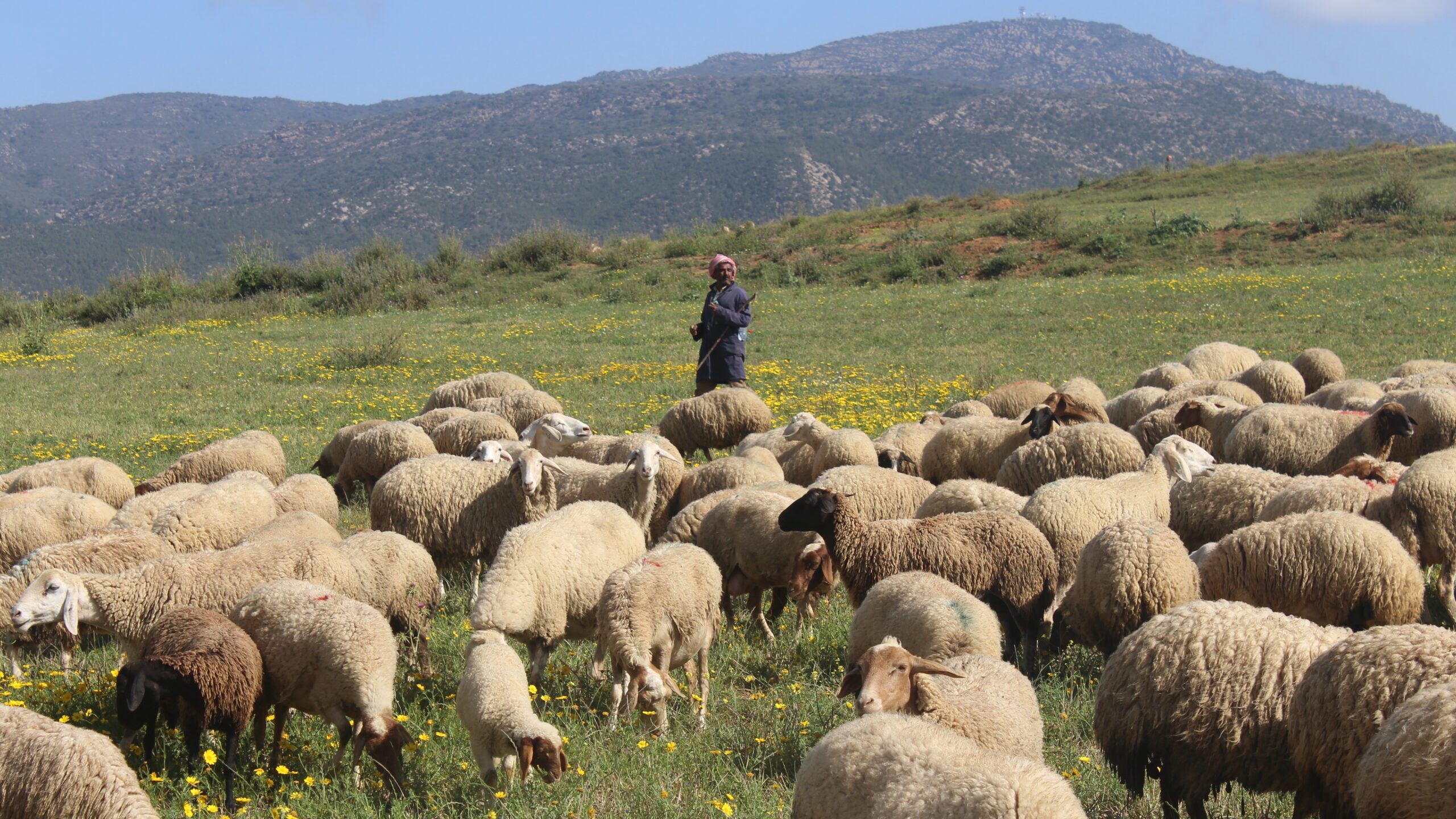
El Chahda integrates trees, shrubs, and herbaceous plants with managed grazing to restore the plant-animal balance: afforestation on the poorest soils, the native forage legume sulla on deeper soils, rotational grazing, and low-cost measures such as contour stone bunds. Sulla—drought-tolerant, nitrogen-fixing, and nutritious—is the linchpin. ICARDA’s assessment found that sulla reseeding raised biomass by around 440%, improved plant cover by 330%, and doubled species diversity, while extending the grazing period and cutting supplemental feed. Those gains flowed through to livestock—lambs and kids gaining 5%-10% more weight and cows 15%-25% more milk—and to household income.
ICARDA leads the site alongside the DGF, the regional authority (CRDA), and the Chahda community, under the PRIMA-funded TransforMed project and the CGIAR Multifunctional Landscapes program. Designed as a learning platform, its most telling signal is behavioral: farmers who first benefited passively from communal grazing now request sulla seed for their own plots, some investing their own capital on the strength of what they saw on the state land. That shift from passive beneficiary to active investor is what scaling looks like on the ground.
Lessons, gaps, and policy implications
Diversity of entry points is a strength. Conservation and restoration in these projects advance through four different models—private, collective, state-led, and public-private. No single one is “correct”; a multifunctional landscape needs a portfolio of arrangements matched to who owns the land, who uses it, and who bears the risk—so scaling means diagnosing the local governance context first, not exporting a template.
Nature-based solutions rest on repeatable building blocks. Native, multipurpose, drought-adapted species (carob, Atlas pistachio, sulla, vetch); crop-livestock-tree integration that closes nutrient and feed loops; minimum soil disturbance and permanent cover; and low-cost water conservation structures recur across every site and transfer readily across North Africa and the Mediterranean.
Seeing is believing—but only with rigorous monitoring. The El Chahda results converted skeptics because they were measured on the ground; public agencies and investment projects already seek to replicate the case at two further MFL sites in 2026-27. The ongoing IFPRI-ICARDA economic valuation of ecosystem services fills a real gap: the carbon sequestration, water regulation, biodiversity, and fodder security these landscapes deliver are not yet captured in the numbers that guide policy.
Persistent gaps threaten sustainability. Propagation and input supply chains—for carob seedlings, sulla seed, and no-till seeders—remain bottlenecks; benefit-sharing within collectives and public-private grazing must be managed deliberately; and long-term financing of restored sites, once projects end, is rarely secured.
Policy coherence is the decisive lever. Fertilizer subsidies and administered cereal prices nudge farmers toward high-input monocultures and away from CA—a reminder that poorly targeted support policies can quietly undercut conservation. Aligning subsidies and prices with soil health and water outcomes, securing community access to restored state lands, and investing in nurseries, seed systems, and monitoring would do more than any single new project.
Tunisia’s northwest has more than its share of environmental degradation—but these four sites show it is not short of solutions either: practical, locally adapted, and already working. The task now is to value them properly, connect them into a coherent strategy, and give the policy environment room to help them grow.
Bedru Balana is a Senior Research Fellow with IFPRI’s Agrifood Innovation and Resilience (AIR) Unit; Aymen Frija is an agricultural economist with ICARDA’s Social, Economic, and Policy Research Team and coordinator of ICARDA’s activities in Tunisia and Algeria; Zied Idoudi is an ICARDA Research Associate based in Tunisia; Upeksha Hettiarachchi is an AIR Research Analyst; Wei Zhang is an AIR Senior Research Fellow and Research Lead on Ecosystem Health and Biodiversity. Opinions are the authors’.
The team gratefully acknowledges the farmers of GDA Fadj Lehdoum and GDA Chahda, Mr. Adnen Abdrabbou, and staff of LACT, the DGF, CRDA, and ODSYPANO for their time and insights.