


Key takeaways
- Introducing tricycles, dehusking machines, and protective equipment to women’s shea cooperatives cut processing time from days to minutes and eased transport burdens, an IFPRI study shows.
- Women gained time and improved well-being. Less physical strain and faster processing freed up time for farming, family responsibilities, and community activities.
- New income opportunities emerged. Women used saved time to expand shea collection, start small businesses, increase farm work, and boost earnings.
In northern Ghana, shea trees—locally known as “women’s gold”—have anchored rural livelihoods for generations. The tree’s oil-rich nuts are an important export and domestic crop, used for food and in products including cosmetics. Across Africa, an estimated 16 million women depend on the shea tree for income; in Ghana’s northern regions alone, roughly half a million are engaged in the sector—for many, it is the primary source of income.
Yet behind the global market’s appetite for shea lies intense drudgery: women walk long distances on foot to collect nuts and carry headloads home. Shea processing is labor intensive and time-consuming, which involves multiple, physically demanding (and, over time, debilitating) stages such as depulping, parboiling, drying, and cracking or deshelling, carried out with only basic hand tools. Despite bearing these burdens almost entirely, women occupy the lowest rungs of the value chain’s economic ladder.
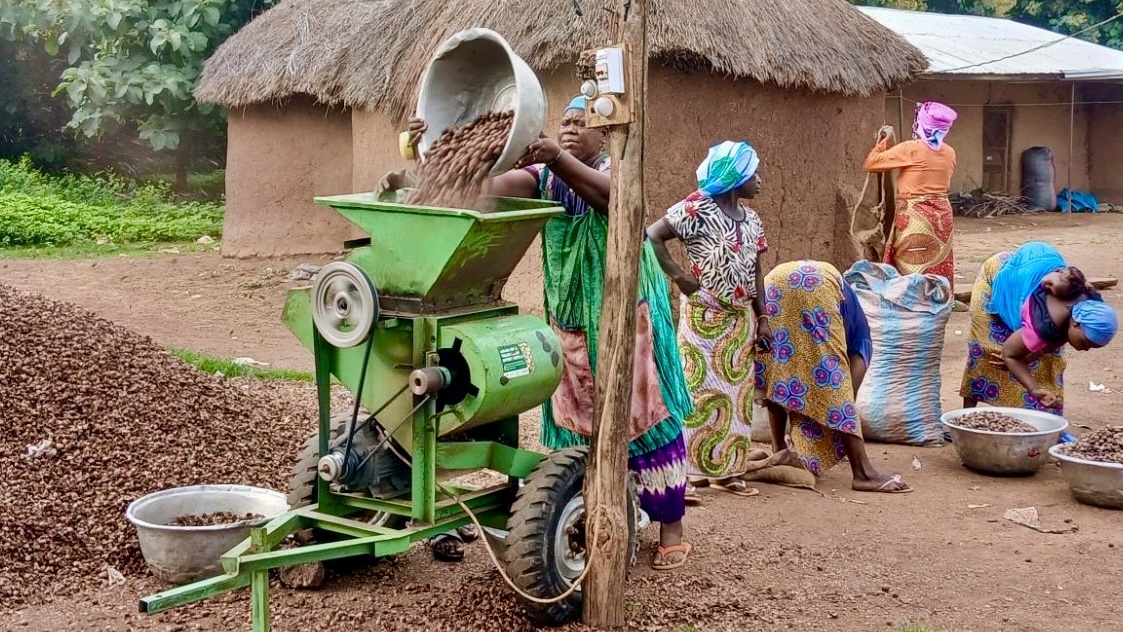
In early 2025, an IFPRI-led project introduced a mechanization package to 20 women’s shea cooperatives in northern Ghana: a motorized tricycle, mechanical dehusking machine, and personal protective equipment (PPE). The Japanese government-funded initiative was conducted in partnership with Fuji Oil Ghana with field support from Presbyterian Agricultural Services (PAS) and Green World Initiative (GWI).
Based on focus group discussions (FGDs), interviews, and field observations across beneficiary women’s groups in 2025-2026, this post explores what changed after the equipment was introduced and potential pathways for mechanization to open new possibilities for women’s economic agency in Ghana’s shea belt. The voices of women on the ground tell a story of transformation that goes well beyond processing efficiency.
The study
We conducted FGDs in 20 cooperatives in June and three in August. Tricycle and dehusking managing committee members, group leaders, and members were invited. In total, 510 and 80 women participated in June and August, respectively. The key findings of the two field visits, which adopted a qualitative method involving intensive FGDs, include:
- Labor saving: Dehusking time was reduced from two to three days to about 30 minutes per 80-100 kg sack (less exposure to malaria).
- Transport: Tricycles eliminated head-loading of 20-40 kg loads over 10-15 km (fewer back injuries).
- Time for other activities: Increased time for farming; more time for family; starting or expanding other economic activities.
The burden before
The shea value chain is, at its core, a sequence of physically punishing tasks performed almost entirely by women using methods unchanged for centuries. This burden manifests across every stage of the shea value chain:
- Collection: Women walk 10-15 km one-way into forests and savannah parklands to gather fallen shea nuts, often without footwear or protective gear, facing snake bites, scorpions, thorns, and rains.
- Transport: The return journey is made on foot, with loads of 20-40 kg balanced on the head—a practice that leads directly to chronic neck, back, and spine injuries.
- Parboiling: Nuts are boiled at 100°C over open firewood fires in outdoor settings—hot, smoky, and time-consuming.
- Manual cracking (dehusking): This is the most labor-intensive stage. A woman working alone requires two to three full days to crack a single 80-100 kg sack of shea nuts by hand, bent over the ground, using a wooden mallet, inhaling dust, and exposed to late-night mosquito bites.
- Shea butter processing: If women proceed to extract butter, additional stages of roasting, grinding, kneading, boiling, and cooling add further labor-intensive days before any income is earned.
Together, these constraints limit how much shea women can collect, how quickly they can process and sell, how much time they have for farming and family, and ultimately how much of the value chain’s returns they can capture.
What changed
While modest in appearance, the tricycle, dehusking machine, and PPE proved transformative in effect.
Dehusking machines—from days to minutes: The most striking change reported across the women’s groups was the collapse in processing time. In Sambu, women described hand-cracking a sack of shea nuts as a three-day ordeal; with the machine, the same task takes approximately 30 minutes. Participants described relief from the chronic stresses of late-night cracking sessions.
“We no longer fall sick from malaria anymore because we don’t stay in the night cracking nuts which exposes us to mosquito bites”—beneficiary, Zilindo.
Tricycles—ending the head-load journey: The motorized tricycles addressed the transport bottleneck from forest to home that had constrained both the volume of nuts that shea women could bring in and the physical toll of doing so. Tricycles eliminated head-loading over long distances and enabled women to access more distant and productive shea collection areas.
Shea works are time-bound to avoid germination. The increased collection efficiency (as well as time saved in dehusking) enabled women to gather more shea nuts timely—expanding the volume they could bring in and, with it, their earnings. For many, the productive frontier of their shea season is enlarged altogether.
Tricycles also proved useful for many purposes: in Kata Banawa, they were used to carry firewood for parboiling and to transport produce to markets. In Bongbini, the cooperative’s income from tricycle services was reinvested into maintenance and even toward purchasing a second tricycle.
Women across communities consistently associated mechanization with improved health outcomes. In Bongbini, participants reported that complaints of waist pain, chest pain, and general body weakness—formerly chronic and widespread—had decreased since the machines arrived, though the extent of improvement was not formally measured.
“We used to visit the hospitals more frequently because we carried heavy loads of shea walking long distances home, but we no longer fall sick or visit the hospitals frequently because the tricycles now carry the nuts, relieving us from the stress of carrying long distances.”—group member, Bilising.
Personal protective equipment (PPE)—enabling women to go deeper and safer: Boots, gloves, and raincoats addressed a safety dimension often overlooked in value chain interventions. Women reported that PPE enabled them to enter forest areas they had previously avoided due to fear of snake bites and scorpion stings, effectively extending the collection frontier. Ensuring all cooperative members have adequate PPE remains an important unfinished task.
Beyond efficiency
The hours that women reclaimed from the shea processing burden were not simply leisure time. They were redirected, often immediately, into a range of activities—petty trading, farming, more shea nut collection, childcare, and community participation—that suggest emerging pathways toward greater economic agency. Whether these gains translate into sustained empowerment depends on the degree to which women can control the time, income, and decisions that follow.
New and expanded income-generating activities: Women across all communities described using saved time to start or expand petty trading, food vending (koose (bean fritters), rice, porridge, kulikuli (nut snacks)), and pito (millet- or sorghum-based beer) brewing. Participants also reported increased earnings, though evidence on women’s control over that income—including how decisions are made within households about its use—was not systematically collected and merits attention in future assessments.
“The arrival of the dehusking machine has relieved me of more time, and I have now started a business. I trade in the market now, buying and selling petty goods in the market and community.”—group member, Bilising.
More time for farming: A repeated theme across the FGDs was the connection between shea processing time and agricultural labor. Women are not only shea processors; they are also farmers, and the time demands of shea cracking had long created seasonal conflicts with farming activities. A husband in Bilising joined a women’s FGD to share:
“Sometime before the project, we needed our wives for farming activities, but they would be engaged in cracking of their nuts for long periods. But with the dehusking machine coming, my wife now spends few minutes cracking the nuts, and the rest of the days are available for her to assist me in farming activities.”—husband of a beneficiary woman.
More time for family: A consistent theme across the FGDs was that reducing severe time pressure appeared to ease competing demands within households. In communities where women once spent entire days cracking nuts—time during which meals were delayed, children were unattended, and spouses lost a farming partner—participants associated the arrival of the machines with a reduction in household tensions.
Women also reported more time focusing on children, preparing more nutritious meals, and participating in community events. In several locations, participants said, “Incomes have increased and the financial relief has brought laughter in our homes—we can cater for our basic needs and take care of children’s school needs.” There seem to be greater benefits in the form of more family social capital and more investments in human capital for the next generation.
Next step
An endline survey is planned later this year to quantitatively investigate the intervention’s impacts, particularly the benefits from saved time due to mechanization. This goes beyond narrowly defined economic activities but also includes, for example, women’s empowerment and investments in the next generation.
Futoshi Yamauchi is a Senior Research Analyst with IFPRI’s Markets, Trade, and Institutions (MTI) Unit; Bedru Balana is a Senior Research Fellow with IFPRI’s Agrifood Innovation and Resilience Unit; Hazel Malapit is a Senior Research Analyst with IFPRI’s Poverty, Gender, and Inclusion Unit; Eduardo Maruyama is an MTI Research Coordinator; Samson Dejene Aredo is an MTI Research Analyst. They are based in Washington, D.C. Doreen Kufoalor and Sena Amewu are Research Officers with IFPRI’s Development Strategies and Governance (DSG) Unit; Seth Asante is a DSG Senior Research Officer. They are based in Accra, Ghana. This post is based on research that is not yet peer-reviewed. Opinions are the authors’.
This work was supported by the Japan Ministry of Foreign Affairs and the CGIAR Science Program on Gender Equality and Inclusion.