



Key takeaways
- AI can amplify women’s voices in agricultural advisory services. Voice-based tools built on radio and mobile call-in platforms help overcome barriers related to literacy and smart phone ownership.
- ·Local data makes AI tools more accurate and useful. Training speech recognition models with real farmer calls can overcome limitations of models trained on clean, scripted speech.
- Gender-responsive design is essential from the start. AI systems must intentionally include women’s voices, protect privacy, and ensure that women’s questions and concerns shape advisory content, research, and programming decisions.
Artificial intelligence is increasingly used to create tools for inclusive agricultural advisory. Across the sector, these applications are being developed to augment research processes and expand last-mile delivery of information, advice, and other forms of support. The promise is clear: faster advice, lower delivery costs, and services that can reach farmers underserved by conventional extension systems. However, this promise often overlooks something essential.
Agricultural advice has never traveled through technology alone. It circulates through trusted networks and local institutions that farmers have relied on for generations. For many rural farmers—and especially for women—this means that access to digital tools is shaped by literacy, phone ownership, language, and entrenched socio-cultural norms.
An AI advisory tool may be technically impressive, but if it is disconnected from these realities, it risks reinforcing the same exclusions it claims to solve. This is why voice matters, and why radio and mobile call-in platforms are more important than ever. Voice‑based systems reduce literacy barriers, allow women to participate from home, and build on well-established communication channels.
In this post, we outline the institutional arrangements and technical capacities that must come together for women farmers to meaningfully participate in AI advisory services and why intentional, gender‑responsive design is essential.
Integrating AI into trusted networks: Farm Radio International
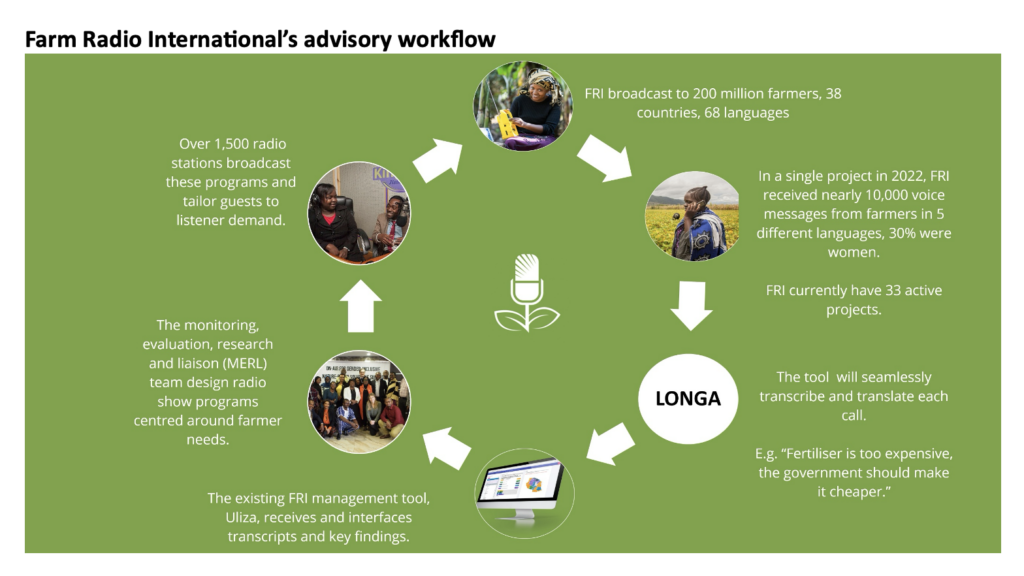
Farm Radio International (FRI) operates a large-scale advisory platform in partnership with over 1,500 local radio stations reaching more than 200 million farmers across 38 sub-Saharan African countries in 68 local languages. Farmers tune into weekly radio broadcasts and call in to an advertised toll-free phone number with questions for extension workers and other experts or to share lived experiences. For women, this model is particularly powerful—radio is accessible, familiar, and socially acceptable, and call‑in systems allow them to participate without needing smartphones or having to travel to reach extension officers.
In the past, FRI has lacked the resources to transcribe, translate, and analyze the thousands of voice messages received during the shows—a rich source of farmer knowledge that has remained difficult to use at scale. It now holds around 8,000 hours of recorded speech.
Recognizing the opportunity to integrate AI to strengthen the existing advisory system, since 2021, IFPRI researchers have been supporting FRI to develop an automatic speech recognition (ASR) tool, called Longa, to analyze farmer voice data. Longa converts voice messages into text that can be analyzed more systematically. For women and youth, who often have low or no digital literacy, Longa creates new opportunities for their voices to be heard in agricultural research and programming. When Longa turns recorded calls from women and youth into analyzable data, it bridges critical data gaps that exist because of underrepresentation of such voices in the training of speech models.
From representative datasets to better advisory
The use of ASR tools also helps agricultural researchers to gain insights into women’s priorities, challenges, and perspectives expressed clearly and directly in their local languages. Gender-disaggregated ASR insights can be used to improve the relevance of advice, for example, by adjusting radio content, advisory messaging, and program design to respond to gender-differentiated concerns and realities.
In FRI’s model, farmers remain connected to a trusted communication platform. Radio continues to deliver information at scale. Mobile systems allow farmers to respond and also allow researchers and wider stakeholders to listen to the farmers.
Figure 1
The AI bottleneck: low-resource languages and biased data
Most speech AI has been built for languages with large digital footprints. English, French, Spanish, and other widely-spoken languages have vast collections of transcribed audio, online text, and standardized language data. This makes it easier to build tools that can recognize speech accurately across different settings.
The picture is very different for many African languages used by farmers in FRI’s programming. These languages often have far fewer digital resources, and existing datasets may not capture local dialects, agricultural terms, or the everyday switching between languages that happens in conversation. For women, these challenges can be even greater, as their calls may be recorded on lower-quality devices or in noisier settings, such as markets, increasing the risk of misrecognition.
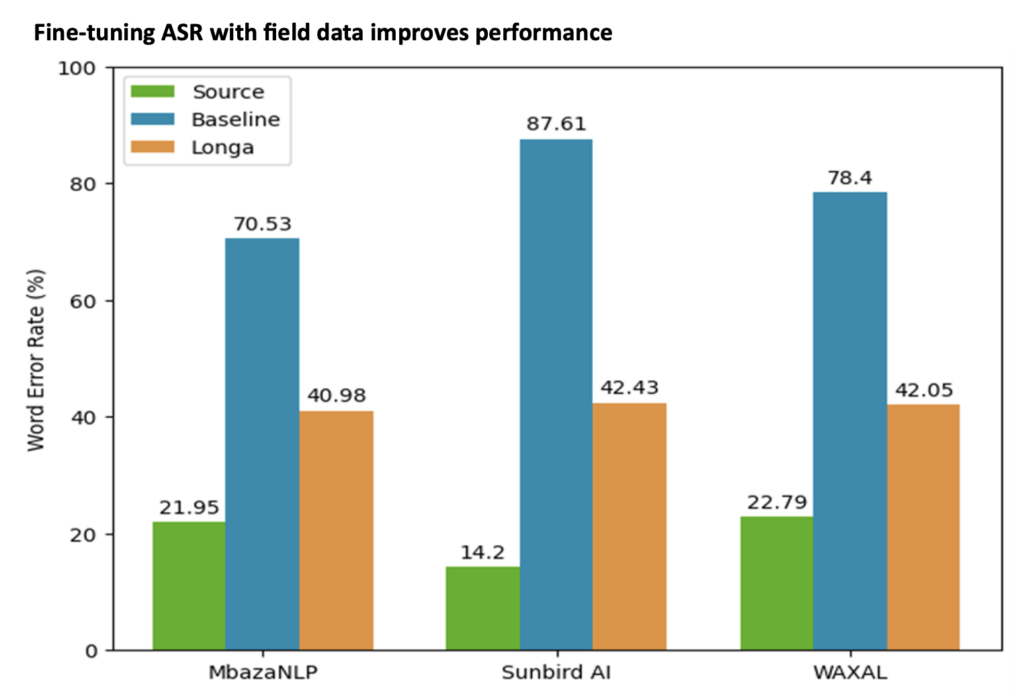
This is where fine-tuning becomes important. Rather than relying only on general speech models, IFPRI and FRI used field data from real farmer calls to adapt ASR systems to the conditions in which they would actually be used. This improved performance across three language datasets (Luganda, Bambara, and Swahili) by roughly 30%, showing that local farmer voice data can make AI tools much more accurate and useful.
We now have fine-tuned models in Luganda and Bambara, and we are quickly expanding to more languages as datasets are released and the community grows.
Figure 2
Designing ASR systems to be gender-responsive
What does this mean for women farmers? Intentional design is essential to avoid gender bias—ASR systems are not automatically gender-responsive. Decisions about call prompts, outreach strategies, and training data strongly influence whose voices are captured and how accurately they are transcribed, underscoring that gender analysis must be embedded throughout the data pipeline.
ASR should complement, rather than replace, traditional gender research methods, such as qualitative research (e.g., interviews or focus groups), to interpret why women and men raise different concerns and how these relate to power dynamics, norms, and unequal access to resources.
Ensuring that ASR systems are gender-responsive requires the following:
- More inclusive language resources: ensuring women’s voices, dialects, accents, and speaking conditions are better represented in ASR datasets.
- Better training data: knowledge corpora will be more reflective of women’s needs if driven by the questions they raise on call-in platforms.
- More visible priorities: analyzing what women farmers ask about in their own words, including issues that may not appear in preset survey questions.
- Designing more gender-responsive programming: using call data to adjust radio segments, guests, timing, and advisory topics to meet women’s needs.
- Better monitoring: tracking whether women’s questions are being captured, transcribed, and answered over time.
- Stronger feedback loops: helping women’s concerns move from individual calls into research, programming, and future advisory design.
- Ethical safeguards: protecting women’s privacy, ensuring informed consent, and preventing misuse of sensitive voice data.
Ultimately, meaningful participation means more than women calling in. It means women influencing the design, content, and direction of advisory services.
Nelson Mganga is a Research Assistant with IFPRI’s Agrifood Innovation and Reslience (AIR) Unit; Gertrude Nalubinga is Program Development and Network Initiatives Coordinator at Farm Radio International; Eliot Jones-Garcia is an AIR Senior Research Analyst. This post first appeared on the CGIAR Gender Equality and Inclusion Accelerator blog. Opinions are the authors’.
This work was supported by the CGIAR Accelerators for Digital Transformation and Gender Equality and Inclusion.