


Key takeaways
- IFPRI is launching new research on seed systems in conflict zones. The project in northern Ethiopia and northern Nigeria examines how climate shocks, conflict, and displacement affect seed access and local seed systems.
- El Niño and conflict are creating a severe agricultural crisis. Drought, flooding, displacement, and violence are disrupting farming and worsening food insecurity across fragile regions of sub-Saharan Africa, including Ethiopia and Nigeria.
- Seed access is often the biggest challenge, not seed supply. Evidence suggests farmers are more likely to face affordability problems after shocks than outright seed shortages, highlighting the importance of designing aid to match local conditions.
Fragile and conflict-affected (FCA) countries face overlapping crises: climate volatility, violence and displacement, food insecurity, and weak institutions. The current “super” El Niño—so far the strongest on record—is now compounding these problems. Intensifying droughts, heavy rains, and other weather impacts associated with the atmospheric phenomenon are already affecting farm production that hundreds of millions of people around the world rely on for food and nutrition. Farming households in the FCA areas of sub-Saharan Africa affected by the El Niño shock face critical decisions of whether, when, and what to plant, particularly if seed and other inputs are difficult to obtain or unaffordable.
Amid these complex crises, emergency seed aid is essential. By getting suitable seeds to farmers ahead of a shock or replacing seed that a shock has destroyed, seed aid can help farmers continue production and build resilience to sustain their operations and communities over the long term.
What kinds of emergency seed aid can best meet immediate needs while strengthening local seed systems? IFPRI is now examining this issue in conflict-affected areas of northern Ethiopia and northern Nigeria, with funding from the UK Foreign, Commonwealth & Development Office (FCDO) under CGIAR’s Breeding for Tomorrow program, with fieldwork set to begin this month (November 2026).
This is more than a matter of simply getting bags of seed to farmers. Many questions exist about how best to structure and deliver seed aid. For example, there is the issue of whether it crowds out local private seed markets (traders and cooperatives that supply farmers in normal years), a concern that has also been raised about food aid. Moreover, careful design of seed aid matters more now that global humanitarian funding has fallen from about $37 billion in 2024 to about $21 billion in 2025.
Exploring how fragility undermines seed systems, this post examines the current landscape of El Niño impacts on agriculture across FCA areas of sub-Saharan Africa and explores the evidence on different types of seed aid and their impacts for recipients, vendors, and local markets. It outlines key context for understanding the relationships between seed aid and resilience.
A perfect storm: Fragility, El Niño, and conflict
Even before the 2026/27 El Niño began, in 2025, at least 149 million people across East, West, Central, and Southern Africa faced high levels of acute food insecurity. Since then, diverse El Niño impacts have put even more stress on food systems.
In Ethiopia, our analysis of CHIRPS rainfall estimates shows June-September 2026 levels to be among the three lowest since 1991 across about two-thirds of the areas that normally receive these rains (Figure 1), and the country’s main or meher harvest is projected to be up to 30% below average. The drought has affected 3.5 million people across six of the country’s 12 regions, according to an assessment by the International Federation of Red Cross and Red Crescent Societies (IFRC).
Southern Ethiopia, Somalia, and northeastern Kenya are more likely than usual to receive above-normal October-December rains, which in past El Niño years have brought flooding, killing livestock and destroying crops and pastures.
In southern Africa, the regional climate outlook shows below-normal rainfall over most of the region in October-December and across the center and south in January-March, particularly in Angola, Botswana, Namibia, Zimbabwe, and Zambia, with above-normal temperatures likely through January 2027.
Several El Niño-affected countries are also in active or recent conflict, including Sudan, South Sudan, Somalia, the central Sahel, and northern Ethiopia (Figure 1); conflict also continues in northern Nigeria, where this season’s rains were close to normal.
In Ethiopia, fighting escalated sharply from late September 2026 across much of Tigray and into parts of Amhara and Afar, including areas where this year’s drought has left little or no meher crop. Multi-agency assessments reported more than 252,500 hectares of crops scorched, and a September overview by Tigray’s disaster risk management commission counted 3.9 million people, more than half of the region’s population, in need of emergency food assistance. The Famine Early Warning Systems Network (FEWS NET) expects the fighting to delay or constrain the harvest in some locations.
In Nigeria, kidnapping, ransom demands, and attacks continue to restrict access to farmland in the northwestern and north-central states, and movement restrictions prevented cultivation in parts of Borno State in 2026.
Conflict strips away the buffers households use to absorb a bad season: assets, livestock, savings, and stored seed. Conflict also cuts the channels that move seed and food: roads close, markets shrink, and agrodealers (shops selling seed and fertilizer) are destroyed. In northeastern Nigeria, some national seed companies closed their remote offices at the height of the conflict, and others stopped supplying conflict areas. The humanitarian response remains severely underfunded: plans for Somalia, South Sudan and Sudan were only about 34%, 40%, and 46% funded as of October 22, 2026.
Figure 1
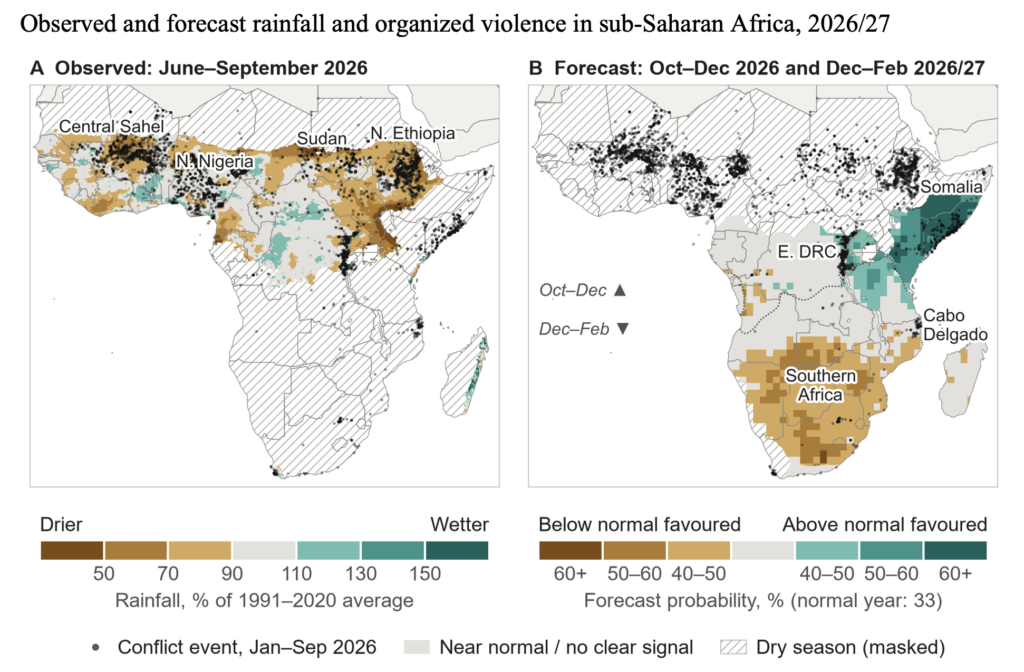
Source: Authors, using CHIRPS v2.0 (Funk et al. 2015; Climate Hazards Center, UC Santa Barbara); NMME experimental probabilistic seasonal forecast, adjusted product, October 2026 (NOAA Climate Prediction Center); GPCC Full Data v2020 long-term means (Deutscher Wetterdienst), to select the season; UCDP Candidate Events Dataset, version 26.01.26.09 (Uppsala Conflict Data Program; Hegre et al. 2020); boundaries from Natural Earth.
How do farmers in fragile and conflict-affected areas access seed?
Drought depletes farmers’ seed reserves in two ways: crops fail, and seed they would otherwise save is consumed when food runs out. Local markets usually resupply seed, but much of what they sell as seed is grain that traders select from farmers’ harvests. Overlapping crises thus weaken both saved seed and local markets: drought shrinks the supply of grain that traders select from, while conflict separates displaced farmers from their stores and closes markets.
Figure 2
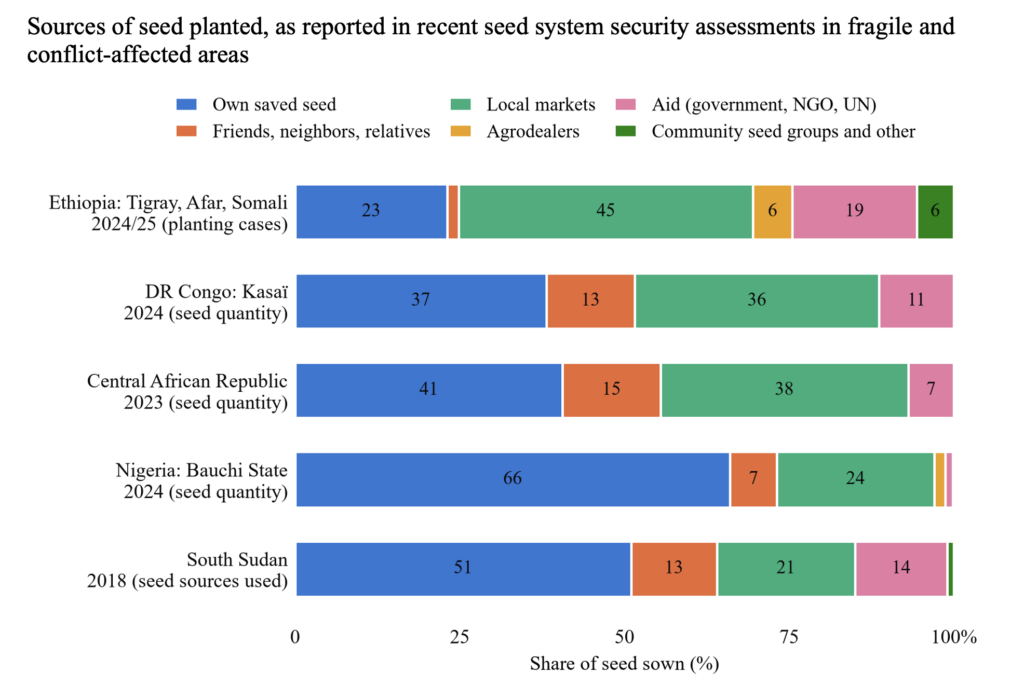
Source: Authors’ compilation from Mercy Corps and Ethiopian Seed Partnership (2025); ADRA, CRS and Mercy Corps (2025); Diowo Shongo et al. (2023); Formson et al. (2026); FAO and MAFS (2019).
What does the evidence tell us about seed aid?
Types of assistance
Targeting seed aid depends on properly identifying the problem: has a shock left no seed locally, or is it available but unaffordable? While seed may truly run short in cases of compounding shocks or where input markets are weak, assessments show that seed usually remains available in local markets after a shock and that access is the main constraint, as households may have lost assets and become poorer.
A 2025 assessment in Bauchi State, Nigeria, found affordability, not availability, to be the main barrier, especially for certified seed: agrodealer prices for sorghum, millet, and rice seed rose by about 40%-55% between the 2024 and 2025 seasons, while local-market prices for sorghum and millet fell. Free distribution is generally considered appropriate where seed is truly unavailable, and vouchers or seed fairs where it is available but unaffordable.
Does seed aid crowd out local sellers?
If providing free seeds undermines sales by agrodealers and other vendors, then local economies will suffer and supplies may go unused.
Evidence on this question is limited and mostly descriptive. For food aid, a review found evidence of market harm thin and often contradictory, with harm most likely when aid arrives at the wrong time, is poorly targeted or enters poorly connected markets. For seed, the most rigorous estimates come from input subsidy programs, not emergency seed aid: in Malawi and Zambia, each kilogram of subsidized maize seed reduced commercial seed purchases by about half a kilogram. Reports from emergency settings point the same way. In eastern Kenya, traders were reported to say that seed aid had caused local seed prices to drop sharply. This suggests seed assistance can have detrimental effects on local markets if not targeted with such consequences in mind.
Procurement issues
How seed aid is procured and distributed can also shape local markets, potentially undermining sellers and causing economic disruption. In Nigeria, a draft assessment of institutional seed markets found that procurement often favors large companies “with financial clout,” that small seed companies struggle to compete, and that seed interventions boost sales only while support lasts. In Tigray, a seed system security assessment found that seed cooperatives have no community-level market because the government and NGOs buy their seed for free distribution, a practice that has grown since 2020 with the humanitarian response to the war. The cooperatives gain a buyer, but the assessment also reports that the practice has suppressed farmers’ willingness to buy improved seed and left large stocks of unsold seed in some years.
Drought-tolerant varieties
Seed aid can also help farmers prepare for a shock if suitable varieties are delivered in time. In a randomized trial in Mozambique and Tanzania, drought-tolerant maize seed provided significant protection against moderate drought, and in Uganda, growing it was associated with 15% higher yields and a 30% lower probability of crop failure. In Madagascar, FAO’s preliminary findings show that 47% of households that received drought-tolerant seed and cash through anticipatory action ahead of the 2023/24 El Niño had acceptable food consumption levels, against 30% of households that did not.
Yet problems exist in distribution and sales. In Zimbabwe, farmers cited the unavailability of drought-tolerant maize in local markets as a main reason for not growing this variety. As IFPRI’s analysis for Malawi also notes, early-maturing and drought-tolerant varieties also tend to yield less in good years, and their seed often costs more.
Learning from this season
The evidence reviewed here suggests that after a shock, seed is more often unaffordable than unavailable, that subsidized or free seed can displace some local sales, and that drought-tolerant seed delivered ahead of a drought can protect harvests. Whether seed aid builds resilience in settings with multiple compounding shocks remains largely unclear.
Our study in northern Nigeria and northern Ethiopia will help fill part of this gap by looking at resilience at two levels: whether households can keep planting through repeated shocks, and whether local seed systems (saved seed, seed companies, cooperatives and agrodealers) can continue to supply farmers once aid ends. Fieldwork will document how overlapping crises have affected seed availability, affordability, and distribution, and how farmers have drawn on saved seed, local markets and aid. Interviews with farmers, seed companies, cooperatives, agrodealers, government agencies, research institutes, and humanitarian organizations will identify where seed systems are breaking down and how they can be strengthened. Did recipients get suitable varieties in time to plant? Could they save or buy seed the following season? Did local suppliers keep selling, or lose customers to free seed? The study will show where current aid practices support or weaken local seed systems, and which questions need rigorous follow-up. Results, expected by March 2027 ahead of the main planting seasons, will inform policy roadmaps and recommendations for governments and humanitarian agencies.
Guush Berhane is is a Senior Research Fellow with IFPRI’s Agrifood Innovation and Resilience (AIR) Unit; Claudia Ringler is Director of AIR; Rewa Misra is Head of National Policy and Innovative Financing in the HarvestPlus section of AIR. Opinions are the authors’.