





Key takeaways
•Irrigation as a service (IaaS) is a transformational approach that reduces irrigation access barriers by offering flexible, low‑cost access to equipment and water.
•Women farmers gain easier irrigation access, reduced labor demands, and new income opportunities.
•IaaS boosts dry‑season production, food security and nutrition, and job creation across the value chain.
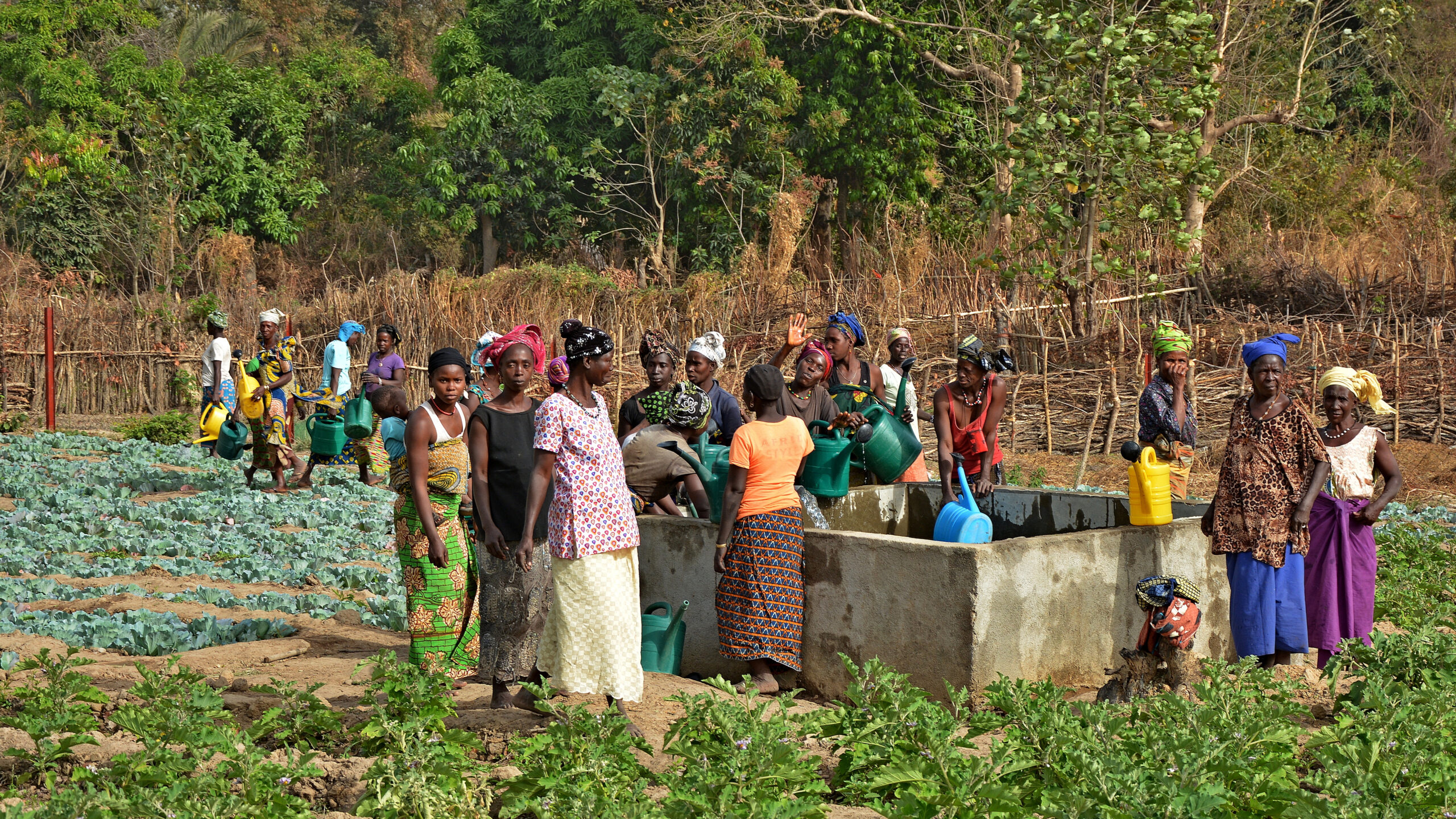
In Tamale, northern Ghana, on a hot day in March, a group of around 40 women are irrigating small vegetable plots leased from the village chief for the dry season.
In the past, this meant spending the entire day carrying heavy buckets of water back and forth from a small reservoir more than 500 meters away.
Today, however, these women are benefiting from a service that has transformed their daily lives and livelihoods, making irrigation more accessible and affordable. Across the plots, some are using hoses to water the crops, while others are still carrying buckets—only now over the short distance to a nearby water tank. This is possible thanks to a local farmer who purchased a solar-powered irrigation pump on credit, who now provides them with irrigation water delivery on demand, extending a pipe from the reservoir and pumping water directly into a large polyethylene tank near their fields, servicing the whole cultivated area of 3-4 acres.
With time and effort freed up, the women are now eager to farm, cultivating profitable market crops like cowpea, okra, and pepper. They no longer have to collect and sell firewood and charcoal to earn an income—more arduous and less profitable work than farming. One woman humorously acted out how strenuous carrying a load of charcoal was, while the rest laughed.
This scene in Tamale is just one example of irrigation as a service (IaaS), a potentially transformative business model emerging across sub-Saharan Africa and South Asia. As we observe World Water Day (March 22)—with the theme, “Where water flows, equality grows”—IaaS offers a model for how to leverage small-scale irrigation technology to benefit smallholders, especially women farmers facing a range of socioeconomic obstacles.
Breaking barriers to small-scale irrigation
Small-scale irrigation is a proven catalyst for transforming agriculture. It boosts crop yields, increases household incomes, improves food security and nutrition, and builds resilience against climate shocks. Yet, despite these clear benefits, adopting irrigation technologies remains out of reach for most resource-poor smallholder farmers.
There are a number of reasons for this. The barriers to adoption are high, including expensive upfront equipment costs, the technical knowledge required to maintain systems, and a lack of accessible credit. For women farmers, the obstacles are even higher. Women often lack secure access to land and water, face mobility constraints, and have limited decision-making authority and capital to access and invest in irrigation technologies. As a result, women farmers are more likely than men to not irrigate at all, or if they do, to rely on manual irrigation, with its burdensome physical labor.
Types of irrigation service systems
IaaS has the potential to bypass many of these barriers. It relieves farmers of the need to personally buy, install, and maintain costly systems. Instead, they can rent irrigation equipment or pay for irrigation water access from private providers. IaaS also provides job opportunities with providers ranging from for-profit companies to microentrepreneurs, women’s self-help groups, and NGOs.
Some providers rent mobile systems on a day-to-day basis, setting up pumps and other equipment on demand to deliver water directly to farmers’ fields. Others operate fixed systems, installing semi-permanent solar pumps, storage tanks, and pipes near surface water or groundwater sources for longer periods (i.e., a full dry season or several seasons). Such systems often serve networks of farmers cultivating multiple plots. Some entrepreneurs combine irrigation rentals with other crucial services, such as tricycles for transporting harvested crops to market, or “equipment libraries” where farmers can rent various agricultural tools. Payment schemes are highly adaptable to farmers’ needs, ranging from hourly and daily rates to seasonal subscriptions, with some providers offering crucial deferred payment options that allow farmers to pay after they harvest and sell their crops.
In Tamale, for example, the cost for irrigating a 4×4 meter plot is roughly 150-200 cedis (about $18.50) per season. Rather than paying the full amount in advance, the irrigation service provider charges each woman 5 cedis for each irrigation, with some wiggle room for deferred payment.
A potential breakthrough business model for women farmers
IaaS shows particular promise for women farmers. As part of an ongoing project, we conducted 12 key informant interviews in 2025 with irrigation service providers in sub-Saharan Africa and India, focused on understanding the clientele of this business model. Irrigation service providers reflected on how IaaS has improved women’s access to irrigation.
“I definitely see women farmers have been more interested in the service compared to purchasing equipment … when we were doing asset financing, I don’t think we had any woman applicants that even applied for it. It was almost exclusively men […] With irrigation as a service, around 20-25% of customers were women directly.”
– Provider in Uganda
Women make up between 20% and 70% of the IaaS customer base across different regions. Women are not always targeted as customers, but interestingly, many irrigation businesses report that women are their preferred clients. In the interviews, providers noted that women are more consistent with payments, rarely default, and handle the rented equipment with greater care than men.
For women themselves, IaaS offers solutions to deep-rooted systemic inequalities, including lack of access to collateral, generally less secure land tenure, drudgery, and mobility constraints. For example, when using IaaS, women do not need to provide land titles as collateral—a common obstacle they face when applying for credit.
Women also typically bear the heavy burden of manual irrigation. IaaS reduces women’s time constraints and drudgery, which are particularly severe during the hot dry season in sub-Saharan Africa when irrigation is indispensable to grow crops. Because IaaS agents usually deliver pumps and other equipment directly to the farm, women facing cultural or logistical mobility restrictions can still access the technology.
IaaS also provides women with entrepreneurship opportunities. According to interviews, women sometimes purchase shared pumps through cooperatives and act as service providers for their neighbors, generating income and elevating their status in the community.
Ripple effects
The availability of IaaS has broader development benefits. IaaS enables year-round production, allowing farmers to cultivate market-ready vegetables during the dry season when prices are substantially higher. In the interviews, company representatives told us that this influx of cash helps families to pay for school fees, health care, income diversification, and home improvements. Access to IaaS also improves local food security and dietary diversity. Instead of relying solely on staple crops like maize and beans during dry periods, families directly consume some of the nutrient-rich vegetables they grow. The growing IaaS ecosystem is also creating employment opportunities for landless youth along the irrigation and agricultural supply chains, including jobs as irrigation entrepreneurs, delivery personnel, maintenance specialists, agricultural input providers, and buyers of agricultural produce.
Overcoming the remaining barriers
While IaaS significantly lowers the barriers to entry for irrigation, affordability remains a challenge. Many smallholder farmers, especially women, lack the cash liquidity needed to pay for services before they have harvested and sold their crops. As a result, women often rent equipment for much shorter durations than men, and their crops may get less water than they need.
To make IaaS truly equitable, we highlight several intentional strategies for IaaS providers and policymakers to reach and benefit women:
- Offer deferred payments: Allowing farmers to pay for the service after they harvest is crucial for expanding access, though businesses need financial backing to absorb this risk.
- Leverage women’s groups: Marketing directly to women’s cooperatives and savings groups has proven to be an effective way to onboard women clients and help them pool resources to afford the service, as demonstrated by the experiences of various service providers.
- Bundle services: Combining water access with transportation, agricultural inputs, and training helps women overcome the multiple overlapping constraints they face in the agricultural value chain.
On World Water Day, the story of the women in Tamale and the experiences of key informants from IaaS companies serve as a powerful reminder that innovation in the delivery of water does not just grow crops. It cultivates equality, relieves burdens, and empowers women and smallholders to transform their livelihoods.
Hagar ElDidi is a Senior Research Analyst with IFPRI’s Natural Resources and Resilience (NRR) Unit; Elizabeth Bryan is an NRR Research Fellow; Claudia Ringler is NRR Director. This post references research that is not yet peer-reviewed. Opinions are the authors’.
This work was supported by the CGIAR Program on Policy Innovations.
NotebookLM, an AI tool grounded in user-provided sources, was utilized initially during the drafting of this blog post. The lead author provided content from field notes and an authored draft research paper to inspire the overall structure of the blog. The authors did not use the tool for generating primary arguments. The content and the text were then carefully reviewed and substantially edited for publication.