





Key takeaways
- Digital inclusion for agricultural advisory tools requires more than access and usability. Farmers should also have agency to shape how technologies are designed and used.
- Farmers are active innovators, not passive users. Their knowledge, feedback, and adaptations are essential for making digital tools relevant and effective.
- Low adoption is a predictable outcome of poor design. Digital tools work best when they reflect farmers’ needs, priorities, and local realities.
Digital technologies are rapidly reshaping how actors across agrifood value chains access information and market and financial services and how organizations govern resources and respond to shocks. Generative AI advisory tools, for example, promise to provide farmers with personalized information at any time and at relatively low cost. However, such applications also risk reproducing or exacerbating existing inequalities, leaving some actors, including women and other marginalized groups, excluded or exposed to new forms of harm.
In response, digital inclusion has emerged as a field of research and practice concerned with ensuring that the design, deployment, and maintenance of digital technologies are fair, equitable, and socially responsive. Digital inclusion is typically seen as an outcome of technology design, most commonly framed in terms of accessibility and usability.
Yet this approach, while necessary, often overlooks the aspects of how digital technologies are actually adopted, adapted, or resisted in practice. A farmer may be able to access an AI advisory tool and understand its recommendations, for example, without having any influence over its capabilities to address specific problems, the knowledge or data on which it draws, or the forms of farming it promotes.
We propose a broader conceptualization of digital inclusion that situates accessibility and usability within a third, often under-theorized dimension: agency. We define agency as the extent to which users can meaningfully shape the design of technologies and their integration into everyday life. Attending to agency is essential not only for inclusion of those at the margins of digital systems but also for strengthening the effectiveness, resilience, and sustainability of digital technologies and the infrastructures that support them.
Accessibility
Within inclusion scholarship, accessibility is commonly understood as the extent to which users are able to reach and connect to digital services. In agrifood systems, accessibility is often presented as a matter of “reaching the last mile”: overcoming persistent barriers related to cost, geography, and time, and enabling information and services to reach populations that have historically been underserved.
From this perspective, accessibility is seen primarily as a technical and logistical challenge: extending network coverage, reducing the marginal costs of service delivery, and enabling remote or asynchronous interaction. For a generative AI advisory tool offered to rural smallholders in a low-income country, for example, this may involve ensuring that potential users have access to a suitable device, reliable connectivity, electricity, and an affordable data plan.
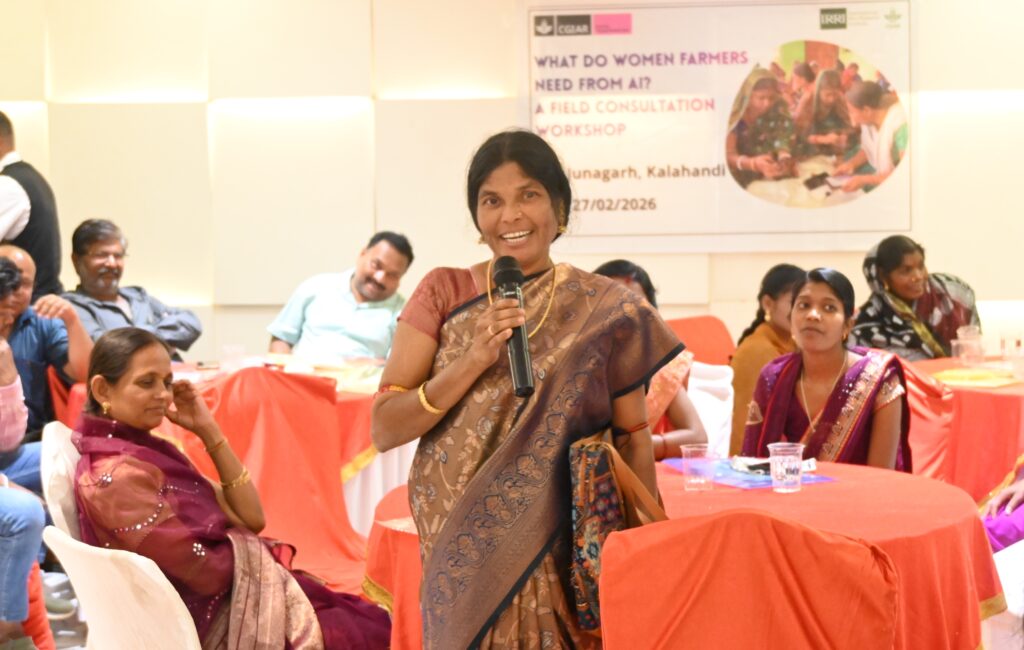
At a recent workshop, a woman farmer in Kalahandi in India’s Odisha State reflects on the kind of support she needs from digital advisory services: “I am old and alone, and I do everything on the field on my own. Getting advice that I can actually use and act on would be helpful.” Her experience highlights why digital inclusion needs to go beyond access to consider whether advice is relevant, usable, and actionable within farmers’ everyday realities.
Yet making such a tool technically available does not determine whether farmers can use it effectively or whether its recommendations generate meaningful benefits—this is where usability and agency enter the picture.
Usability
Usability refers to the extent to which users are able to understand and effectively engage with digital technologies once access has been established. In agrifood systems, usability is commonly framed in terms of whether digital tools are intuitive, understandable, and aligned with users’ capacities.
The usability of a generative AI advisory tool might be defined by whether farmers can formulate questions in familiar language, whether the system understands local accents or terminology, and whether its responses are clear, actionable, and appropriately timed. Design choices such as offering voice interaction, translation, simplified interfaces, and follow-up questions may reduce cognitive and operational burdens.
From this perspective, usability is treated as a property of the technology itself, shaped by design choices assumed to translate into uptake and sustained use. Usability builds on accessibility by addressing how farmers interact with digital technologies.
However, context also plays a central role in how farmers use such applications. Farming conditions, practices, and cultural attitudes all shape farmer behavior and can vary dramatically by location. Thus, the usability perspective alone does not fully explain how farmers interpret advice, whether they can act on it, or whether it supports outcomes they value. An advisory response may be understandable yet also irrelevant because it assumes access to particular inputs, labor, land, or markets that users don’t have. This is where agency, which considers users’ active role in shaping the design and outcomes of digital technologies, comes into play.
Agency
Agency should be a central dimension of digital inclusion. This idea draws on Forney et al.‘s concept of everyday digitalization, which stresses how the use of agrifood technologies determines their utility. We reject the view of inclusion that frames farmers as passive recipients of innovation or as located on the “wrong side” of digital divides. Framing the challenge around some perceived deficiency among farmers obscures the fact that innovation does not only originate in research institutions, nor is knowledge solely disseminated through formal extension services. Rather, farmers are experts in their own production systems, and locally embedded networks often play a more influential role in agrifood systems transformation than external models of technology transfer.
Failing to recognize farmer agency has two important implications.
First, it overlooks the well-established insight that technologies rarely unfold in practice as designers envision. Social, economic, and material conditions enable and constrain how farmers employ technologies, shaping not only whether they are used but also how and to what ends.
Policymakers, program managers, and app developers should pay attention to the often-invisible labor that farmers invest to make technologies “fit” their contexts, as well as to the social relations and institutional conditions—including gendered norms, responsibilities, and resources—that structure opportunities for digital engagement. As AI tools spread, a focus on adaptability can create new opportunities for farmer input, and questions and patterns of use can inform subsequent changes to advisory tools. This does not remove the need for meaningful engagement upstream, nor does it guarantee that participation will be equitable, adequately supported, or free from exploitation.
Secondly, low or uneven uptake should not be treated as a failure by farmers to adopt innovations but as a predictable outcome of design processes that insufficiently account for farmers’ needs, practices, and aspirations. Low uptake is often framed as a deficit of trust to be overcome through incentives or the bundling of additional services. Yet this interpretation undermines users’ agency: rejection may more simply be a reasonable judgment that a technology is neither wanted nor useful. Putting the onus for low uptake on farmers, not AI apps, also allows designers to avoid questioning their own assumptions about farmers’ needs and the value their technologies provide. In doing so, attention remains fixed on making technologies more accessible, while more important questions about their underlying relevance go unexamined.
Conclusion
In current practice, offering digital technologies is seen as an unqualified good, with the idea of inclusion often reduced to a proxy for adoption. The success of a generative AI advisory tool may be measured through broad indicators such as downloads or platform traffic, while downsides including new forms of surveillance, dependency, or exclusion go unexamined. The result may be tools that farmers find difficult to use or reject entirely.
Recognizing agency offers an alternative development approach. For digital advisory systems, this means involving farmers not only in testing interfaces but also in defining the problems the technology should address and determining what forms of knowledge it should recognize and share. From this perspective, inclusion is not about integrating people into predetermined technological futures but about elevating and activating their ability to influence which futures are pursued and on what terms.
Eliot Jones-Garcia is a Senior Research Analyst with IFPRI’s Agrifood Innovation and Resilience (AIR) Unit; Niyati Singaraju is a Postdoctoral Fellow with the International Rice Research Institute (IRRI); Kristin Davis is an AIR Senior Research Fellow; Cambria Finegold, Director, Data Science, Modelling & AI at CABI. Opinions are the authors’.