





Second of two blog posts on a recent study on a social learning game intervention in the state of Madhya Pradesh, India. Read the first here.
Empowering women in decision-making is not just a matter of human rights; it is a key driver of sustainable development. When women’s knowledge, perspectives, and priorities are integrated into governance, communities design solutions that are more equitable, inclusive, and durable. When women hold political office, for example, governments tend to allocate more resources to public goods and services such as childcare, education, public health, and foreign aid.
India’s experience illustrates this clearly. Evidence shows that legally mandated quotas for women on village councils, in force since the 1990s, along with mandated low-caste and minority representation, have expanded access to public goods such as drinking water. Through this policy change, women leaders have gained platforms to voice preferences, demand accountability, and influence decisions—improving both representation and development outcomes.
Responsible community management of water resources is increasingly important as India faces the growing problem of over-exploitation of groundwater and other freshwater sources. What role do women play in encouraging better water governance? In a study published in PNAS Nexus, we examined how women’s participation in experiential learning game workshops relates to the management of local dams and reservoirs in the state of Madhya Pradesh—finding that greater women’s involvement was associated with improved water governance.
Our study focused on 56 villages in Madhya Pradesh, where village dams and reservoirs are essential for irrigation, domestic use, livestock, and fishing, but often suffer from neglect. Many communities have no effective agreements and bylaws for ensuring adequate maintenance.
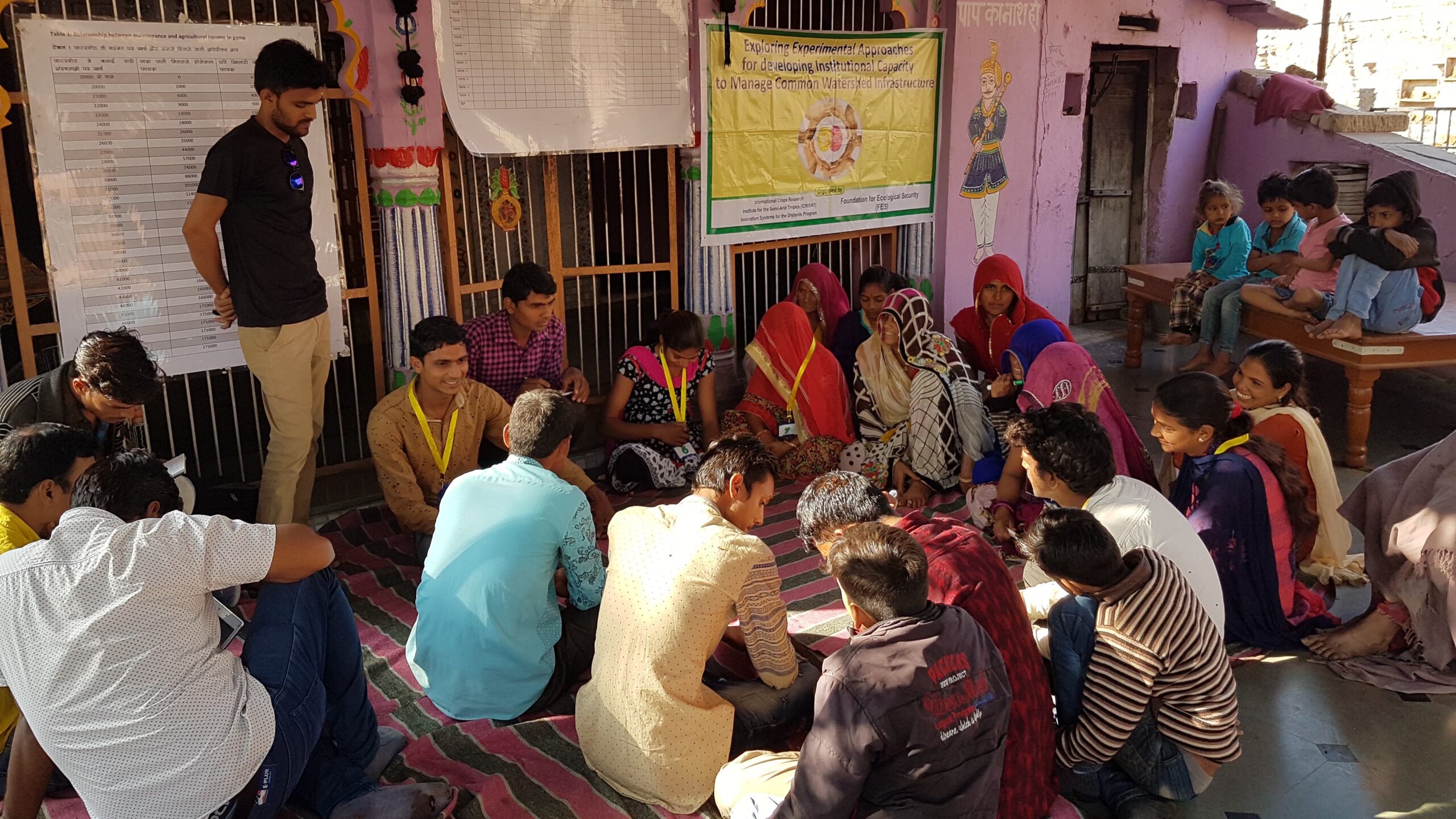
In each village, 14 people who strongly benefited from a dam took part in a learning game workshop that simulated water management dilemmas associated with the reservoirs, followed by a broader community-level discussion on water management challenges.
Participants were recruited by representatives of each village administration, who were instructed to invite a high share of women without setting a quota. Participants included residents with leadership roles, such as involvement in village administration or community organizations, as well as those without leadership roles. Both men and women were represented in the study. This design allowed us to observe patterns in gender composition, leadership, and intervention outcomes across communities. In total, there were nine villages with no leader participation, 27 with only male leaders, 12 with only female leaders, and eight with both male and female leaders.
We investigated how the presence of female leaders affected women’s participation in the workshops and, subsequently, if it led to improved water management almost two years later. Our analysis compares villages where only female leaders took part in workshops to those with only male leaders, mixed-gender leadership, or no formal leaders. Two years after the games took place, we surveyed village leaders, asking whether their villages had dam management rules and whether dams had been maintained in the past year.
What we found:
- Female leaders boost inclusion: Villages with only female leaders participating saw 20.7% more non-leader women attend the workshops than those with no leaders. (Villages with mixed-gender leadership and male leadership did not increase female participation compared to villages with no leaders.)
- More inclusive participation improves governance: A 10% higher participation by non-leader women was linked to a 14.4 % higher likelihood of dam management rules having been created.
- Improved governance improves maintenance: Villages with such rules were much more likely to maintain their dams.
Figure 1

These results demonstrate that female leadership helps unlock broader engagement by women, which supports the creation of rules needed for sustaining water infrastructure. Women in many rural Indian communities are often better organized than men, thanks to self-help groups, quotas, and civil society gender initiatives. Our evidence suggests that this capacity can translate into influence in governance processes and practical outcomes for resource management.
Our findings echo broader global evidence showing that female leaders tend to foster pro-social values, reflect diverse community needs, and enhance collective responsibility. In water governance, these qualities translate into tangible benefits: better-maintained infrastructure, more reliable water supply, and more resilient rural livelihoods.
Promoting women’s participation and leadership in agricultural water management is both an equity imperative and a strategic investment in sustainability. Women’s voices in governance are key to securing India’s water future and the well-being of rural communities.
Thomas Falk is a Research Fellow with IFPRI’s Natural Resource and Resilience Unit; Björn Vollan is the head and Ivo Steimanis is a Research Fellow at the Working Group on Sustainable Use of Natural Resources at Marburg University, Germany; Lara Bartels is a Senior Research Fellow at the Max Planck Institute for Research on Collective Goods, Vishwambhar Duche is Senior Scientific Officer a the International Crops Research Institute for the Semi-Arid Tropics (ICRISAT); Ruth Meinzen-Dick a Research Fellow Emeritus with IFPRI’s Director General’s Office. Opinions are the authors’.
The work has been supported by the German Federal Ministry for Economic Cooperation and Development (BMZ), the CGIAR Policy Innovations Science Program, and the Co-Impact Philanthropic Funds.
Reference:
Steimanis, Ivo; Falk, Thomas; Bartels, Lara; Duche, Vishwambhar; and Vollan, Björn. 2025. The role of women in learning games and water management outcomes. PNAS Nexus 4(8): pgaf243. https://doi.org/10.1093/pnasnexus/pgaf243