





Key takeaways
- When emigration declines and return migration increases in Guatemala, economic growth is projected to improve, a new study indicates. GDP rises faster, exports increase, and manufacturing and agriculture perform better.
- However, these economic gains do not reach everyone equally. Reduced migration lowers remittance inflows, slowing income and consumption growth among households that depend on them, especially in rural areas.
- Policies should support returnees and vulnerable households. Facilitating migrants’ economic reintegration while protecting remittance-dependent households can help spread the benefits of stronger growth.
Migration has long shaped economic and social outcomes across Central America. Between 2002 and 2021, Guatemala recorded an estimated net emigration of about 856,000 people, while remittance inflows accounted for around 20% of GDP, placing the country among the most remittance-dependent economies in the world.
Recently, however, migration patterns have shifted in Guatemala (and Central America more broadly). The number of returnees has been rising, driven by policy shifts in destination countries, deportations, or voluntary returns. At the same time, emigration has moderated. These changes pose both challenges and opportunities for Guatemala’s economy: what happens when fewer people leave and more migrants return home?
Our recent study in World Development examines how changes in emigration and return migration are likely to affect economic growth, sectoral performance, and household welfare in Guatemala. The findings reveal an important trade-off: lower emigration and higher return migration can strengthen economic growth and support productive sectors of the economy, but the benefits are not distributed evenly across households.
When migration patterns change
Migration affects economies through several channels. Emigration reduces the domestic labor force, while return migration expands it. Migration also influences remittance flows. Together, these changes affect production, employment opportunities, and household welfare.
To examine these effects, the study compared recent historical migration patterns in Guatemala with model scenarios reflecting fewer departures and greater return flows. The analysis employed a general equilibrium model to compare a reference scenario based on migration patterns observed during 2019-2022 with a reduced-emigration scenario (outflows halved and inflows doubled) and a net-return migration scenario (outflows one-third down, inflows tripled). These alternative scenarios are especially relevant given the growing prevalence of return migration in Guatemala and elsewhere in Central America.
Stronger growth and expanding productive sectors
The results show that lower emigration and higher return migration can generate gains in economic output. As more workers remain in or return to Guatemala, the results indicate that the domestic labor force expands, supporting production across the economy. Compared with recent historical migration patterns, GDP grows by an additional 0.3 to 0.5 percentage points under the alternative scenarios (Figure 1). Exports perform substantially better, reflecting higher domestic production and improved export competitiveness, while import growth slows.
Manufacturing is projected to experience the largest gains, particularly non-agro-processing manufacturing activities, reflecting their strong labor-absorption potential. Agricultural sectors also perform better, especially cash crops, while services continue to expand under the alternative scenarios. Overall, the findings suggest that changes in migration patterns can strengthen productive sectors and contribute to economic growth.
Figure 1
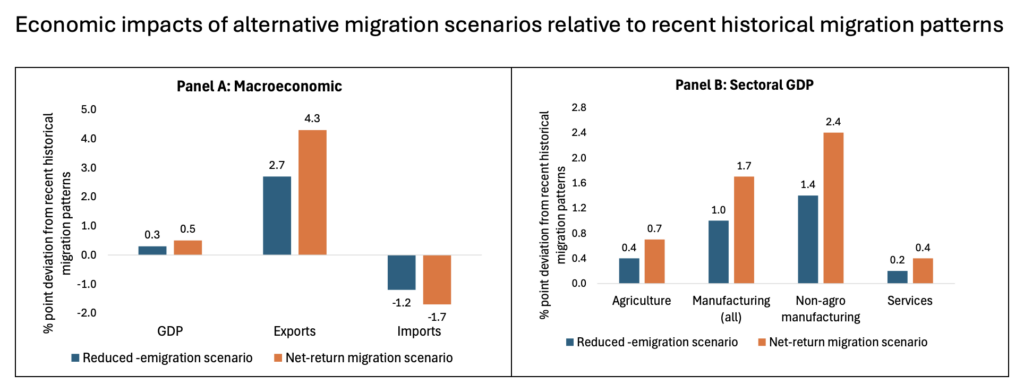
Note: Bars show percentage-point deviations relative to recent historical migration patterns in Guatemala. The alternative scenarios represent lower emigration and higher return migration.
The alternative migration scenarios similarly generate stronger labor-market outcomes. Compared with recent historical migration patterns, wages increase further in both rural and urban areas, while demand for labor expands substantially, particularly for skilled workers. These findings suggest limited risks to labor markets from lower emigration and higher return migration.
Economic gains are not shared equally
However, the study also finds that stronger economic performance at the national level does not automatically translate into improved welfare for all households.
While GDP increases under lower-emigration and higher-return migration scenarios, household income and consumption grow more slowly than under recent historical migration patterns. Much of this difference reflects lower remittance inflows as fewer people migrate abroad and more migrants return home. At the national level, household income and consumption growth are 0.6 to 0.9 percentage points lower than under recent historical migration patterns.
The effects are not evenly distributed across households. Rural households experience larger reductions in income growth than urban households, reflecting their greater dependence on migration and remittance flows. Higher-income households are also more affected, largely because they receive a disproportionate share of international remittances.
Consumption patterns show a similar trend. Non-food consumption experiences the largest slowdown relative to recent migration patterns, while food consumption remains comparatively stable. The effects are particularly pronounced in rural areas, where forgone remittance income is not fully offset by the more modest gains observed in agriculture.
Figure 2
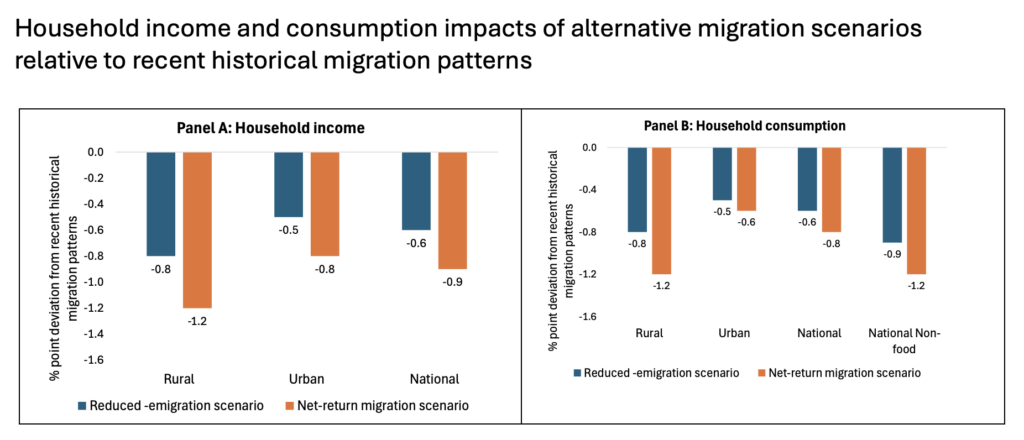
Note: Bars show percentage-point deviations relative to recent historical migration patterns in Guatemala.
Policy implications: Helping return migration deliver broader benefits
Return migrants often bring skills, experience, and human capital acquired abroad. Maximizing the benefits of return migration therefore depends on how effectively returnees are integrated into labor markets and productive activities.
The findings highlight the importance of policies that facilitate reintegration while supporting households that may be more vulnerable to changing migration patterns, especially in rural areas. This includes measures such as skills recognition and vocational training to help returnees reintegrate into the labor market, alongside stronger social protection for households that depend on remittances. Such policies can help ensure that the gains associated with lower emigration and higher return migration translate into broader development benefits.
More broadly, the results show that migration influences economies through multiple channels. Changes in migration patterns affect labor supply, production, trade, remittance flows, and household welfare, often in different ways.
As migration dynamics continue to evolve across Guatemala and other countries in the region, understanding both the aggregate and distributional consequences of migration will remain critical for designing effective development policies.
Manuel A. Hernandez is a Senior Research Fellow with IFPRI’s Markets, Trade, and Institutions (MTI) Unit; Luis Escalante is an Associate Research Fellow with IFPRI’s Foresight and Policy Modeling (FPM) Unit; Emerta Aragie is an FPM Research Fellow. Opinions are the authors’.
This work was supported by the CGIAR Science Programs on Policy Innovations, Food Frontiers and Security, and Scaling for Impact.