





Key takeaways
- Generative AI can deepen power imbalances. Farmers see simple tools, but providers often control the data, infrastructure, and knowledge generated behind the scenes.
- ·Current governance protections are weak. Many agricultural AI services provide limited transparency, weak user control, and insufficient safeguards for farmers’ data and privacy.
- ·Farmer-centered governance is essential. Farmers need stronger data rights, meaningful choices over data use, and a greater role in shaping how agricultural AI systems are designed and governed.
In the Global North, digital agriculture emerged in the form of precision systems built around tangible technologies such as sensors and connected machinery operating alongside farm management software and other digital tools. Farmers often approached these systems cautiously, given the sustained investments required and the challenges of integrating new technologies into everyday farm operations, and voluntary initiatives on data governance, including sector-specific codes of conduct on agricultural data sharing, emerged gradually.
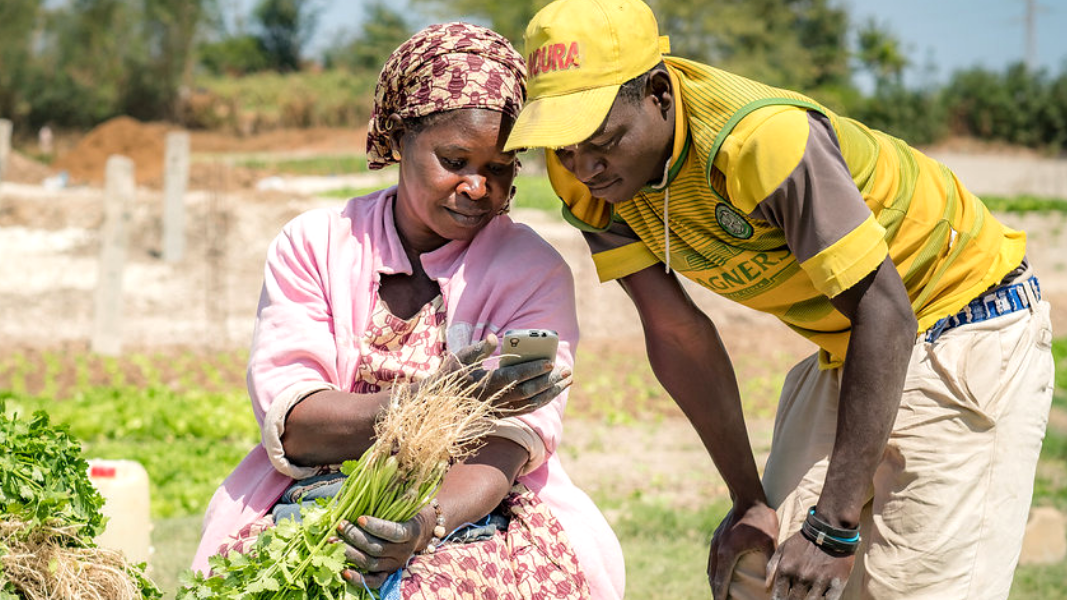
Generative AI applications for agriculture operate differently and are being deployed much more quickly. Many take the form of chatbots that ask questions such as “How can I help?” The conversational interface creates an impression of immediacy and simplicity that earlier agricultural technologies rarely offered.
Yet the ease of use also obscures the infrastructure, incentives, and data flows operating behind these systems—making governance far more challenging, particularly in low-income countries.
In some contexts, the accessibility of generative AI apps can deepen power asymmetries: while farmers encounter a simple interface, providers retain control over the underlying infrastructure, the terms of use, and how actionable knowledge is generated through AI-enabled systems. At the same time, data governance is often not the first priority when agricultural advice is closely tied to livelihoods—or even survival—and so may not get the attention it deserves.
This lack of meaningful choice on the handling of user data is precisely why robust mechanisms for rebalancing these power asymmetries are so critical. As opaque algorithms increasingly mediate agricultural decision-making, we need comprehensive AI governance frameworks to build and maintain farmers’ trust in digital agriculture over the long term.
What current platform policies reveal
These tensions are already visible in the data and usage policies governing major services within today’s generative AI ecosystems. Policies across the OpenAI ecosystem—including those of the general-purpose assistant ChatGPT as well as specialized, agriculture-oriented services built on top of OpenAI models, such as Norm and Farmer.Chat—show that governance is generally weak.
None of these services perform strongly across all key dimensions of user protection and empowerment. This problem is acute in low-income countries, where access to free or low-cost services may come at the price of granting providers broad, perpetual, and irrevocable licenses to reuse and monetize users’ input data.
Farmers’ formal rights over that data are often limited, fragmented, and difficult to exercise in practice. Notably, agriculture-focused services do not consistently provide stronger data safeguards than general-purpose ChatGPT, despite operating in contexts where trust and reliability may be low. In some cases, the protections are weaker, especially with respect to user rights over how data is used after it is captured. These problems highlight the broader governance challenges for AI in agriculture.
Privacy risks become harder to anticipate
Generative AI systems introduce structural vulnerabilities in data privacy that traditional privacy frameworks are not well equipped to address. By bringing together scattered, seemingly non-sensitive details disclosed over the course of a conversation, such as yield levels or sowing dates, and interpreting them in context, generative AI systems can infer sensitive information beyond what the farmer intended to disclose.
Once agricultural data is combined across models, interfaces, and external services, it also becomes much harder for users to anticipate the possible ways it may be interpreted and used. Yet privacy policies often primarily focus on sensitive personal information, saying much less about the sensitivity of farm operational data and their downstream analytical value.
This blind spot becomes even more serious when conversational systems are connected to external services through application programming interfaces (APIs), plug-ins, or other integrations. As farmers engage with these systems through a single AI interface, their data may flow across a far more complex ecosystem than they realize, including to third-party providers of speech processing, translation, geolocation, weather, or other integrated services that may receive or process parts of users’ inputs or associated metadata, sometimes under different or less transparent data governance arrangements than the original provider’s—for example, where a third party service applies different rules on data retention, onward sharing, or secondary use.
Control mechanisms fall short
User control over data in the generative AI value chain is also far more limited than formal policy language may suggest. Farmers may be told that they retain ownership of inputs and outputs or that they will be able to export or transfer their data. But such provisions do not necessarily translate into meaningful user control. In practice, they may do more to limit provider liability than to give users real leverage over how their interactions are used to improve, adapt, or optimize models.
The problem is compounded when terms of service or privacy policies state, in vague terms, that users’ data may be used for “service improvement”—a phrase that may cover a wide range of practices, from narrow fine-tuning to deeper system optimization, without users being in a position to know what it entails. Even where opt-out mechanisms exist, they may be difficult to find, difficult to understand, or too burdensome to use in practice.
Beyond vendor lock-in
A third issue concerns lock-in: when users become dependent on a particular provider because switching to another service is difficult or costly. Control over accumulated data can increase switching costs when farmers cannot transfer their historical record, settings, or derived insights to another platform in a complete and usable form. In earlier digital agriculture debates, portability rights were often presented as a key response to data concentration: if farmers could move their data between platforms, market competition could be better preserved and dependence on a single provider reduced.
Generative AI adds another layer to these lock-in dynamics. While farmers may be able to transfer their raw data to another provider, that data may already have contributed informational value to the system they leave behind. App interactions, preferences, or farm inputs are often captured and used to train, fine-tune, personalize, or otherwise adapt a system and are then incorporated into model behavior or other adaptations. This shapes outputs and downstream value creation in ways that are difficult to trace, audit, or undo.
This matters particularly in agriculture, where conversational generative AI apps can capture and aggregate not only structured farm data but also locally grounded, practical, and often uncodified knowledge.
This creates a broader structural risk: a small number of actors with disproportionate control over compute, infrastructure, and deployment channels may gain an effective monopoly over the digital capture and interpretation of local knowledge. Their goals—for agricultural optimization or business strategy—may not align with farmers’ long-term interests, local agronomic realities, or broader sustainability objectives.
The need for farmer-centered AI governance
If this diagnosis is correct, the response cannot stop at strengthening narrow approaches such as disclosure requirements and privacy protection. What is needed is a more substantive model of farmer-centered AI governance.
At a minimum, agricultural AI systems should meet baseline standards for data rights, transparency, and meaningful user control. For example, farmers should be clearly informed about what data are collected, for what purpose, how they will be used, how long they will be retained, and with whom they may be shared. Governance must also address the stewardship of agricultural knowledge itself: who curates it, how its quality is maintained, and how benefits are shared when farm data or collective farming expertise contribute to value to AI models.
This also means treating optimization goals as a governance issue rather than a purely technical one. Farming communities should have a real say over what agricultural AI systems are designed to optimize and what trade-offs they embed.
These are not trivial design questions. They concern whether a system prioritizes yield over resilience, short-term efficiency over soil health, or automation over human judgment. Because algorithms tend to favor what is easiest to quantify, farmer participation is essential if agricultural AI is to reflect values that matter in practice but are harder to measure.
Farmer-centered governance also requires independent checks and accountability mechanisms—not only for data flows but also for the reliability, safety, and quality of model outputs. Interoperability and competition safeguards remain essential as well, especially if the sector is to avoid deeper dependency on a handful of dominant providers. In parallel, certification systems or quality labels for agricultural AI tools could help farmers and advisors compare systems against minimum standards for transparency, safety, and reliability. Work in this direction is already under way: the ongoing GAIA initiative is developing evaluation and benchmarking protocols for generative AI in agricultural advisory, alongside ethics guidance.
Finally, human agency must remain central. Farmers need access not only to AI tools but also to advisory support, digital literacy, and data governance literacy that enable them to manage operational data safely, use available controls in practice, and critically assess AI-generated recommendations as part of their own informed decision-making.
What trustworthy AI requires
Generative AI should not be treated as just another layer of digital agriculture. It changes how power operates in the sector: not only through data extraction, but through control over models, interfaces, and the production of actionable knowledge. That is why the future of agricultural AI cannot be governed solely through existing approaches, including disclosure, portability, or narrow privacy safeguards.
If digital agriculture is to remain worthy of farmers’ trust, governance must give farming communities meaningful influence over how these systems are designed, what they optimize, and how the value they generate is distributed. In the age of generative AI, farmer-centered governance is not a desirable add-on. It is a precondition for a more just, accountable, and sustainable digital transition in agriculture.
Katarzyna Kosior is a Research Fellow at the Institute of Agricultural and Food Economics – National Research Institute in Warsaw, Poland. Her research focuses on agricultural data governance, digital transformation in agribusiness, and policy analysis for sustainable agricultural development. Opinions are the author’s.