





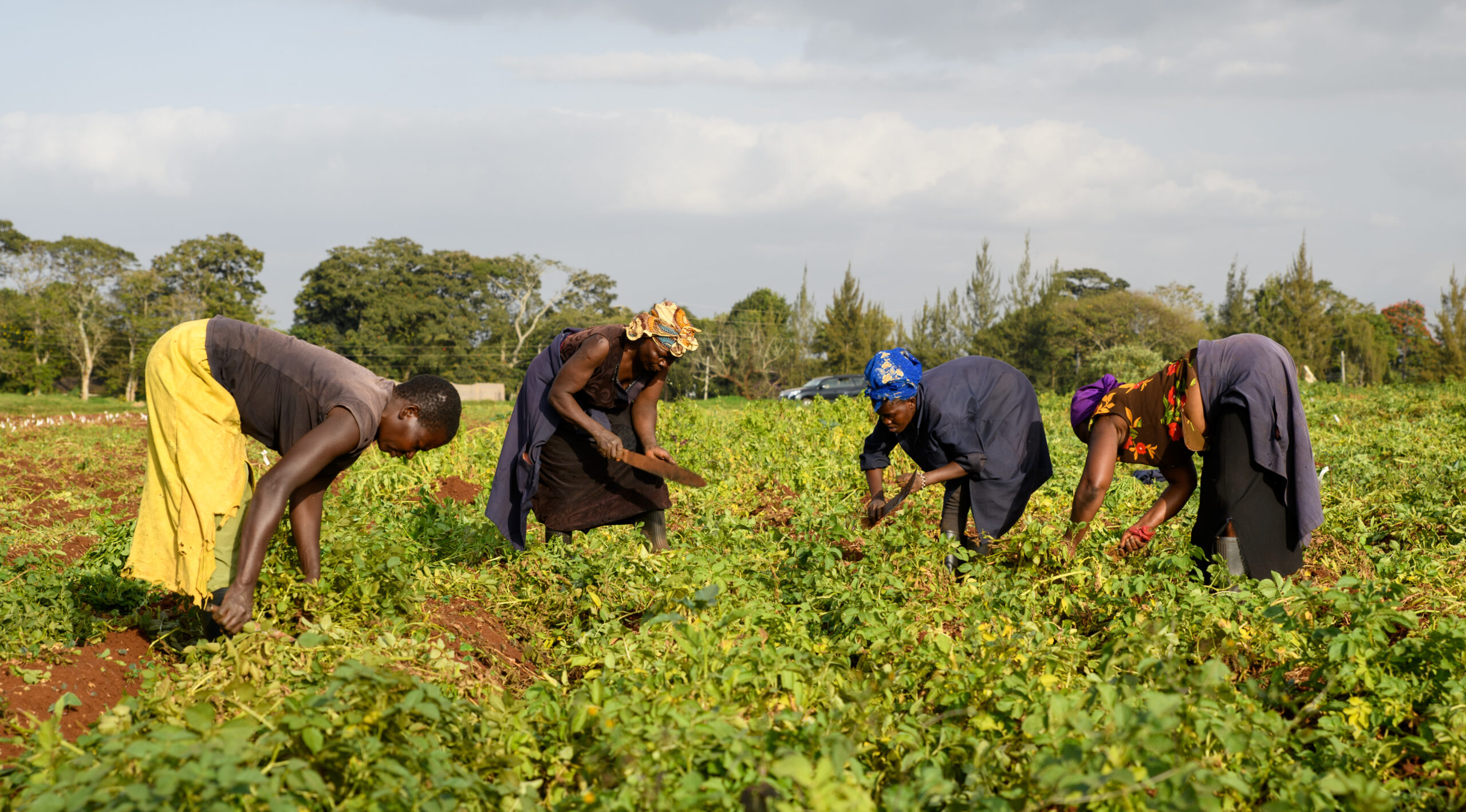
Farmers in Kenya are facing growing impacts of climate change, including prolonged droughts, erratic rainfall, and sudden floods. Approximately 70%-80% of the country’s land area is classified as arid and semi-arid lands (ASALs), and roughly 98% of the agricultural production systems are rainfed. This makes cropping and livestock systems highly sensitive to changing climatic patterns. Severe droughts have repeatedly devastated livelihoods, including a 2008-2009 event that affected nearly 10 million people and killed more than 643,000 livestock. Recurring flash floods following droughts have also compounded losses and driven many rural households deeper into poverty.
Financial safety nets, insurance, and other risk transfer mechanisms can cushion such shocks. Yet many farmers lack access to these, leaving them exposed to alternating extremes that can trap them in a pattern of repeated shocks, undermining their ability to recover, adapt, and build long-term climate resilience.
In recent decades, index-based insurance has emerged as a promising approach to overcome those challenges. Transferring climate risks to agricultural insurance markets empowers smallholders to shift the financial burden of extreme weather events onto insurers who can pool and manage it more efficiently. Unlike traditional insurance instruments, where claims are paid based on the actual loss incurred by the policyholder, index insurance payouts go to all policyholders in a given area when an objective index (e.g., rainfall) falls below or exceeds a pre-determined threshold. A new strategic partnership between IFPRI and the Government of Kenya focuses on strengthening the Kenya Agricultural Insurance Program (KAIP), which offers index insurance to the country’s smallholder farmers.
Index insurance addresses significant obstacles of the traditional indemnity approach that make it impractical for smallholders in developing countries like Kenya. The requirement for individual claim assessments, often in the aftermath of a disaster, is prohibitively expensive. The products are also prone to information asymmetries such as moral hazard, adverse selection, and general insurance fraud.
Many policymakers around the world have embraced agricultural insurance, and it is now included in international policy agendas as a comprehensive climate risk management tool for highly exposed farming populations, mostly in developing countries (UNFCCC, 2025).
The Kenya Agricultural Insurance Program
The government launched KAIP in 2016 to cushion smallholder farmers against escalating climate risks and improve resilience by providing access to affordable, tailored insurance products. The program is structured as a public-private partnership between the government, insurance companies, and development partners.
KAIP operates across most Kenyan counties (Figure 1) and covers five value chains: Maize, sorghum, green grams, potatoes, and onions. As of the start of 2025, it had trained more than 3.5 million farmers and provided insurance coverage for 1.6 million farmers across 38 counties. For farmers with less than 20 acres of land, the government covers up to 50% of the insurance premiums per acre, significantly reducing the cost burden for many low-income households. The program primarily relies on area yield index insurance, which tracks average yields in specific regions, and on weather-based index insurance models, which use rainfall data from satellite or ground stations. These approaches minimize the high costs, delays, and inaccuracies associated with individual farm loss assessments while ensuring more transparent and timely payouts.
Figure 1

Strengthening resilience through institutional partnership
The IFPRI-government partnership, begun in July 2025, seeks to address persistent challenges such as basis risk, limited farmer awareness, and weak institutional capacity, which have constrained the program’s effectiveness and uptake. Through this collaboration, IFPRI will provide research-based expertise, technical assistance, and capacity development to ensure KAIP becomes more reliable, inclusive, and sustainable. The areas of support will include:
1. Development of a dynamic index trigger. Using crop phenology, the growth stages of a crop from planting to harvest, this tool can significantly reduce basis risk in agricultural index insurance programs by aligning payouts more closely with the actual conditions experienced by farmers. Unlike static indices that apply uniform thresholds across the entire season, dynamic triggers automatically adjust according to the specific water or weather needs of the crop at each growth stage. For example, insufficient rainfall during germination or flowering has far more severe yield consequences than when it occurs at crop maturity. A phenology-based index can capture this variability more accurately. By tailoring thresholds to crop development, such indices improve the correlation between measured weather conditions and actual farm losses, ensuring that farmers receive payouts when they are most needed.
Figure 2 shows a comparison under a dynamic (blue line) and static (green line) triggers for maize farmers in Kenya’s Central Machakos sub-county. Under the static trigger, farmers receive no compensation because, regardless of the yield, the cumulative seasonal rainfall remains above the trigger point. Under the dynamic trigger, farmers receive a payout because the rainfall outcome during the crop maturity stage falls below the trigger point (red line). This approach is expected to enhance farmer trust in insurance products, increase uptake, and strengthen the credibility and sustainability of programs such as KAIP. Based on its earlier experience in the development and implementation of risk contingent credit (RCC), IFPRI will support the design and testing of crop-phenology-based indices that account for different growth stages.
Figure 2

2. Bundling insurance with credit: A central focus of the partnership will be integrating crop insurance with agricultural credit for smallholders. By linking KAIP coverage to loan products, the partnership will reduce default risks for financial institutions and give farmers the confidence to invest in improved seeds, fertilizers, and other technologies. Based on RCC experience, IFPRI will contribute research-based insights to guide the design of bundled products that are affordable, farmer-friendly, and suited to diverse production systems.
3. Farmer education and awareness: The partnership will support the creation of tailored training materials, simplified communication tools, and localized awareness campaigns (in both print and digital formats) to ensure farmers clearly understand what KAIP covers, how payouts are triggered, and how insurance complements other farm management practices. Special focus will be placed on reaching women and youth farmers who are often excluded from insurance markets.
4. Capacity sharing and institutional strengthening: Joint training programs will be developed for government officials, insurance companies, local cooperatives, and agricultural extension officers to build long-term expertise in index design, actuarial analysis, subsidy administration, and claims processing. This will ensure smooth coordination between institutions and strengthen the sustainability of KAIP.
5. Data systems and technology support: IFPRI will support the government in strengthening the use of high-resolution satellite imagery, automated weather stations, and yield monitoring systems to improve index calibration and accuracy. Investments in digital platforms and mobile applications will also be promoted to streamline farmer registration, premium payments, claims processing, and the timely dissemination of insurance information.
6. Monitoring, evaluation, and learning: The partnership will establish a robust monitoring and evaluation framework that collects real-time feedback from farmers and stakeholders to assess KAIP’s performance. This will inform continuous improvements in subsidy structures, product design, and delivery channels, ensuring the program remains relevant, transparent, and responsive to farmer needs.
Anne G. Timu is founder of SAPA Kenya and a former IFPRI Associate Research Fellow; Kennedy Anahinga and Eileen Bureza are officials with the Kenya Ministry of Agriculture; Liangzhi You is a Senior Research Fellow with IFPRI’s Foresight and Policy Modeling Unit. Opinions are the authors’.
This work is supported by the CGIAR Science Program on Climate Action.