





Key takeaways
- Developing countries are highly exposed to impacts from the closure of the Strait of Hormuz, IFPRI economic modeling shows.
- Poverty and food insecurity rise modestly in percentage terms, but absolute numbers show a significant impact, with about 20 million more people in poverty and 2.5 million more facing undernourishment.
- Broader economic impacts are limited but uneven. GDP declines are generally small, but agriculture and supply chains face stronger pressures.
The economic impacts flowing from the closure of the Strait of Hormuz continue to reverberate, raising concerns across developing countries facing spiking global fuel and fertilizer prices. New economywide modeling conducted by IFPRI shows that high prices could increase global food insecurity and push more than 20 million into poverty across 20 developing countries.
High exposure to global price shocks
In general, developing countries rely heavily on imported fertilizer and fuel and thus are highly exposed to changes in the global market prices of those items (Figure 1). The Iran war has disrupted supplies originating from or shipped through the Persian Gulf region, a major producer of both fuel and fertilizer, driving prices up. Fuel import dependence exceeds 90% in many developing countries, while fertilizer imports dominate supply across much of Africa and Asia. These dependencies are creating growing economic burdens. When import prices rise by more than export prices, foreign exchange revenue falls and domestic prices increase.
Even oil-exporting countries such as Ghana and Nigeria face challenges. While they stand to earn more from higher oil prices, it usually takes time for oil revenues to filter through domestic economies and benefit populations. At the same time, both Ghana and Nigeria import refined petroleum, despite exporting crude oil, and both import most of their fertilizers.
Figure 1
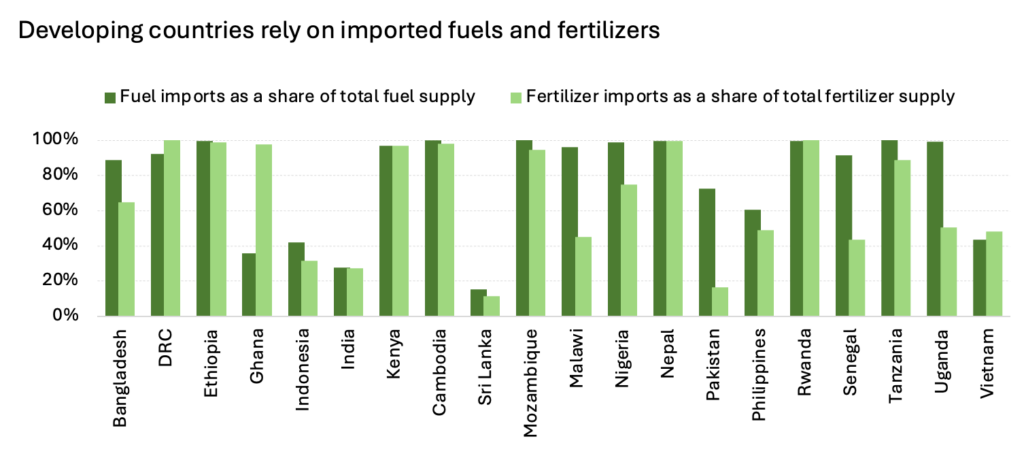
Note: Fuels refer to refined petroleum products rather than crude oil. Indicators are the share of imports in total final demand for fuels and fertilizers (i.e., after removing any exports).
Economic impacts are modest in most countries
IFPRI’s country models were used to simulate the impacts of a 60% increase in global fuel prices and a 40% increase in fertilizer prices—spikes consistent with prevailing prices today—in 20 developing countries. The modeling scenario assumes the simulated price spikes persist through 2026. The models capture how higher fuel prices affect supply chains, raising production costs and prices for most products in domestic markets. Higher fertilizer prices reduce farmers’ demand for and use of fertilizers, leading to lower crop yields.
Estimated macroeconomic impacts are relatively small (Figure 2). Most countries experience GDP declines of less than 0.5%, reflecting the short-term nature of the shock and the fact that production systems do not immediately contract.
Figure 2
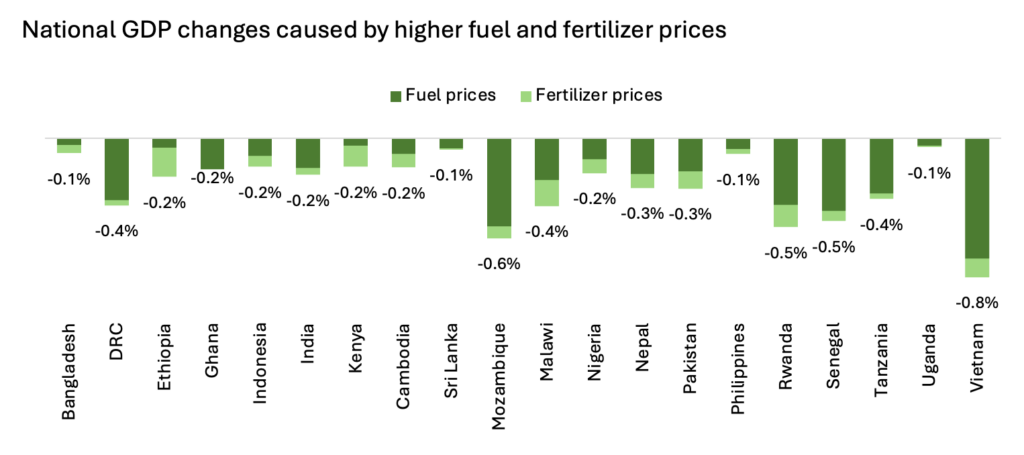
Impacts vary across countries, but three patterns emerge. First, fuel price increases are the main driver of GDP losses, because higher transport costs affect most economic sectors. Second, while not shown, agriculture is more exposed than the broader economy, because higher fertilizer prices directly reduce crop productivity. This effect is more gradual than the fuel shock, but it has important implications for future output and rural incomes. Third, the timing of price shocks matters because fertilizer decisions are tied to planting cycles. If high fertilizer prices persist, GDP losses could worsen as the year unfolds.
Larger impacts on poverty and food insecurity
Falling GDP has a particularly adverse impact on developing country households, especially the poor. Higher transport costs increase food prices and reduce real incomes for both urban and rural households. Under the modeling scenario, the share of people living in poverty rises by 1-2 percentage points in most countries (Figure 3). Yet these small percentage changes obscure the large increases in poor populations in absolute terms. The analysis suggests that 20.9 million more people may be living in poverty across the 20 countries due to the Iran war. Urban households are particularly affected by rising food and transport costs, while rural households face higher input costs and reduced profitability.
Figure 3
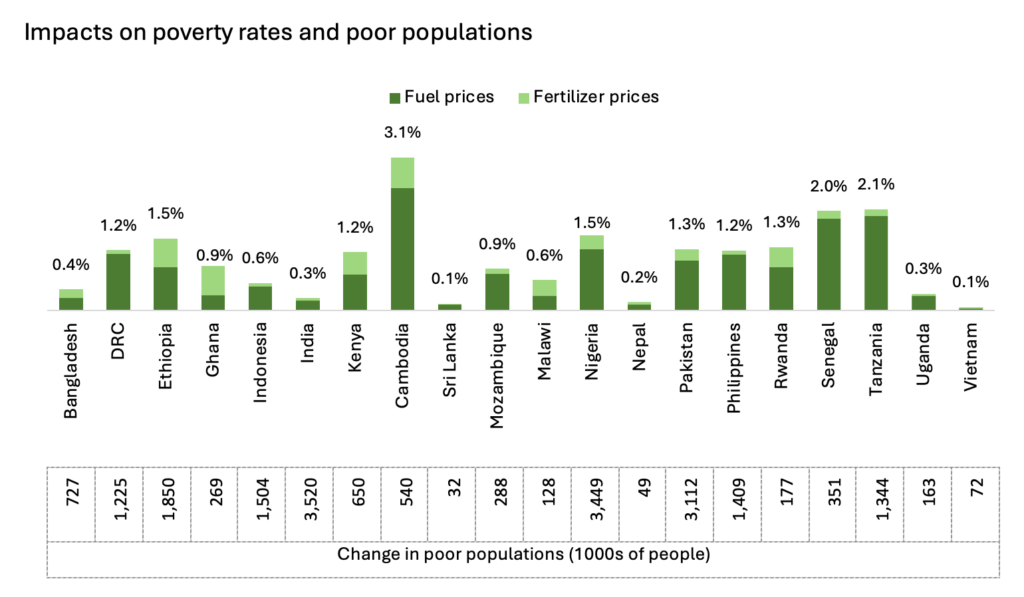
Note: Poverty is measured using the World Bank’s $3-a-day poverty line.
While fuel prices drive poverty outcomes, fertilizer prices play a larger role in determining food security. Country-level impacts are determined by many factors, including how much fertilizer is produced and used in the country, how responsive farmers are to changes in fertilizer prices, and the yield gains from applying fertilizer. Figure 4 shows how higher fuel and fertilizer prices impact the share of the population that is not consuming enough calories each day. The level of undernourishment worsens in most countries, though some show declines, especially those that produce their own fuels or fertilizers. Again, small percentage changes hide large absolute changes in undernourished populations. Overall, the undernourished population across the 20 countries increases by 2.5 million.
Figure 4
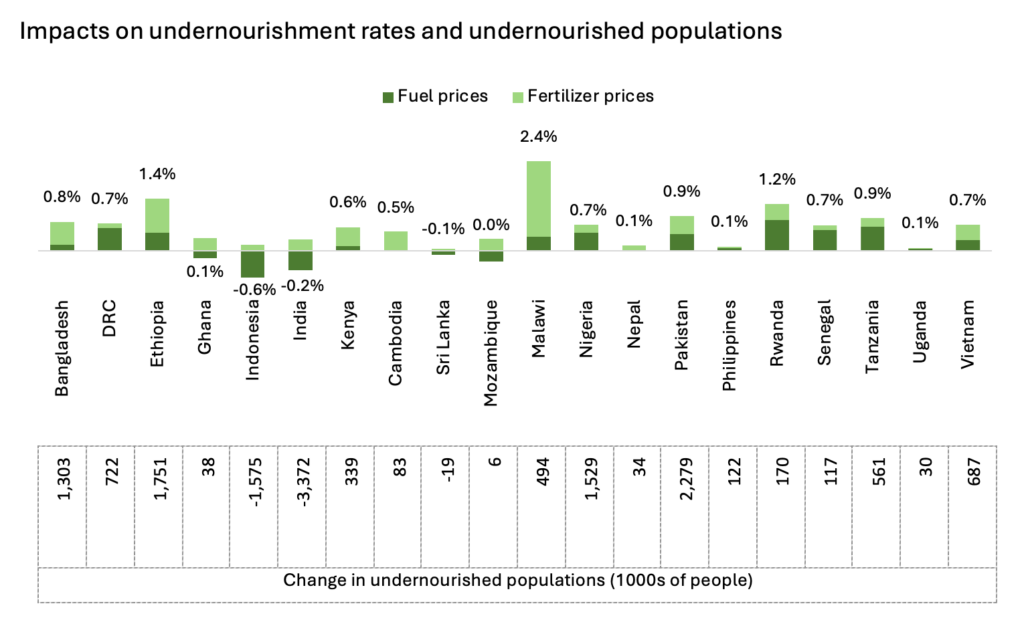
Note: Undernourishment is measured using the FAO’s daily per capita calorie consumption threshold.
Situating the current crisis
The impacts of the Iran war, for now, appear less severe than those of the last such crisis, the fuel and fertilizer price spikes triggered Russia’s invasion of Ukraine in 2022. Poverty rates fluctuate each year due to domestic production and world price shocks (Figure 5). In Ethiopia, for example, poverty rates typically fluctuate over a range of four percentage points above or below trend depending on prevailing weather and world market conditions. Previous modeling suggested that poverty rates in Ethiopia spiked towards the top of this range during the Ukraine war price crisis; the current analysis suggests another spike in poverty, but below that of 2022. This is because today’s fuel price increases are larger, but fertilizer price increases are smaller than in early 2022. Importantly, global food prices have not yet risen significantly, and the current crisis appears less likely than past ones to trigger price spikes.
Figure 5
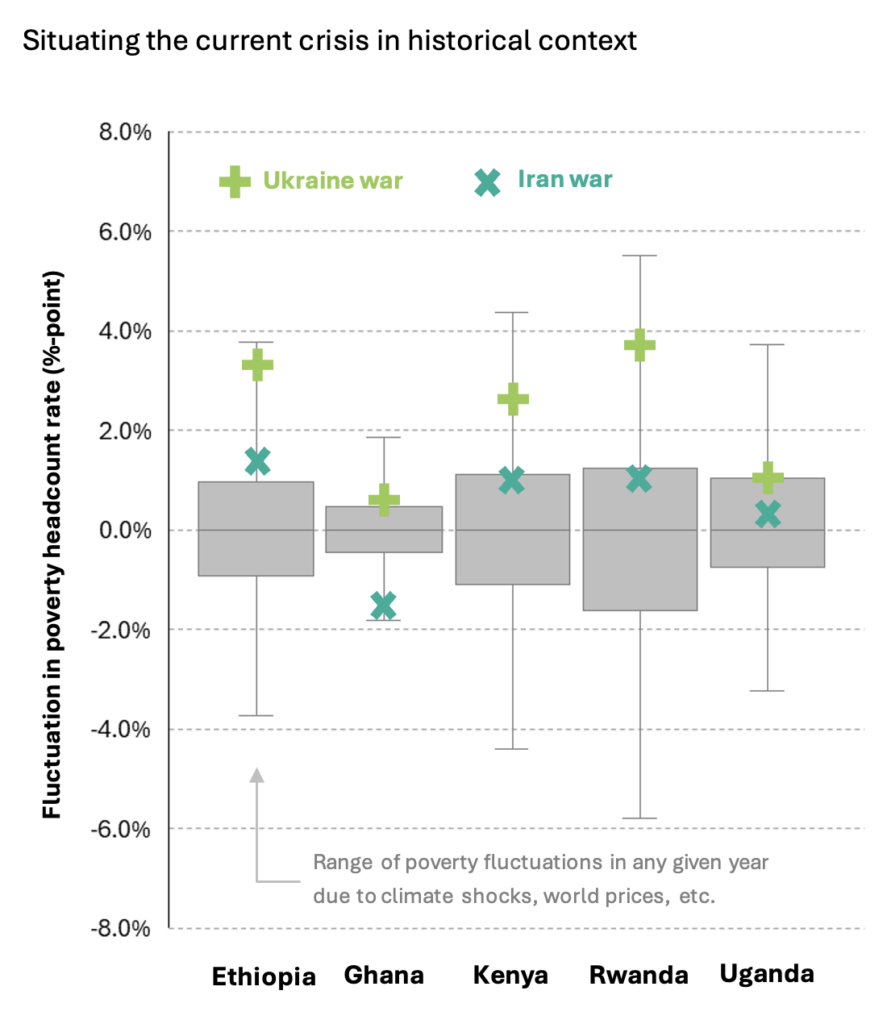
Note: Poverty rate is the share of the population living below the poverty line. The box-whisker plots show the range of poverty outcomes under the full range of historical domestic production and world price shocks.
Looking forward
IFPRI’s modeling shows the Iran war is having detrimental impacts on global poverty and food security—both of which worsen in most of the 20 countries analyzed.
The situation could deteriorate further, especially if fertilizer supplies remain constrained and farmers reduce use in the next cropping season. A recent analysis by colleagues at North Dakota State University projects urea prices peaking at 67% above pre-crisis levels and potentially exceeding 2022 peaks if the conflict extends. If high fertilizer prices persist or rise further, this could cause global food prices to rise later in the year. There is also concern about the El Niño atmospheric phenomenon, which projections suggest will occur later in the year, potentially worsening farming conditions in key regions. IFPRI and other organizations are closely monitoring global and domestic food prices because any increase would further exacerbate the rise in poverty and undernourishment expected under today’s global fuel and fertilizer prices.
James Thurlow is Director of IFPRI’s Foresight and Policy Modeling (FPM) Unit; Eleanor Jones is an FPM Program Manager. Opinions are the authors’.
This work was supported by the CGIAR Programs on Policy Innovations and Food Frontiers and Security and the U.K. Foreign, Commonwealth & Development Office.