





Key takeaways
•Odisha has embedded gender equity into its development agenda, with extensive programs focused on women and nearly half of the state budget containing gender-responsive components.
•Women are essential to agrifood system transformation; ignoring gender barriers undermines productivity gains, structural transformation, and equitable development outcomes.
•Self-help groups (SHGs) play a crucial intermediary role in Odisha, helping women access resources, technology, and markets—though they cannot fully substitute for long-term structural reforms like land rights.
•Effective gender policy requires more than counting female beneficiaries; it demands addressing social barriers, improving implementation, and collecting gender‑disaggregated data to ensure women truly benefit.
The Indian state of Odisha has made significant strides in placing women at the center of its development agenda: it has 85 programs exclusively for women, 420 gender-sensitive programs, and 45% of the state budget includes measures with some gender component. The goal is to achieve an economically, socially, and environmentally sustainable agrifood system in which women play an empowering and pivotal role.
This is a complex process that involves weighing many potential economic and social impacts, including women’s empowerment. Yet evidence suggests the many clear advantages to prioritizing gender equity. No transformation success story exists without women playing a pivotal role—nationally, regionally or globally.
Our work with the Gender Responsive Cell (GRC)—an Odisha policy initiative developed with IFPRI input that aims to embed gender equity into agricultural policy, services, and outcomes for women farmers—casts light on this process.
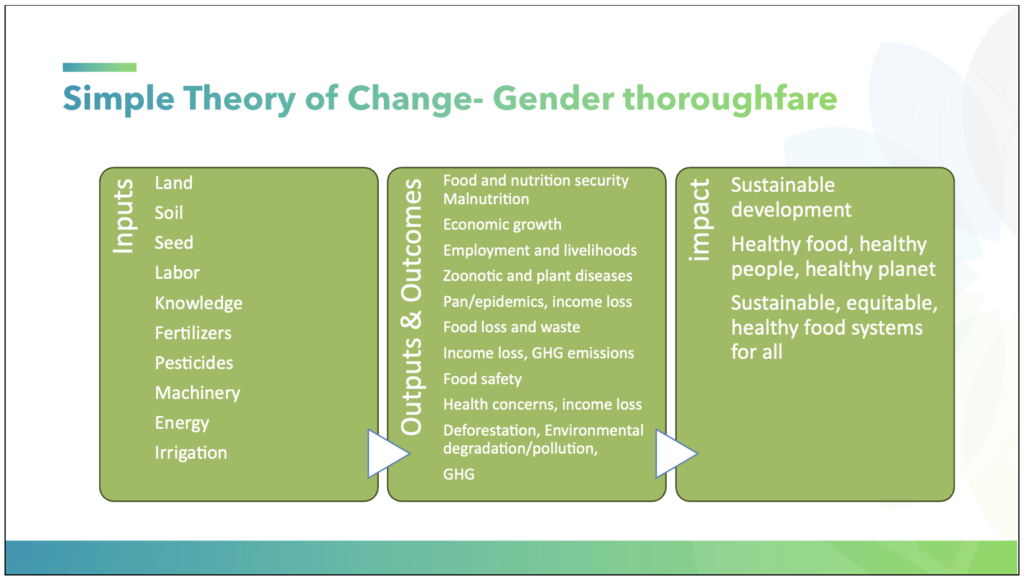
Our theory of change, moving from the goal of economic growth to development comprising a healthy, equitable, and sustainable agrifood system (Figure 1) includes a gender thoroughfare: the many paths through which gender exerts influence. Gender has always been embedded in the pathways from inputs to outputs that drive growth: land, labor, productivity. Yet gender is often left out of the policy conversation. Achieving food system transformation requires giving currency to gender throughout this process of change.
Figure 1
Learning from the three schools on growth
There are three schools of thought on the development process, all of which illustrate the importance of integrating a gender perspective into policies and programs.
All of these see economic growth as the precursor to development, which comprises other goals such as equity, poverty reduction, and a sustainable and healthy food system. Gender enters into each stage of this process. Gender roles and effects influence growth, whether through structural transformation, or spurred by improvements in education, health, or investment or other institutions.
The first school of thought focuses on structural transformation: resources move from low-productivity to higher-productivity sectors, and overall productivity increases. Those resources cannot move seamlessly for structural transformation if the gender lens is ignored.
A second school of thought views growth itself as the fundamental challenge, aiming to develop broad capabilities and institutions like human capital and infrastructure to facilitate it. Yet the issue of gender does not get enough attention in the planning and policy discourse.
A third school of thought underlines the agrifood system role in growth and development, focusing on the importance of the transformation of agricultural value chains (AVC) in retail, midstream, and downstream segments including food services. Here, too, women play a pivotal role in this process, often in leadership positions, as in food manufacturing in India.
Efforts to bring in women in the development discourse are not new. In the 1970s, the women in development (WID) movement emerged out of questioning trickle-down economic theories and growing recognition that economic development affects men and women differently. The 1980s saw a shift to the gender and development (GAD) approach, recognizing that gender inequality is rooted in social relations and cannot be addressed by merely redirecting resources to women (Razavi & Miller, 1995). GAD introduced intersectionality into the conversation: women themselves are not a homogeneous group, and diverse identities influence social and economic relationships. In the 1990s, the gender, environment, and development (GED) approach emerged, based on the recognition that the environment is not a gender-neutral space either: women are typically more exposed to environmental impacts and climate shocks.
Odisha’s gender policy landscape
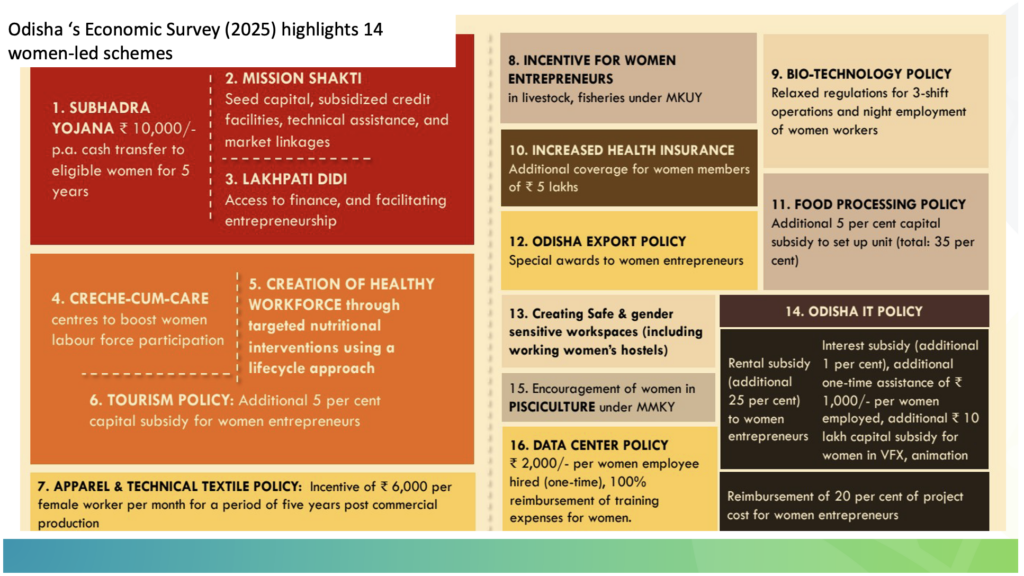
Odisha’s record putting women at the center of development planning and practice offers insights into how governments can navigate these issues (Figure 2). based on latest economic survey prior to the current Odisha budget, highlights these efforts. For example, while land ownership requirements remain a obstacle for many women to qualify for subsidies and benefits, Odisha’s strong network of self-help groups (SHGs) has risen to fill that gap meaningfully by leveraging their identity as a group: pooling resources, renting machinery, extending low-interest rate loans. The robust roles SHGs play in Odisha in this regard makes them the gold standard in this area.
Figure 2
While reforms like equal land rights and joint ownership require longer time frames, SHGs provide an interim solution for women to access public resources. Through these groups, women can bypass social norms that otherwise restrict mobility and participation.
Several flagship programs testify to the gender responsiveness of policies in Odisha.
Odisha Millets. With an aim to revive traditional crop varieties, achieve better nutritional outcomes, promote processing facilities and adopt climate-resilient practices. The program provides support to farmers throughout the value chain from production to procurement with roles earmarked for SHGs and farmer-producer organizations (FPOs). By 2019-20, driven by government procurement of ragi and its integration into India’s Public Distribution System (PDS) (the country’s principal public assistance program), there was significant uptake of millet.
The Mushroom Mission and Floriculture Mission take this approach a step further, with an explicit focus on helping women build sustainable livelihoods through export-quality production, with SHGs and women farmers as direct beneficiaries. Over the five-year period from FY 2022-23 to FY 2026-27, 10,000 members of women’s SHGs are to be trained in mushroom cultivation.
The Drone Didi scheme aims to support advanced technology and provide livelihood support to women by distributing agricultural drones to SHGs. This has enabled SHGs to diversify their activities, improve agricultural practices, and access technology that was previously out of reach, opening new income streams for women in rural communities.
The Odisha Integrated Irrigation Project for Climate Resilient Agriculture (OIIPCRA) gives special preference to women, small/marginal farmers, Scheduled Caste/Scheduled tribe (SF/MF/SC/ST) farmers for a range of activities including hybrid vegetable cultivation, vermicomposting, greenhouse structures, mushroom units, and processing infrastructure—ensuring support throughout the value chain. This and many of Odisha’s schemes target support for commercialization by women farmers, helping to overcome a common obstacle.
Despite this range of efforts, SHGs are not a panacea for women’s empowerment in agrifood systems, given the complexity and scale of the challenges. Often, for example, elderly, economically and socially vulnerable women get left out of SHG activities and struggle to repay group loans. Meanwhile, government still has an active role to play in regulating macro-level forces, promoting gender equity and ensuring that public benefits reach all.
Pradhan and Rao’s (2018) work offers an important insight in this regard: even a universal entitlement like the PDS fails to reach women equitably because local delivery is shaped by the hierarchies of caste, class, and land ownership. Equal entitlements do not guarantee equal access. In other words, both gender-neutral and gender-specific policies are put to test by the ground realities that determine who benefits the most. Given such obstacles, allocating resources is not enough; it is equally important to collect gender-disaggregated data to track the outcomes. A gender justice framework therefore requires going beyond counting women as beneficiaries and actively asking whether the social conditions that prevent certain women from claiming what is theirs are being addressed in implementation.
Bhumika Mishra is a Research Analyst with IFPRI’s Development Strategies and Governance (DSG) Unit based in Bhubaneswar, Odisha, India, working for the Gender Responsive Cell (GRC), Department of Agriculture and Farmers’ Welfare (DAFE), Government of Odisha (GoO); Vandana Vidhani is a DSG Research Analyst, based in Bhubaneswar, Odisha, part of the GRC and Climate Resilience Cell (CRC), DAFE, GoO. Devesh Roy is a DSG Senior Research Fellow based in Delhi, India. Mamata Pradhan is a DSG Research Coordinator based in Delhi, India and leads the GRC. Opinions are the authors’.
References:
Pradhan, M., & Rao, N. (2018). Gender Justice and Food Security: The case of public distribution system in India. Progress in Development Studies, 252-266. https://doi.org/10.1177/1464993418786
Razavi, S., & Miller, C. (1995). From WID to GAD: Conceptual Shifts in the Women and Development Discourse(No. 1). UNRISD Occasional Paper. https://digitallibrary.un.org/record/227388