






Key takeaways
- A systematic analysis of 39 national fertilizer subsidy programs suggests major data gaps exist, complicating reform efforts.
- While many fertilizer subsidies are designed to be universal, few meet that standard. Registration requirements, paperwork, and supply shortages often limit access.
- Subsidies are progressive, reaching more poorer households, but this is mainly because those households are more likely to rely on farming.
- Better data are essential for reform. Governments often lack reliable information on who receives subsidies and who benefits most.
Fertilizer subsidy programs remain a common policy tool for promoting food security and supporting agricultural livelihoods in low- and middle-income countries (LMICs), though they have serious downsides. They command substantial government resources but do not always deliver economic benefits, often undermine market development, and are linked to reduced water quality, deforestation, and other negative environmental impacts.
Lately, debates over these programs have intensified: many LMICs are seeking to rein in public spending and realize savings by better targeting fertilizer subsidies—even as demands have recently risen for increasing them in response to rising global market prices sparked by the Iran war.
Yet, for policymakers seeking to shape subsidy reform, there is little systematic evidence showing how fertilizer subsidies are currently targeted and how different approaches to targeting perform. To fill this gap, we conducted a systematic analysis of whether and how 39 national fertilizer subsidy programs were targeted. Our findings suggest major data gaps exist on subsidy program impacts, posing significant challenges that must be addressed if reforms are to succeed.
We took away five key lessons from this exercise.
Lesson one: The myth of universal implementation
Many subsidy programs are designed to be universal—i.e., available to all without restrictions—though few are universal in practice. As shown in Figure 1, while only 10 out of the 39 programs are formally targeted, we find that only seven out of the remaining 29 programs are “truly” universal in that they do not require formal registration processes or other administrative hurdles in order to receive subsidized fertilizer, beyond presentation of basic identification at the point of purchase.
Figure 1
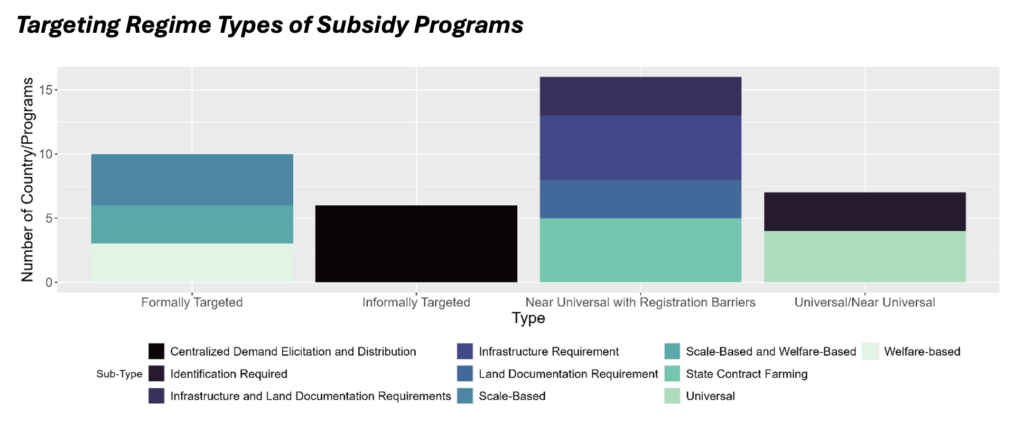
Sixteen programs have implicit “self-targeting” mechanisms. By requiring participants to have mobile phone access, bank account ownership, or land documentation to receive subsidized fertilizer, they restrict access and may unintentionally screen out the most marginalized farmers who may lack the necessary documentation or access to infrastructure such as mobile phone service.
Additionally, we identify six programs that are designed to be universal but are not in practice due to regular supply shortfalls and thus are informally targeted in practice. Given that not all interested farmers can benefit, local officials must use ad hoc, discretionary criteria to distribute the subsidized fertilizer. As such, in programs with registration barriers or informal targeting, the distinction between universality and targeting is often blurred by the practicalities of delivery and supply.
Lesson two: Strong regional variations in policy
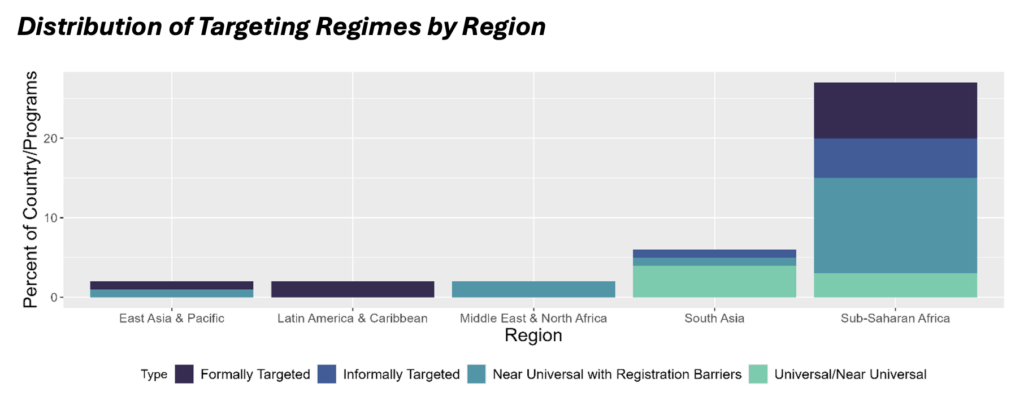
Choices of targeting regime vary regionally (Figure 2). For example, universal or near-universal programs are heavily concentrated in South Asia, while informally targeted programs are almost entirely located in sub-Saharan Africa. Furthermore, state-sponsored contract farming arrangements that subsidize fertilizer for participating farmers are found exclusively within the West African cotton sector. Country income level, rural population share, and government effectiveness do not clearly predict targeting regime nor explain these regional differences.
Figure 2
Lesson three: Subsidies tend to be progressive because poorer individuals are more likely to practice agriculture
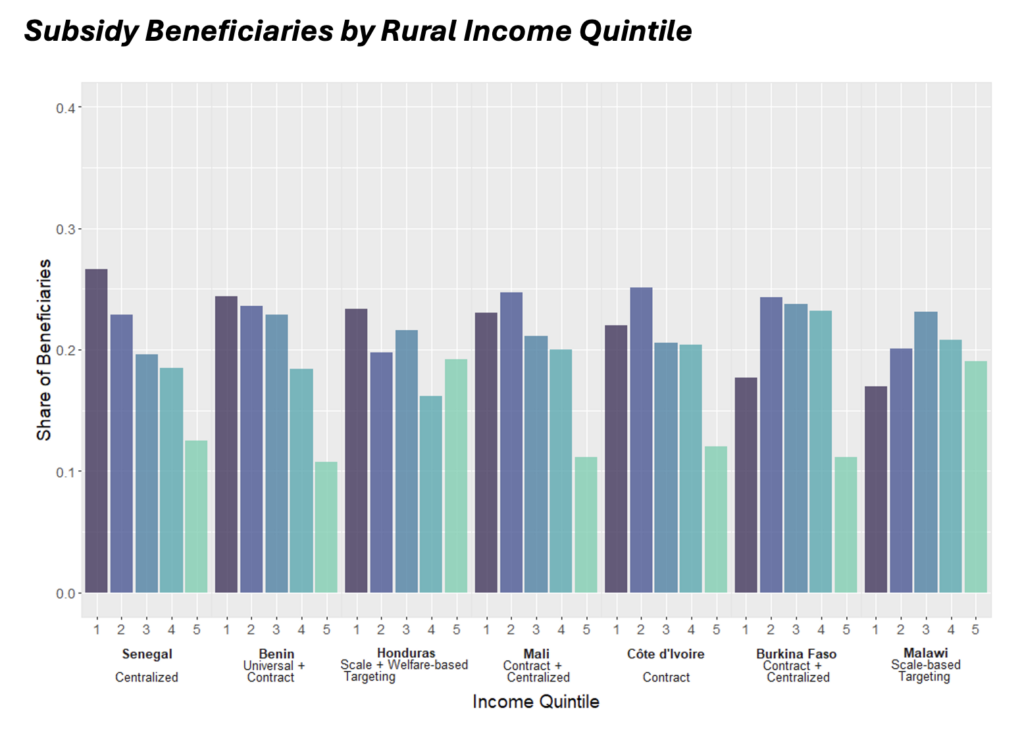
If fertilizer subsidy programs have a social protection motive, it may be important to policymakers to show that they are indeed reaching the poorest households. To explore the progressivity of subsidy incidence, we use publicly available household survey data to look at where subsidy recipients fall in the income distribution. Figure 3 shows that subsidy incidence is generally progressive across the seven programs explored, with higher shares of beneficiaries in lower quintiles of the income distribution.
This outcome is likely driven far more by the basic facts of fertilizer demand rather than any specific targeting measure. Because poverty is highly concentrated in rural areas and within the agricultural sector, fertilizer subsidies may naturally capture lower-income households, even without explicitly targeting the poorest farmers.
Yet, when we restrict our subsidy incidence analysis to rural populations only, the degree of progressivity significantly diminishes (Figure 4). This suggests that current targeting policies may not effectively identify the poorest of the poor within rural farming communities but rather benefit a broad swath of the rural population engaged in agriculture. Notably, within the rural population, while beneficiaries tend to be poorer than non-beneficiaries in terms of consumption, they also tend to have larger land holdings and are more likely to list agriculture as the household head’s main source of income.
Figure 3
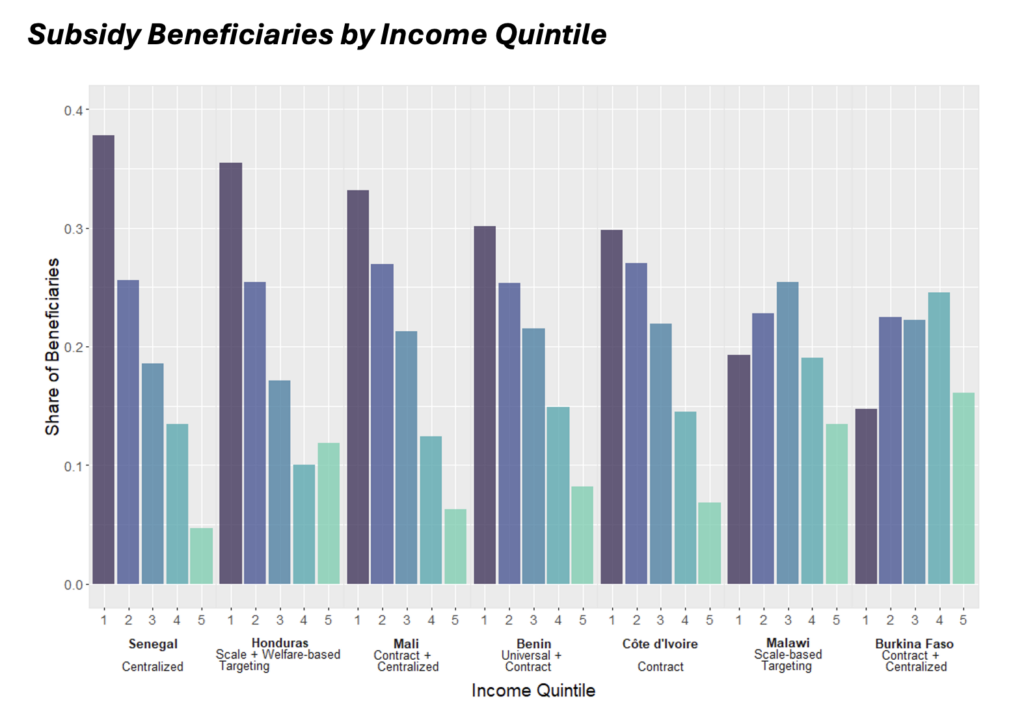
Figure 4
Lesson four: Targeting regimes do not predict progressivity
Our analysis challenges a prevailing assumption in policy reform: that transitioning to more explicit, formal targeting regimes (e.g., means-testing) will inherently yield more equitable distributional outcomes.
As shown in Figure 3, for the countries for which we have data to assess this, there is no clear systematic relationship between the choice of targeting regime and the progressivity of the policy. This disconnect may be explained by a divergence between how programs are written on paper and how they function in the field.
Lesson five: The prevailing data gap hinders evidence-based reform
A significant barrier to meaningful reform is the chronic lack of systematic data on who actually receives subsidy benefits. The majority of current evidence in the literature is derived from a small, non-representative sample of well-documented, formally targeted programs in countries including Malawi, Ghana, and Zambia. These programs represent only a small fraction of the global landscape, yet they dominate the academic and policy discourse, leading to potentially biased lessons.
For many of the existing national subsidy programs, we lack the consistent, nationally representative data needed to truly understand the beneficiary pool. Even in cases in which we could find large-scale household survey data to use in our analysis, there are often not direct questions about subsidy receipt, forcing us to rely on self-reported fertilizer prices to identify beneficiaries. This data void prevents policymakers from assessing the effectiveness of existing policies and forces them to design reforms based on incomplete information or anecdotal evidence.
Conclusion
As governments in LMICs navigate the complex landscape of agricultural reform, they need better data on who currently benefits from fertilizer subsidies. This can be assembled through nationally representative data surveys, improved administrative record-keeping, or both. Investing in the administrative capacity to verify who is actually receiving subsidized inputs allows governments to transition toward more efficient, data-driven policy design for supporting agricultural livelihoods.
Carly Trachtman is a Research Fellow with IFPRI’s Markets, Trade, and Institutions (MTI) Unit; Ruth Hill is MTI Director. This post is based on research that is not yet peer-reviewed. Opinions are the authors’.
This work was carried out under the CGIAR Science Program on Policy Innovations. We would like to thank all funders who supported this research through their contributions to the CGIAR Trust Fund.