





Key takeaways
- Fertilizer recommendations derived from soil tests of farmers’ plots, when provided on their own, produced no measurable change in fertilizer use or maize yields among Malawian smallholder farmers.
- The same recommendation paired with a $100 voucher raised fertilizer use on the soil-tested plot and lifted maize yields by about 20%.
- Yet voucher recipients generally did not follow the recommendations, spending the money on a mix of fertilizers closely resembling that offered by the standard subsidy program.
Africa’s input subsidy programs have been the subject of a long-running reform debate. One strand of this debate proposes moving beyond blanket fertilizer recommendations toward more targeted ones that better reflect local conditions. These recommendations can vary in their degree of granularity, ranging from those tailored to agro-ecological zones to plot-specific prescriptions based on soil tests from individual fields.
This approach is expected to increase the efficiency of fertilizer use compared to universal programs, an objective that has become especially important as international fertilizer prices have proven highly volatile in the wake of the war in Ukraine and conflict in the Middle East. These conflicts have raised the fiscal and economic costs of blanket subsidy designs and sharpened the case for spending scarce fertilizer budgets efficiently—matching nutrients to what each plot actually needs.
Malawi’s national fertilizer subsidy program is often highlighted in this reform debate. It subsidizes a 100-kg bundle of NPK (nitrogen, phosphorus, potassium) basal blend and urea topdressing distributed each season to eligible households. In a recently released working paper, we assess a modification to the national subsidy program that, at comparable cost, uses site-specific fertilizer recommendations and vouchers to improve the efficiency of input use.
Results from a year-long randomized trial across 113 villages in central Malawi suggest that this approach increases fertilizer use and maize yields, even though recipients did not follow the precision fertilization advice they were offered.
Experimental design
We randomized villages into three groups.
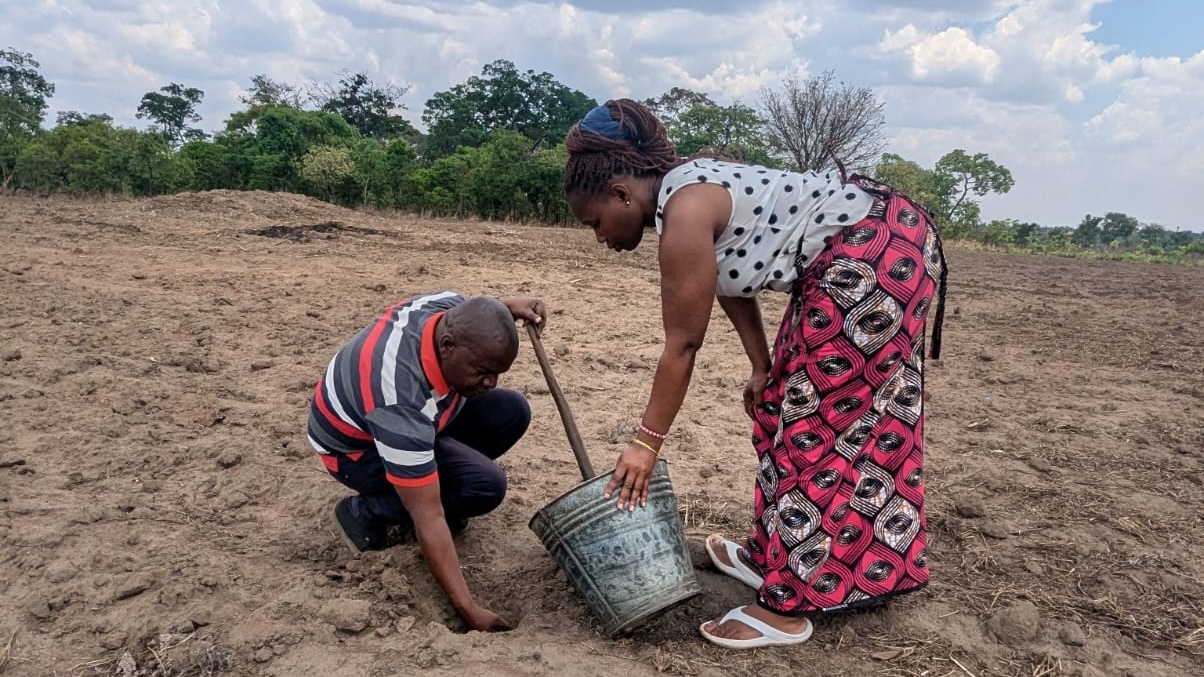
In the first, a trained agronomist collected a soil sample from a farmer-selected plot and delivered a fertilizer recommendation tailored to that plot’s measured nitrogen, phosphorus, potassium, sulfur, and micronutrient levels: a hyperlocal, individually customized prescription specifying fertilizer products or blends, application rates, and quantities.
In the second group, farmers received the same soil test-based recommendation plus a voucher worth 170,000 Malawi kwacha ($100), benchmarking the value of the national subsidy, redeemable for fertilizer at a named branch of the Farmers World agro-dealer network.
A third group of farmers received neither the soil-test recommendation nor the voucher and thus served as the comparison group.
Results
The recommendation alone
The recommendation-only treatment arm produced no measurable change in fertilizer purchased, nutrients applied, or maize harvested.
This null result stands in contrast to a broader literature showing that agricultural information interventions on soil health can shift farmer behavior. Text-message campaigns have increased lime uptake in Kenya and Rwanda, while rule-of-thumb guidance has reduced wasteful urea applications in Bangladesh. Our experiment also highlights an additional issue: advice can only be acted on when the recommended products are practically available and accessible to farmers.
Yet these successes generally involve simplifying the management of a familiar input or encouraging uptake of a single, clearly defined product. Evidence that soil-test-based recommendations can meaningfully shift inorganic fertilizer use is considerably thinner. The closest precedent in our setting is a cluster RCT in central Malawi, which found that soil-test-based advice increased complementary soil management practices—including organic fertilizer use, crop-residue incorporation, and maize-legume intercropping—but did not alter inorganic fertilizer use, attributing this partly to the pervasive influence of the national fertilizer subsidy program.
Adding a voucher to the recommendation
The voucher arm tells a different story.
On the soil-tested plot, voucher recipients applied roughly 30 kg more fertilizer than the comparison group and harvested about 20% more maize per acre.
Deconstructing voucher purchases by product, however, qualifies the finding. Overall, the fertilizers purchased closely resembled the 50-50 composition of the national subsidy program bundle, consisting overwhelmingly of urea (about 18 kg) and NPK 23:10:5 basal blend (about 19 kg).
Where the soil-test-based recommendation prescribed something different from the modal Malawi maize prescription, farmers did not buy it:
- Potassium products (MOP—muriate of potash or potassium chloride, and SOP—potassium sulfate) were prescribed for roughly two-thirds of households—often in place of urea—yet application in the voucher arm was essentially zero. The standard national subsidy bundle itself consisted of urea and an NPK basal blend; MOP and SOP were alternatives prescribed by the soil-test recommendations, not components of the standard national subsidy bundle.
- Urea was prescribed to fewer than one in 10 households, yet was the single largest component of additional fertilizer that voucher recipients actually purchased. This is consistent with farmers favoring familiar nitrogen fertilizer, whose effects on crop growth are more immediately visible than those of phosphorus or potassium.
- Lime was recommended for about a quarter of households. No household in any arm applied lime.
This suggests that the voucher reinforced the standard Malawi maize bundle rather than shifting farmers toward soil-matched fertilizer combinations. The productivity gain came primarily from intensification of fertilizer products farmers were already using, not from adoption of the precision blend that the recommendation prescribed.
This finding contrasts with evidence from the most cited prior study on the same question. An experiment in Tanzania by Harou and co-authors (2022) found that the bundle shifted half of farmers toward the soil-test-prescribed product (ammonium sulfate, the relevant input where soils were sulfur-deficient), compared with only 4% of farmers in the voucher-only arm.
Our Malawian voucher arm does not produce a comparable shift in product choice. The contrast suggests the failure to shift product mix may reflect something specific to the Malawi context—most likely the strong expectations built up around the bundle used in the national subsidy program—rather than a universal property of voucher-plus-recommendation interventions.
Implications for input subsidy reform
The case for incorporating site-specific fertilizer recommendations into subsidy programs rests on the expectation that better information improves the efficiency of fertilizer use. Our findings suggest that embedding such recommendations within a subsidy scheme was insufficient to induce shifts towards precision fertilizer use over a single season. The pattern of relying on familiar input bundles despite tailored advice points to constraints beyond information and affordability, including product availability and accessibility, package sizes, uncertainty around unfamiliar inputs, and expectations shaped by long-running subsidy systems. Our experiment cannot isolate which of these constraints was decisive.
Furthermore, because the intervention covered a single growing season, these results capture farmers’ initial response to unfamiliar recommendations rather than a longer-term learning process. They therefore do not imply that more precise recommendations should be abandoned; instead, they point to the importance of product familiarity, access, experimentation, and learning over time.
The lesson extends beyond fertilizer policy. A growing share of agricultural development investment focuses on improving information and advisory services, including AI-assisted extension, digital decision-support tools, satellite-derived plot diagnostics, precision-irrigation advice, and hyperlocal weather and pest alerts delivered to farmers’ phones. The implicit assumption is that limited access to timely, customized information is a key constraint on technology adoption and input use. Our results suggest a more cautious interpretation: even when information is highly tailored and paired with financial support, adoption may remain limited if surrounding markets, incentives, and institutions are unchanged. Improving one link in the chain may therefore be insufficient to change farmer behavior.
Thomas Assefa is a Research Fellow with IFPRI’s Agrifood Innovation and Resilience Unit, based in Nairobi, Kenya. Jonathan Atkinson is Managing Director for Southern Africa with Solidaridad, based in Johannesburg. Hailemariam Ayalew is a Research Fellow with IFPRI’s Development Strategies and Governance (DSG) Unit, based in Nairobi. Joachim De Weerdt is a DSG Senior Research Fellow and Director of IFPRI’s Malawi Country Office, based in Lilongwe, Malawi. Edwin Siyame is a DSG Research Analyst based in Lilongwe. David J. Spielman is a Professor at the Bursky School of Public Health at Washington University in St. Louis and was formerly a director and researcher with IFPRI. Bjorn Van Campenhout is a Senior Research Fellow with IFPRI’s Markets, Trade, and Institutions Unit, based in Leuven, Belgium. This post is based on research that is not yet peer-reviewed. Opinions are the authors’.
This research was supported by the CGIAR Science Program on Policy Innovations.
Reference:
Assefa, Thomas; Atkinson, Jonathan; Ayalew, Hailemariam; De Weerdt, Joachim; Siyame, Edwin W. P.; et al. 2026. Soil tests, vouchers, and the limits of site-specific fertilizer recommendations: Experimental evidence from Malawi. https://hdl.handle.net/10568/183376