





Key takeaways
- India’s Soil Health Card scheme has reached hundreds of millions of farmers but simplified soil health into a limited set of standardized measurements, a study shows.
- Providing information alone was not enough to change farmer fertilizer practices or encourage widespread adoption of recommendations.
- Stronger farmer engagement and local input are needed to make government-led soil health programs more effective.
Promoting soil health has become a prominent focus of agricultural policy, attracting support from scientists, farmers, environmentalists, and policymakers. However, there is much less consensus on what policies can help improve soil health. One problem is that the term “soil health” is conceptually vague, meaning different things to different food system actors. How particular meanings of soil health are incorporated into agri-environmental policies can have important implications for production, livelihoods, and ecosystems.
In a recent article, we explored these questions through an analysis of one of the most ambitious state-led initiatives organized around the concept of soil health: India’s Soil Health Card (SHC) scheme. The program’s national standardization, the study found, may limit its effectiveness and ability to encourage improved, sustainable farming practices.
Addressing fertilizer overuse
India’s focus on soil health measurement is, in part, a response to significant overuse of nitrogenous fertilizers and urea, a legacy of the mid-20th century Green Revolution. Decades of subsequent crop improvements and subsidies created conditions of fertilizer dependence and overuse.
In response, India’s government launched the Soil Health Card (SHC) scheme in 2015. The program aims to provide every farmer (about 120 million total) with a soil test report every two years, along with crop-specific fertilizer recommendations tailored to local soil conditions at no cost to the farmer. The underlying assumption is that improved information will encourage more judicious use of fertilizers.
A decade later, the scheme has issued about 240 million soil health cards to farmers around the country at a cost of $200 million. The scale of the SHC scheme makes it a valuable example of how governments seek to translate the concept of soil health into implementable institutional solutions.
Coordinating national soil data collection
The sheer scale of this scheme required a massive coordination effort. The government used a grid-based system to organize sampling: 10 hectares for rainfed areas and 2.5 hectares for irrigated areas, with samples collected every two years. To achieve soil testing targets, the government significantly expanded its soil testing infrastructure. Since its launch, the government has modernized 885 existing laboratories and established more than 8,000 new ones, with an emphasis on new forms of testing in the form of mobile, mini, and village-level labs rather than traditional laboratories. Additionally, the chosen indicators printed on the card were standardized across states and districts.
The focus on standardization and soil testing capacities shows how the SHC scheme is consistent with a technocratic view of agricultural knowledge. At the same time, the commitment to gather the same indicators across the country afforded the development of a nationwide database but also limited the set of indicators to those for which data could be collected everywhere and within budget. As a result, soil chemistry is prioritized while more costly soil microbial data is left out. More broadly, the program assumes that the same indicators are relevant across the country’s diverse ecological and farming systems. Such a focus on standardizing data collection reflects a particular top-down epistemology and hyper-emphasis on centralized order rather than a system where soil tests are carried out flexibly in response to place-based needs.
Farmer perceptions
Studies on farmer perceptions revealed that awareness of the SHC cards was high and farmers generally viewed the scheme positively. In the state of Telangana, over 70% of farmers reported awareness and favorable perceptions. In Chhattisgarh, over 95% expressed medium-high approval. A 2017 study submitted to the Ministry of Agriculture reported national awareness rates of 81%.
However, farmers reported making few changes to their fertilizer practices despite being aware of the recommendations. Concerns about potential yield losses, uncertainty about whether their own fields had been sampled, and difficulties interpreting the information limited adoption. A study in Haryana found that some interpreted the card scheme as being about human health rather than farming.
Where extension agents engaged with farmers or provided additional support around the cards, uptake was significantly higher, as farmers were more likely to trust the recommendations, adjust fertilizer use, and report benefits such as lower input costs and improved productivity. These findings suggest that meaningfully changing farmer behaviors requires more than just providing information.
Main insights from the Soil Health Card scheme
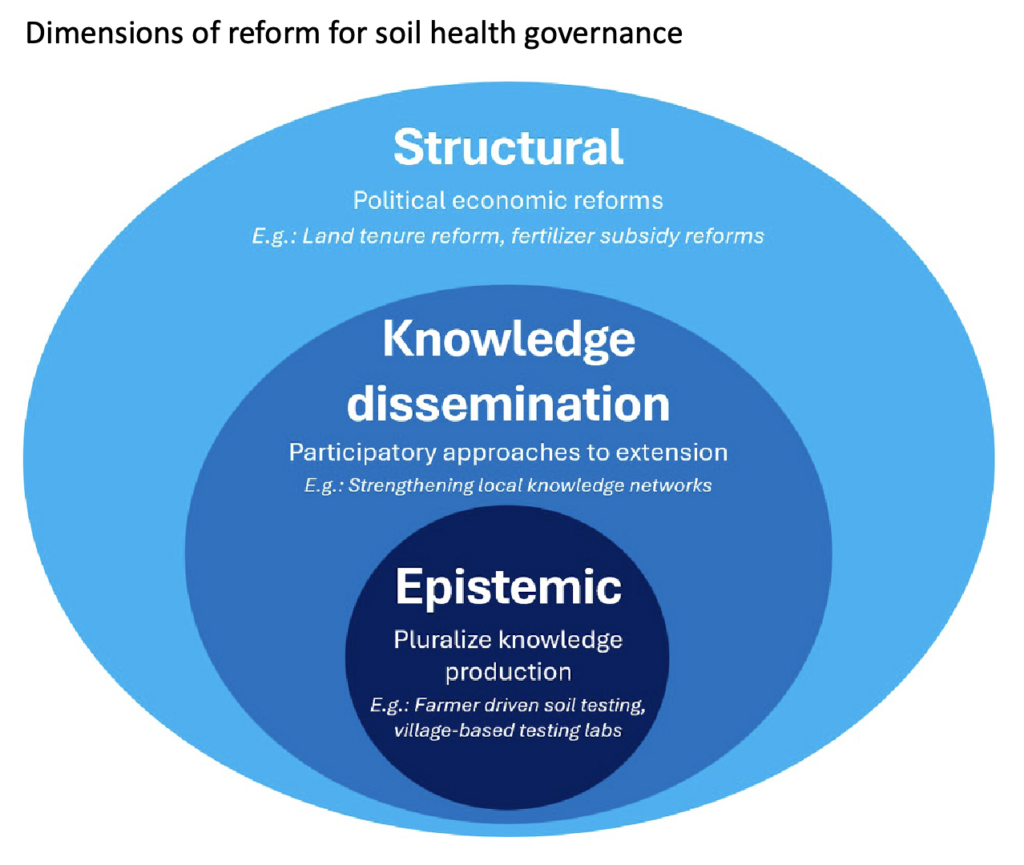
Our analysis identifies three issues that we explore below:
1. The SHC scheme measures what is easiest to quantify and organize in a nationwide program. The indicators on the card focus largely on soil chemistry, particularly nitrogen, phosphorus, and potassium concentrations, and provide recommendations for fertilizer use. Important biological indicators, such as microbial activity and soil respiration, are absent, largely because they are difficult and costly to assess at a national scale. As a result, the scheme offers only a partial picture of soil health.
2. The scheme relies on a top-down institutional approach to information dissemination. Farmers are not active participants in what is measured, where samples are collected, or how recommendations are generated. Studies show that farmers are much more likely to adopt recommendations when soil testing is accompanied by extension support and dialogue.
3. The effectiveness of the SHC scheme is constrained by broader structural factors. India’s fertilizer subsidy system, particularly for urea, keeps prices artificially low, making alternative soil health practices less attractive economically. At the same time, insecure land tenure discourages farmers from making investments that may reduce yields in the short term but improve soil quality and yields over the long run.
Figure 1
Conclusion
The SHC scheme illustrates how a transformative concept such as a focus on soil health can become bureaucratized. To reach millions of farmers, the program reduced soil health to a standardized set of indicators and recommendations that could be organized in a centralized top-down scheme. While impressive in scale, this approach leaves little room for local knowledge. Our research suggests that future efforts should move beyond standardized national reporting systems and instead work more directly with farmers through participatory, locally driven approaches. In doing so, soil health could become a catalyst for broader agricultural transformation.
Ritwick Ghosh is an Assistant Professor in the North Carolina State University College of Natural Resources; Wei Zhang is a Senior Research Fellow and Research Lead on Ecosystem Health and Biodiversity with IFPRI’s Agrifood Innovation and Resilience (AIR) Unit; Upeksha Hettiarchchi is an AIR Research Analyst; Francis Phillip is an AIR Research Intern; Ryan Nehring is an AIR Research Fellow. Opinions are the authors‘.
This work was supported by the CGIAR Science Program on Multifunctional Landscapes.
Reference:
Ghosh, Ritwick; Nehring, Ryan; and Zhang, Wei. 2026. After quantification: Insights from India’s Soil Health Card scheme. Land Use Policy 169 (October 2026): 108147. https://doi.org/10.1016/j.landusepol.2026.108147