




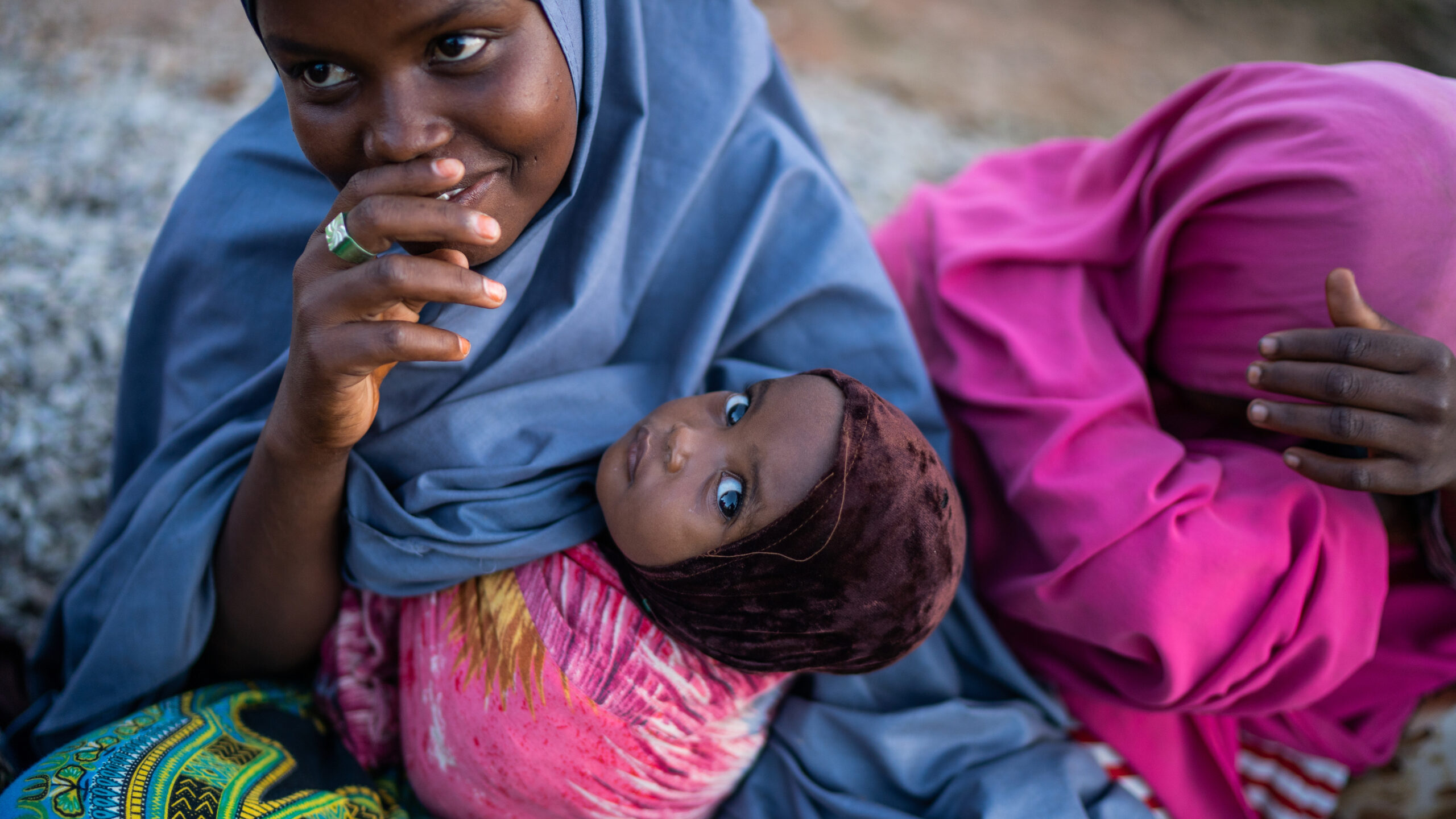
Globally, one in every seven people is now a migrant or a refugee. Displacement has reached record highs, reshaping communities worldwide. As of 2024, close to 120 million people had been forcibly displaced and more than 300 million were living outside their country of birth. By 2050, projections indicate that over 200 million people will be displaced in their own countries as a result of climate change alone.
These large-scale movements are driven by a complex mix of increasingly protracted conflicts, poverty, intensifying climate change impacts, and economic shocks—and continue to worsen, driving more and more people from their communities.
Moreover, under these pressures, vulnerabilities compound: Four in five displaced people face acute food insecurity, and women are disproportionately affected, with heightened risks of violence and exploitation both along their journeys and in host settings. Thus, displacement poses serious threats to survival, dignity, and basic human rights.
In addition to forced displacement, people worldwide are also making difficult choices about whether to migrate—internally or across national borders—even when not compelled by immediate threats. These decisions emerge from a complex web of push and pull factors, creating both opportunities and challenges for migrants themselves and for the communities that receive them.
Given the scale of these problems, there is an urgent need to better understand and address the forces that push or pull people from their homes. Yet policymakers and researchers face serious obstacles that get in the way of finding solutions; for example, traditional datasets do not always fully capture how and why populations move. Meanwhile, the funding needed to manage and study these critical challenges is declining, even amid growing need.
As part of IFPRI’s Fragility to Stability Policy Seminar Series, CGIAR and IFPRI hosted a policy seminar—Mobility in a Fragile World: Evidence to Inform Policy—on September 18, 2025 at IFPRI headquarters in Washington, DC. Researchers and implementing partners came together in this hybrid event to explore the pressures collectively shaping migration and displacement—and to identify effective policy responses to mobility of different forms. The discussions showcased cutting-edge research from CGIAR programs and from academia, as well as critical insights from the United Nations High Commissioner for Refugees (UNHCR), the International Organization for Migration (IOM), and the Center for Global Development (CGD).
New evidence and tools to inform migration policy
Anna Maria Mayda, Professor of Economics at Georgetown University and incoming Director of the Institute for the Study of International Migration, noted that refugees can have uneven impacts on host communities. While they may compete with agricultural workers, contribute to rising local prices, and strain health care systems, they also benefit farmers who can hire them and stimulate investments in infrastructure to support expanding local populations. Mayda emphasized that refugee-inclusive policies (those that ensure benefits are shared between refugees and host communities) can reduce tensions and even garner political support for incumbent policymakers.
Several speakers highlighted innovative tools for anticipating and managing migration patterns. Silvia Peracchi, Postdoctoral Fellow at the Institute of Economics and Social Research (IRES) and UCLouvain, presented a new harmonized global data and machine learning framework to predict internal migration. Her work shows that demographic and geographic factors are the strongest drivers, and she stressed the importance of anticipating domestic migration flows, which exceed international ones.
Francisco Ceballos, IFPRI Research Fellow, presented the Migration Propensity Index (MPI), a tool based on a small set of indirect, easy-to-ask household questions that can predict both international and domestic migration in Central America—providing policymakers with practical tools to target prevention and support programs more effectively. Thomas Ginn, CGD Research Fellow, presented evidence that expanding refugee work rights benefits both the refugees and their host communities. Studies on this issue conducted in Colombia, Jordan, and Germany demonstrate higher refugee incomes, reduced aid dependence, and fiscal savings—making inclusive labor policies both cost-effective and politically feasible when paired with benefit-sharing for local communities.
Panel insights: Bridging research and policy in migration and displacement
Next, the event brought practitioners to the stage to share their experiences on the ground, working in fragile and conflict-affected settings facing displacement and heavy in- and out-migration.
Stronger bridges must be built between researchers, policymakers, and donors to ensure that responses to migration and displacement are both evidence-driven and people-centered, panelists agreed. Andrew Harper, UNHCR Special Advisor on Climate Action, flagged the extreme value of research to the organization’s mission, noting that humanitarian action alone is not enough to address the realities of displacement in fragile contexts. He suggested that while emergency responses often succeed in the first months of a crisis, they often quickly fade, leaving people without support.
“There might be a relatively quick emergency response … but after 2–3–4 months, there’s no support in the resilience or getting people to adapt to an increasingly hostile environment,” Harper said. “And so, what we have seen is that the traditional approach of humanitarian agencies or protection agencies like UNHCR is not sufficient. We need to be bringing in the players who have a long-term commitment to human security, to development, to climate adaptation and resilience.”
Panelists stressed the importance of having good data to produce evidence that can support better policy design. Damien Jusselme, Head of Data Science and Analytics at IOM, highlighted the promise and opportunities of non-traditional data sources to aid the understanding of population movements, monitor informal settlement, and assess damages after natural disasters—which supports more inclusive and equitable policy responses to displacement.
“Conflict and insecurity will render traditional data collection methods like face-to-face surveys too risky … making it difficult to understand the scale of displacement, [or] the specific needs of a population,” Jusselme said. To fill these gaps, he pointed to the promise of innovative datasets: “I think leveraging more innovative data sources is critical. Trying to get larger data sets from sources like mobile phone records, [or] social media to get that sense of population movements [and] satellite imagery is also a good way of getting information to monitor growth of informal settlements or assessing damages after an earthquake.”
Combining these different data sources can help policymakers devise “less reactive, more proactive type of actions,” he said, “ultimately allowing our decision-makers and member states to take more evidence-based decisions.”
Jean-François Maystadt, IRES Research Associate and Professor at UC Louvain, added a note of caution on the growing reliance on big data for migration research. “I can get very excited about mobile phone data, social media data to track population movement. But also, I’m a bit critical,” he said. Problems include the question of how widely accessible data are to those who need them and their reliability and representativeness. Such caveats must be considered when using them in policymaking, Maystadt said. The way forward, he argued, is collaborative work with operational actors to ensure proper safeguards are in place, while also rigorously assessing the effectiveness of interventions so that evidence can directly inform more inclusive and context-sensitive responses.
Such knowledge gaps indicate the urgent need for action: We need stronger bridges between research and policy and more sustained engagement across sectors.
However, amid the daunting statistics and complexity of forced migration, there are bright spots—evidence-based solutions that work. Refugee work rights yield diverse benefits. Fielding simple household questionnaires can enable policymakers to better anticipate migration and design more targeted support. And thanks to new technologies—satellite imagery, mobile phone data, and machine learning—we are gaining unprecedented visibility into how and where people move, even in areas where data have long been scarce or unreliable. This is transforming how policymakers plan for and respond to human mobility.
In every context of crisis, individuals and communities are rebuilding, offering lessons in resilience, solidarity, and adaptation. As researchers, policymakers, and practitioners, our role is to ensure these stories are not exceptions, but the norm. With the right data, the right partnerships, and the right policies, we can move from reaction to readiness.
Katrina Kosec is a Senior Research Fellow with IFPRI’s Poverty, Gender, and Inclusion (PGI) Unit and Interim Lead of CGIAR’s research on Fragile and Conflict-Affected Food Systems; Lucia Carrillo is a PGI Research Analyst. Opinions are the authors’.