





India stands at a critical juncture in its agricultural transformation. With over 60% of the population dependent on agrifood systems for their livelihoods and the Agriculture, Forestry, and Other Land Use (AFOLU) sector accounting for 14% of the country’s greenhouse gas (GHG) emissions, the challenge is no longer a choice between agricultural and economic growth and sustainability, but the need to find a pathway that ensures agricultural growth and livelihoods while increasing the sustainability of the country’s food production systems.
Agriculture plays a major role in this transition to a low-carbon development pathway, particularly in India. India reported GHG emissions from the AFOLU sector of 334 million metric tons (MT) CO2 equivalent in 2020. Croplands and forests offer a high potential as carbon sinks, sequestering about 22% of India’s total CO2 emissions in 2020 and offering an additional carbon sink of 2.5-3 billion MT CO2 equivalent through improvements of degraded lands and expansion of forests and tree cover by 2030.
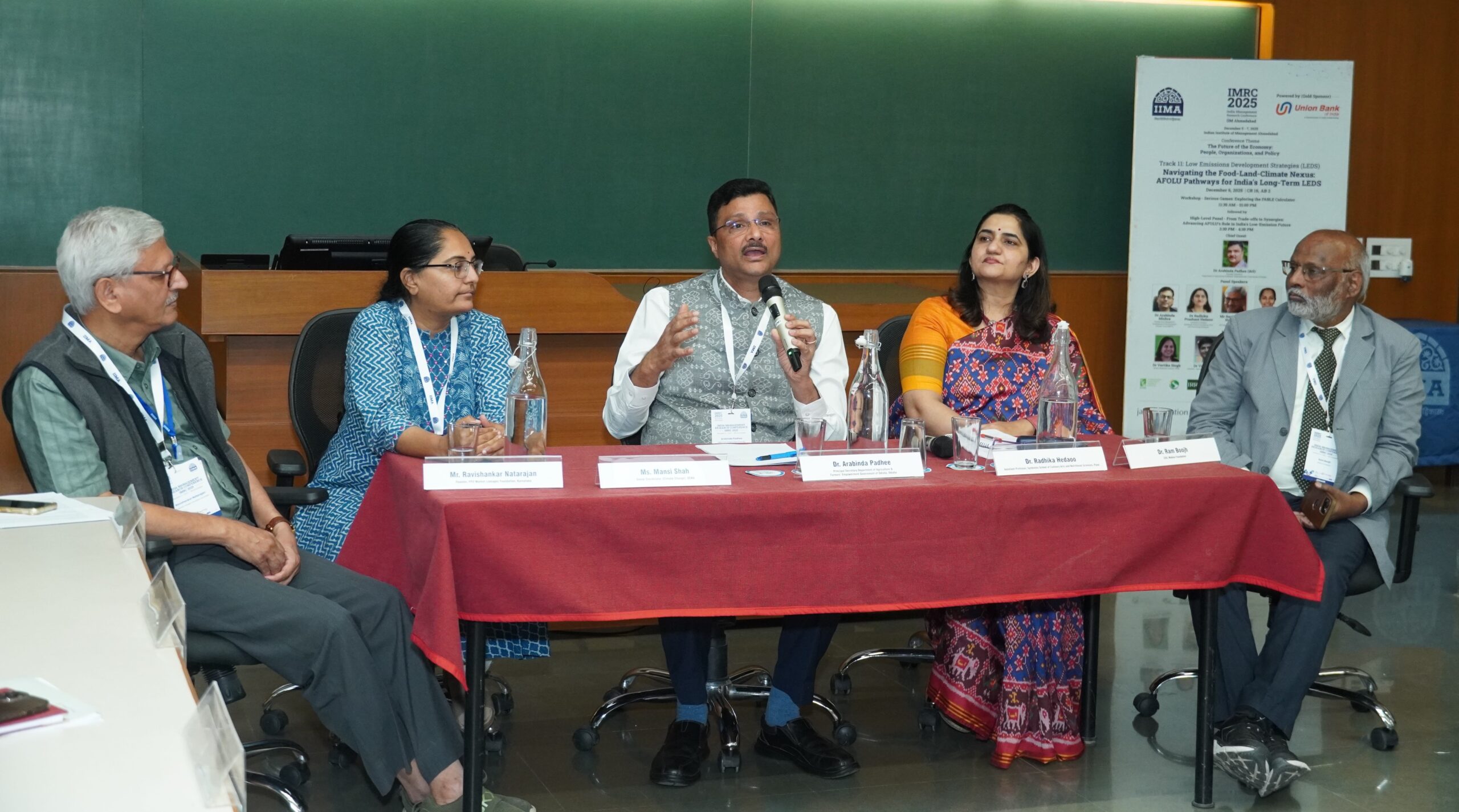
To discuss these opportunities, leading voices from policy, research, grassroots organizations, and the private sector gathered at the Indian Institute of Management Ahmedabad (IIMA) on December 6 for a panel titled From Trade-offs to Synergies: Advancing AFOLU’s Role in India’s Low-Emission Future. The event was co-organized by IIMA, IFPRI, and the International Rice Research Institute (IRRI), under the umbrella of the India Management Research Conference.
Participants addressed a fundamental challenge: How can India meet its climate commitments while ensuring food security, protecting farmer livelihoods, and advancing sustainable development? Drawing on examples from Odisha, Gujarat, Bihar, and Maharashtra states, panelists shared experiences across sectors offering solutions, including empowering women farmers, reviving forgotten foods, localizing diets using regionally and seasonally grown foods, connecting farmers to fair markets, and conserving ecological diversity.
Climate-smart agriculture is not an abstract ideal but a practical approach that can be improved by continuous testing and refinement, participants agreed. Directly managed by states and operating within the central government’s framework, agriculture in India presents an opportunity to balance national coordination with increased flexibility for states to customize programs and policies based on local contexts. Odisha is a living laboratory where several policy solutions are being tested simultaneously, but progress depends on political will to drive reforms.
Among several highlights, the session offered three key takeaways with examples offered by panelists to suggest that possibilities of “transformational” adaptation exist.
1. The importance of crop diversity
Crop diversification is a crucial strategy towards diversifying consumption. Analyses from India’s Household Consumption Expenditure Survey reveal that Indian diets have increasingly shifted towards consumption of grains and ultra-processed foods—two distinct cases of poor quality diets.
To address this, policymakers and civil society groups are making efforts to increase dietary diversity through a variety of interventions. A key focus is promoting the balanced consumption of diverse nutritious foods, including coarse grains and fruits and vegetables, per recommendations from national and global organizations such as the EAT-Lancet Commission. Millets and other coarse grains grown in India offer nutritional benefits, thrive in rainfed areas, and emit less GHG than many other staple crops.
These also provide buffers to farmers against the impacts of climate change. Regions such as Odisha with diverse cropping systems with many smallholders have maintained production over the past two decades, despite a number of extreme weather events. Diverse cropping systems, including landrace (locally-adapted) varieties of rice and wheat, offer resilience during adverse weather shocks, especially when grown in regions historically suited to their production.
Releasing landrace varieties as notified varieties has enabled farmers to conserve crops that perform during adverse weather conditions. Participants suggested extending conservation beyond millets by mapping, characterizing, and conserving diverse local variants of pulses such as moong, urad, and arhar.
From the demand side, grassroots experiments like Poshan Jatra and Govardhan Eco-village‘s Thali model in Maharashtra demonstrate participatory approaches where local communities take ownership in making traditional foods desirable. To further increase demand for more diverse crops and foods, panelist Ravishankar Natrajan, Founder, FPO Market Linkages Foundation, suggested labeling food items as “safe-to-consume” rather than “organic” or “sustainably produced,” noting that this could help scale up demand and avoid the premium pricing that currently makes organic foods accessible only to select consumers.
2. Building stronger markets
Linkages with markets are critical to ensure the economic viability of sustainable agriculture. While supply-side measures aim at boosting production, market constraints present major barriers for smallholder farmers.
Arabinda Mishra, Founder Trustee and Chairperson, Development and Environment Futures Trust (DEFT), noted the continuing success of millet cultivation in Odisha, including farmers’ willingness to adapt to sustainable, climate-smart techniques when incentives are made available.
Yet the current Indian government approach often asks too much of farmers without providing sufficient support, he said. Many farmers are asked to produce crops that do not yet have well-established markets or have specialized markets with high barriers to entry. Farmers also face rising insurance costs from climate impacts. The goal of seeking to create public goods in the form of resilience with private farmers bearing the costs may be unreasonable, he said, suggesting we need smart ways of providing support for farmers in the transition to a low-carbon pathway.
Mishra linked this to the idea of “custodian farmers,” suggesting instruments like stewardship fees for farmers who maintain traditional systems and seeds, and startup capital or transition financing as one-time support. The Self Employed Women’s Association (SEWA), he said, already has a “a pool of blended finance instruments” combining soft loans, equity grants, and patient capital that enables women farmers to adopt new technologies.
3. Empowering women farmers
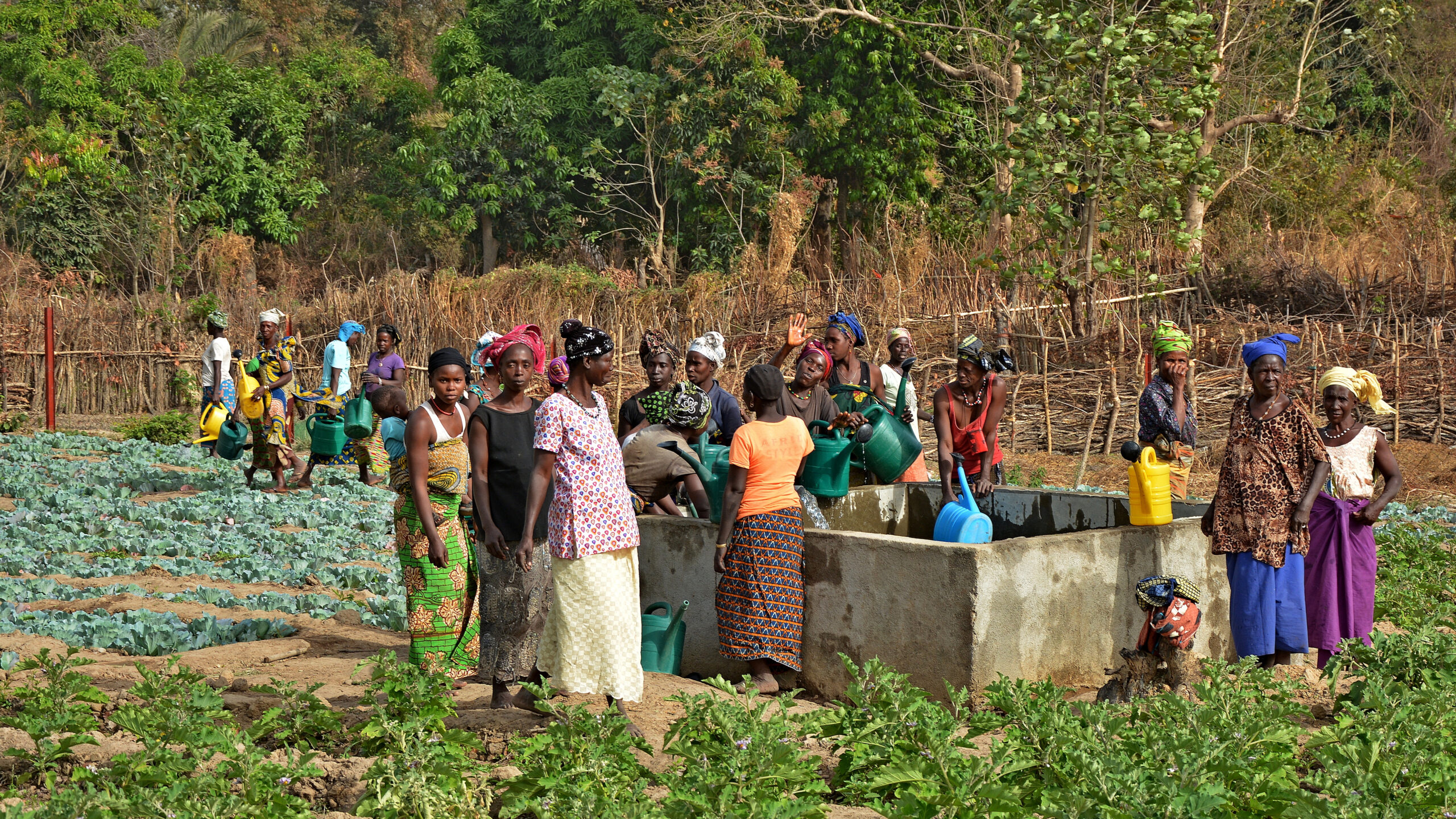
Women farmers must play a key role in bringing about a sustainable agricultural transformation. Using examples from her organization’s work with millions of women farmers in India, SEWA Senior Coordinator Mansi Shah stressed that the purposeful inclusion of women farmers across sectors, schemes, and policies is essential to this transition.
More often than not, women are forced to sell their produce in distress due to small volumes and poor market linkages. SEWA’s agricultural campaign rests on four pillars: “capacity building, access to inputs, including fertilizers, access to finance, and access to market,” and has had success in empowering women farmers, she said. SEWA’s tested model positions young women as change-makers in agriculture. Women are organized into clusters to achieve economies of scale, for example, by maintaining their own seed and fertilizer banks. They produce and sell biopesticides and biofertilizers within villages at affordable rates, ensuring fellow women farmers have access while creating dignified livelihood opportunities for younger members.
From trade-offs to synergies
The discussion closed on a note of optimism, highlighting enormous possibilities at the intersection of traditional knowledge systems, innovative policy, and inclusion of youth. Technology, from genetically modified seeds such as Bt cotton to artificial intelligence, was recognized as both a disruptor and enabler in the transformation to a low-carbon future.
Regenerative, climate-friendly agriculture in India cannot be built through devising new schemes alone. It must be rooted in traditional knowledge, particularly women’s expertise, diverse cropping systems, seed-preservation practices, and heritage landscapes that already integrate farming, biodiversity, and culture, such as the Chilika Wetlands in Odisha, as outlined by Ram Boojh, CEO/Advisor, Mobius Foundation. Radhika Hedaoo, Assistant Professor, Symbiosis International University, suggested a CLAN approach—Climate smart, Livelihood smart, Agricultural smart, and Nutritionally sensitive interventions.
What emerged from this rich dialogue wasn’t a simple roadmap but something more valuable, a recognition that India’s AFOLU transformation requires simultaneous action across multiple fronts: policy frameworks that create enabling conditions, market systems that reward sustainable practices, research that illuminates synergies, grassroots organizations that ensure equity, and farmers who ultimately make daily decisions about the land and their livelihoods. . It requires intentional integration, courageous policy choices, patient investment in alternative models, and above all, centering the voices and needs of those closest to the land at the forefront.
Vartika Singh is a Senior Research Analyst with IFPRI’s Natural Resources and Resilience Unit based in New Delhi; Arabinda Padhee currently serves as Principal Secretary, Department of Agriculture and Farmers’ Empowerment, Government of Odisha. Opinions are the authors’.