





Key takeaways
- AI can expand access to finance for smallholders, a key element of food system transformation. AI tools can improve risk assessment, lower costs, and help lenders reach farmers without traditional credit histories.
- Real-world applications show strong potential. Tools using satellite data, machine learning, and digital images are increasing credit uptake, insurance adoption, and investment decisions.
- Risks and gaps must be addressed. Limited data, unequal access—especially for women—and weak governance can deepen exclusion without responsible design and oversight.
Improving smallholders’ access to finance is a crucial element of food system transformation. Farmers in many low- and middle-income countries (LMICs) lack consistent access to loans, insurance, and other important financial services, leaving them more vulnerable to shocks and unable to build resilience or invest in more innovative, productive, and sustainable practices.
Among the obstacles they face are high transaction and monitoring costs (because borrowers are geographically dispersed), small loans, and lenders who often lack the tools to assess risk effectively. Insurance products are often poorly designed for small farmers’ needs. Meanwhile, for financial institutions, agriculture presents serious lending risks, including weather shocks, pests, and disease outbreaks. Other problems include policy instability, weak infrastructure, and macroeconomic volatility in LMICs.
Artificial intelligence (AI) applications show promise in addressing these constraints by improving how financial institutions assess, price, and manage agricultural risk. The experience of IFPRI and partners in AI projects targeting smallholders in several countries shows that AI applications can reduce financial uncertainty and make returns more predictable for banks, insurers, investors, and other value chain actors, ultimately helping smallholders gain access to more reliable, consistent financial support.
AI tools are increasingly employed across food systems and in various dimensions of food system transformation, from precision farming to automating and expanding extension advisory services. However, they face a number of obstacles, particularly in LMICs, including limited access to technology, incomplete national and local data essential for model training, and issues of reliability and trust. These challenges must be weighed and addressed in any AI project targeting smallholders.
Potential advantages
IFPRI and its partners are exploring the role of AI systems in financial services across a range of projects, seeing potential to:
- Improve timely risk and returns assessment of banking and insurance products.
- Lower initial and ongoing transaction and monitoring costs in the delivery of financial services.
- Access more accurate and granular information at faster and lower cost, improving decision-making and expanding outreach to underserved clients and markets.
- Improve communication and engagement between financial institutions and clients through low cost, AI-powered language tools, chat-based advisory, and automated support.
How AI is being used to transform smallholder agricultural finance
AI-enabled lending systems can help expand formal credit access for farmers lacking traditional collateral or financial histories.
Digital credit assessment
Dvara E-Registry’s KhetScore, developed with IFPRI’s collaboration, is a digital credit assessment tool to expand formal lending to smallholder farmers in Odisha, India. It combines georeferenced farmer profiles and satellite data to estimate productivity and incorporates insurance to reduce repayment risk. An impact evaluation found that KhetScore increased formal credit uptake by about 20 percentage points, boosted insurance enrollment, raised agricultural profits, and improved loan repayment—leading to a larger scale-up of the tool.
Crop scoring
ACRE Africa, a Kenyan-based insurance service provider, is scaling TARA (Tool for Agricultural Risk Assessment) with IFPRI support—an AI-based crop risk scoring platform designed to support agricultural lenders, insurers, and development organizations across East and Southern Africa. TARA leverages climate data combined with agronomic modeling to assess crop suitability, monitor loan portfolios, and guide financial decision-making. It transforms raw climate and field data into actionable insights, such as predicting yields, estimating farmer revenue and return on investment, and identifying climate-related risks before loans are issued. By integrating climate intelligence with financial tools, TARA helps institutions manage risk more effectively while enabling smallholder farmers to access climate-informed loans and insurance products.
Assessing risk and return for agricultural technologies
AI modeling also has the potential to inform the decisions of impact and climate investors on a broader scale. For example, IFPRI researchers are currently building a tool that will harmonize data from evaluations of agricultural technologies across contexts and employ AI-based modeling to understand the risk and return to investment in these technologies across different weather scenarios. Such a tool can help investors make more informed decisions while better gauging risks from droughts, extreme storms, and other weather events—ultimately driving more capital to food systems.
AI can further strengthen agricultural finance by helping reduce basis risk and lower verification costs in agricultural insurance, often linked with agricultural credit to de-risk investments.
Picture-based insurance
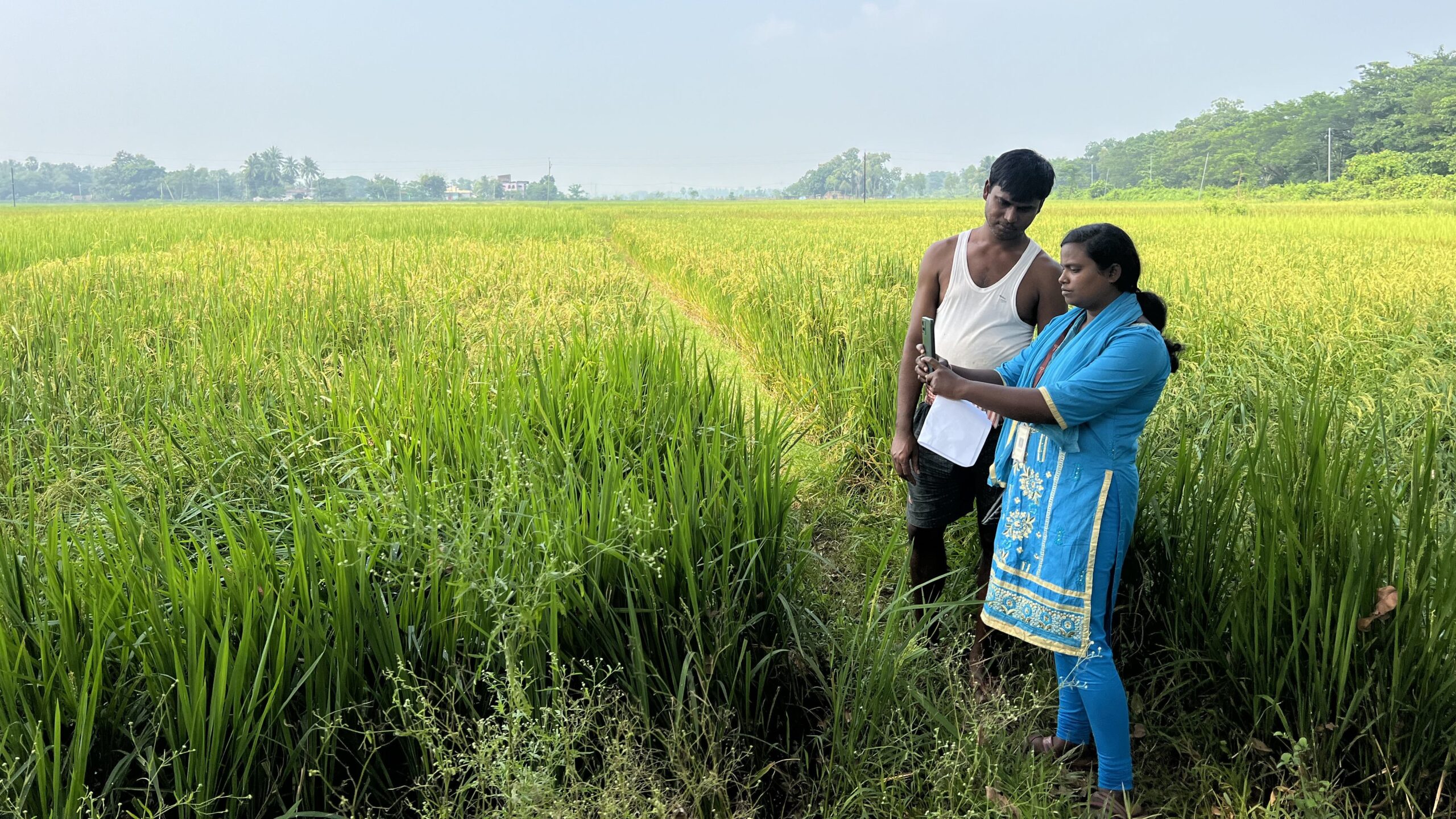
IFPRI’s picture-based insurance (PBI) method uses digital technology and AI to accurately measure crop losses. Farmers upload geotagged and time-stamped smartphone images of their fields throughout the growing season. Computer vision models analyze these images to monitor crop conditions and assess damage. By allowing insurers to verify losses remotely rather than sending agents into the field, claims verification becomes cheaper and payouts become more reliable.
Evidence from IFPRI’s PBI work shows clear gains in uptake. In Kenya, a randomized evaluation with ACRE Africa found that PBI significantly increased insurance adoption relative to weather index products. Complementary evidence from Ethiopia similarly documented that PBI improved insurance take-up, trust, and the perceived fairness of insurance payouts, reinforcing the case that visual verification can overcome key barriers to adoption.
Smallholder credit profiles
AI systems can also help analyze farmers’ financial behavior in order to build better lending systems. Kenya-based Apollo Agriculture has created a set of tools to expand credit access for smallholders. It began by offering high-risk loans to farmers with the aim of generating repayment data at scale to build a lending algorithm. It now uses machine learning to analyze data, including satellite imagery of fields, agronomic information, and mobile repayment behavior, to assess farmers’ credit risk and improve the accuracy of the lending algorithm. The resulting risk assessments are used to generate credit profiles for small-scale producers who may otherwise be excluded from formal financing, enabling more than 350,000 farmers to access credit for quality inputs and to improve productivity.
Risks and governance challenges
Despite its potential, the use of AI in financial products in food systems raises significant social, ethical, and governance concerns. AI-driven credit scoring systems may reinforce existing inequalities by excluding individuals with limited financial histories and making it difficult for borrowers to overcome low scores. Women in LMICs are particularly vulnerable. Compared to men, they typically have less access to technology, weaker land tenure rights, and limited decision-making power.
Similarly, although generative AI is emerging as a key enabling technology in customer service—enhancing, for instance, document processing and multilingual client interactions at an unprecedented scale—language barriers across culturally diverse LMICs can deepen exclusion.
Many AI systems are primarily trained in dominant global languages and perform poorly in local languages and dialects. Smartphone ownership and reliable connectivity are also critical to unlocking many of these benefits, and many smallholders still lack access to this critical infrastructure. In addition, limited transparency and concerns about misinformation can reduce farmers’ trust in AI-enabled finance, particularly when systems lack the local knowledge and human engagement provided through traditional in-person banking models. Thus, it is essential to train AI finance models in relevant contexts, as needs and outcomes vary significantly across different environments.
Addressing these challenges requires that AI systems in agricultural finance be designed and deployed responsibly. This includes ensuring transparency, fairness, data privacy, accountability, and inclusion, so that AI-driven financial services do not reinforce existing inequalities or exclude vulnerable farmers with limited digital footprints. In practice, this means financial institutions and service providers need explainable and context-specific approaches aligned with responsible AI principles, supported by measures such as clear recommendations, bias monitoring, strong data protection, human oversight, and the engagement of farmers from different environments throughout the development and use of AI systems.
Conclusion
AI alone will not solve the financing challenges facing food systems, but these applications can become powerful enablers of transformation by making agricultural risk more visible, measurable, and manageable. Yet many AI-enabled finance solutions in agriculture remain at an early stage of implementation, and evidence on impact is still emerging. Thus, it would be a mistake to view AI as an all-purpose solution. Rather, it should be seen as an evolving set of tools that require continuous testing, learning, and adaptation across different agricultural and financial contexts.
Amid the ongoing expansion of AI technologies in agrifood systems, research institutions such as IFPRI, CGIAR, and their partners will play a central role in shaping how these tools are developed, evaluated, and applied in practice. However, generative AI systems present particular accountability challenges. Their outputs are probabilistic and thus often non-replicable; models are continuously evolving. Greater transparency and accountability are critical for building trust among users and investors. In parallel, there is a need for more rigorous impact evaluations that generate causal evidence on the extent to which AI-driven tools actually contribute to food systems transformation, improve financial inclusion, and reduce, rather than exacerbate, existing social and economic inequities.
Tamsin Zandstra is a Research Analyst with IFPRI’s Director General’s Office; Berber Kramer and Kate Ambler are Senior Research Fellows with IFPRI’s Markets, Trade, and Institutions Unit. Opinions are the authors’.