





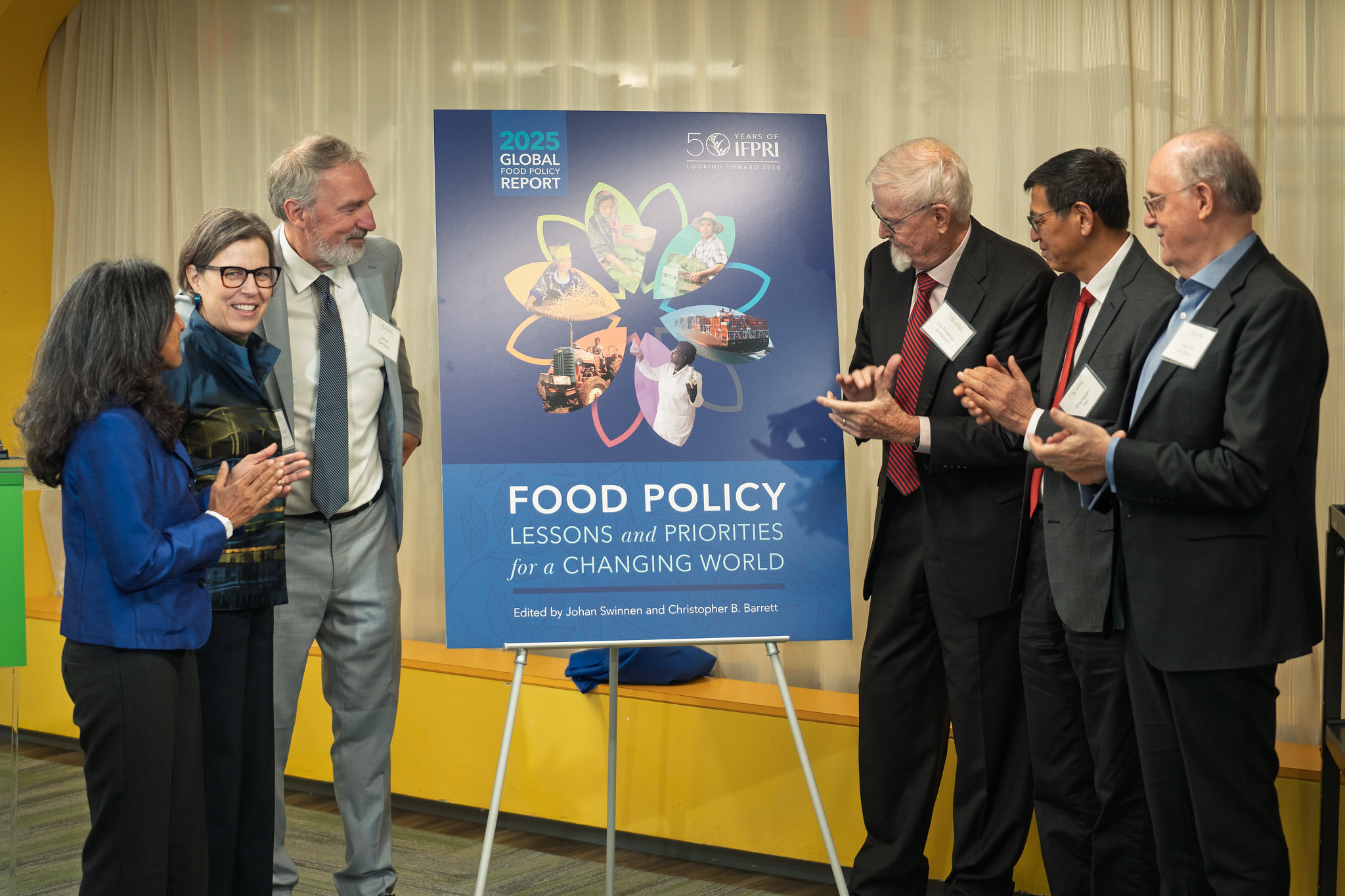
IFPRI’s 2025 Global Food Policy Report—which received the American Agricultural Economics Association’s (AAEA) Quality of Communication Award on July 27—continues to spark discussion about the future of food systems and the role of evidence-based policymaking. Edited by IFPRI Director General Johan Swinnen and Cornell University economist Christopher B. Barrett, the report marked IFPRI’s 50th anniversary by taking stock of five decades of advances in food policy and considering the challenges that lie ahead for global agrifood systems. In this conversation, Swinnen and Barrett discuss the report’s key findings, emerging trends, the value of interdisciplinary research, and how evidence can help guide policymaking in an increasingly uncertain world.
Q: The GFPR focused on emerging trends in global food systems that policymakers should be paying attention to. Which ones strike you as most important, and are there any additional ones that you would put on the table now?
Christopher B. Barrett: Food prices are on the rise again due to new supply chain disruptions; the FAO real price index is now 74% above its December 1999 all-time low! This underscores the 2025 GFPR’s emphasis on the importance of sustainable productivity growth, especially in today’s import-dependent economies in which most food demand growth to 2050 will occur. Above all, that’s in Africa, Central America, and South Asia. And this task requires mobilizing more R&D investments from public, philanthropic, and private sources, identifying and overcoming barriers to the diffusion of promising innovations through food value chains, from farm to table, and especially for nutrient-rich foods. At the same time, rising acute malnutrition raises a humanitarian imperative. Global leaders must embrace both tasks simultaneously. IFPRI is perhaps uniquely placed to inform actions in both spaces.

Johan Swinnen: The GFPR covers many aspects of food policy, ranging from nutrition and trade to poverty reduction, technology adoption, and other major trends. A particularly worrying development is the global increase of shocks and volatility. We are seeing a rise in conflicts, coupled with an increasing concentration of food-insecure populations in conflict-affected areas. IFPRI is closely following the ramifications of the conflict in the Middle East and other shocks to food systems, both in our country-level engagement and our global assessments. Building resilience to shocks, volatility, and fragility requires political commitment, funding, partnerships across borders and sectors, and time. These developments underscore the call to combine short-term relief with long-term development efforts.
The 2025 GFPR report examined how new technologies such as AI create opportunities and challenges. IFPRI is quite focused on how AI impacts food systems and on the use of these tools in food policy research. AI poses many pressing questions, ranging from the energy use and environmental impact of data centers, the effects of AI-powered crop breeding and biotechnologies, and the need for AI governance and ethics. I’m excited that IFPRI has decided to dedicate our 2027 GFPR to this important topic.
Q: The 2025 GFPR brings together a wide range of research from across disciplines. Why is this interdisciplinary approach important?
CBB: High-stakes problems in the world rarely respect the boundaries of academic disciplines. We need tools and insights from multiple disciplines to overcome the challenges confronting agrifood systems globally today.
Q: What do you think made the Global Food Policy Report 2025 stand out as a communications product?
JS: To commemorate IFPRI’s 50th anniversary year, this GFPR takes a sweeping look across time: it is unique in that it looks back over the past 50 years to assess what we have learned and achieved in food policy but also looks forward to upcoming challenges. The GFPR was more than a book; it drove a broader communications and engagement effort during a time of significant upheaval in global food security and development. Launch events at our headquarters in Washington, DC, and a number of countries around the world engaged with local stakeholders, policymakers, and analysts to connect our findings with local and global problems and to discuss the report’s implications. Our experience shows that evidence-based policy continues to matter as the world transforms around us.
Q: Where do you believe food policy research can make the greatest difference in today’s world? How can we strengthen the link between research and real-world impact?
JS: In an era of overlapping crises, we must ensure that everyone, from farming households to policymakers at the highest level, is equipped to respond to shocks. To build resilience, vulnerable populations and countries must have the capacity to act. That means closing the gap between evidence and implementation. We know that evidence is important, but it alone is not enough to convince policymakers to make a needed change. Research can illuminate the obstacles and the most effective actions to address them. International research organizations like IFPRI can also have a role in shaping dialogue, sharing capacity, and facilitating relationships among national research institutions, development partners, government ministries, and the private sector to deliver on shared priorities.
CBB: The rate of technological advances—from new genomic techniques and artificial intelligence to synthetic biology and beyond—far outpaces that of their safe deployment. Policy measures and institutional innovations can help unlock the considerable latent potential for healthy, equitable, resilient, and sustainable agrifood systems transformation. Past episodes of rapid, effective transformation have all depended on identifying and implementing socio-technical innovation bundles well-suited to specific ecological and cultural contexts. Research must engage deeply with communities, market and civil society actors, and policy influencers from the design stage to identify, evaluate, adapt, and scale bundles that work.