




Key takeaways
- High sugar prices in India are largely driven by domestic factors. Falling production, low stocks, and tight supplies matter more than global market trends.
- Ethanol demand is squeezing sugar supplies. Continued diversion of sugarcane to ethanol has added pressure to an already tight market.
- More flexible policies could stabilize prices. Better stock management, adaptive blending targets, and alternative feedstocks could reduce future shocks.
A spike in domestic sugar prices in India has triggered a contentious political debate and finger-pointing. While the opposition blames national policies that divert a significant portion of sugar juice to ethanol production, government briefings are blaming alleged hoarding by sugar mills to conserve their stocks ahead of the upcoming festive season.
To put this debate in perspective, one is forced to look at the hard evidence. From January to July 2026, sugar prices increased by an average of 3% compared to the same period the previous year. In August alone, the increase was 30% over July’s price (Figure 1). During the same period, India’s annual overall inflation rate was 4.95% (S&P Macro data, July 2026).
Figure 1
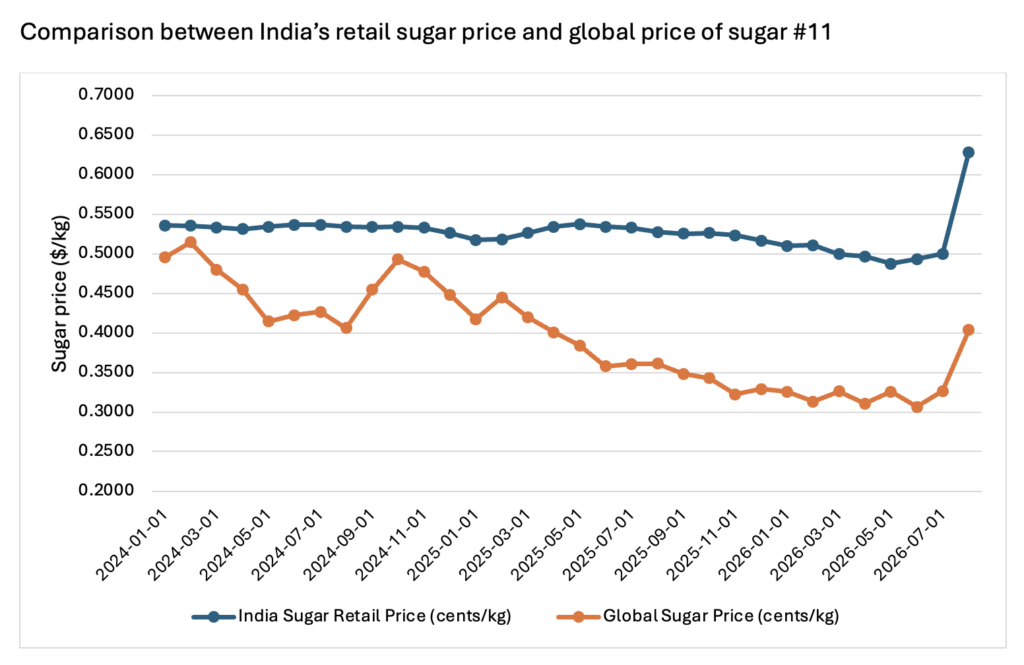
This does coincide with a spike in the global price of sugar. After a period of substantial decline, international sugar prices leveled off and then rose in August by more than 12% (Figure 1). Higher crude oil prices, amid already tightening supplies, were the main cause. These have increased returns for biofuel production, raising demand for sugar (a major biofuels feedstock) and driving up prices. Persistent hot and dry weather in the European Union, another major sugar producer, added to the pressure on international prices. Concerns about El Niño-related weather in India and Thailand added further pressure.
However, the main source of India’s price spike is domestic. In a bid to protect the Indian domestic market, on May 14, 2026, the Indian government prohibited exports of raw and refined sugar through September (with some relaxation allowed under special conditions). The export ban has largely insulated India from international price volatility, leaving domestic sugar prices to be largely determined by local factors.
What is driving the sudden hike in India’s sugar prices?
As Figure 1 shows, sugar prices in India’s domestic market continued to rise despite the export ban. Multiple factors have contributed to a perfect storm driving this sudden sugar price escalation: the government’s ethanol blending policy, lower stocks, lower production, increased demand during the festive season, and hoarding by some industries. We analyze each of them below.
Reduced production
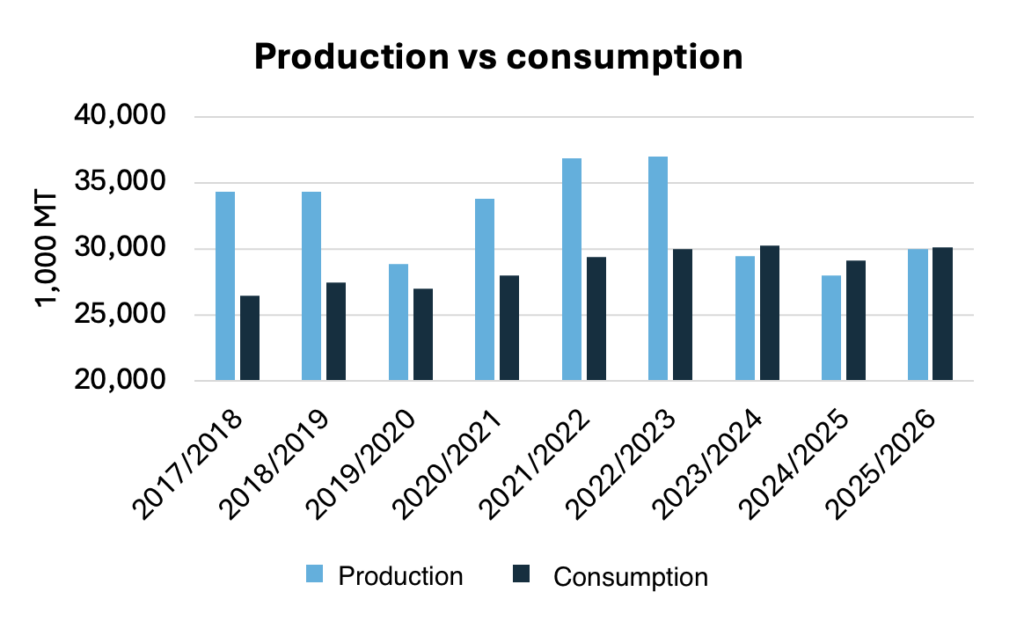
While the consumption demand for sugar has remained stable at around 30 million MT (USDA-PSD, 2026) over the last several years, weather-dependent production has fluctuated (Figure 2). Crop years 2021, 2022, and 2023 had record sugar production. But since then, sugar production has barely met domestic consumption needs. Government estimates suggest that current season production will be less than expected: instead of an expected output of 34.3 million MT, it is expected to total around 30.6 million MT in 2025/26. As a result, India’s usual sugar surplus has shrunk quite significantly—a worrying sign that cannot be ignored.
Figure 2
Export scenario
Surplus production for crop years 2019 through 2023 enabled India to export sugar; such surpluses shrank to nearly zero in 2024, 2025, and 2026—making the country more vulnerable to tight supplies and price increases. Yet net exports have fallen in response (Figure 3) and may remain very low in 2026/2027 or could be negative, given the export ban and if the government continues to allow sugar imports to boost supplies and keep prices in check. (The situation could change if production rises.)
Figure 3
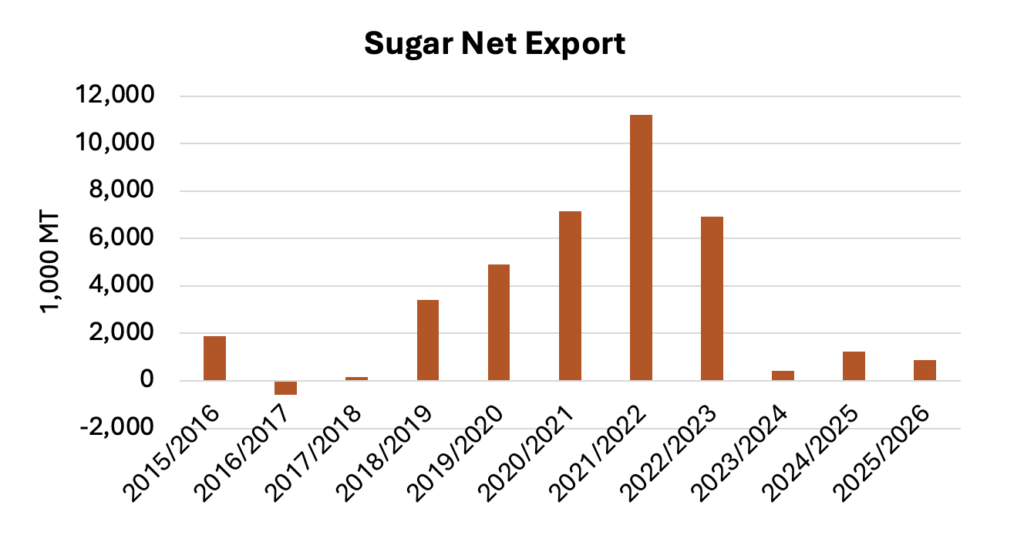
Although one of the largest global producers and consumers of sugar, India is both an importer and an exporter in the same year, a pattern not unusual in the world of commodity trade. India has been importing raw sugar and exporting refined sugar. According to the USDA, for marketing year (MY) 2026-27, India is expected to import 2.4 million MT of raw sugar and to export around 1.2 million MT of raw sugar and 2.4 million MT of refined sugar (USDA FAS, 2026). Due to the export ban, the actual export numbers will be much lower for the current MY.
Stocks scenario
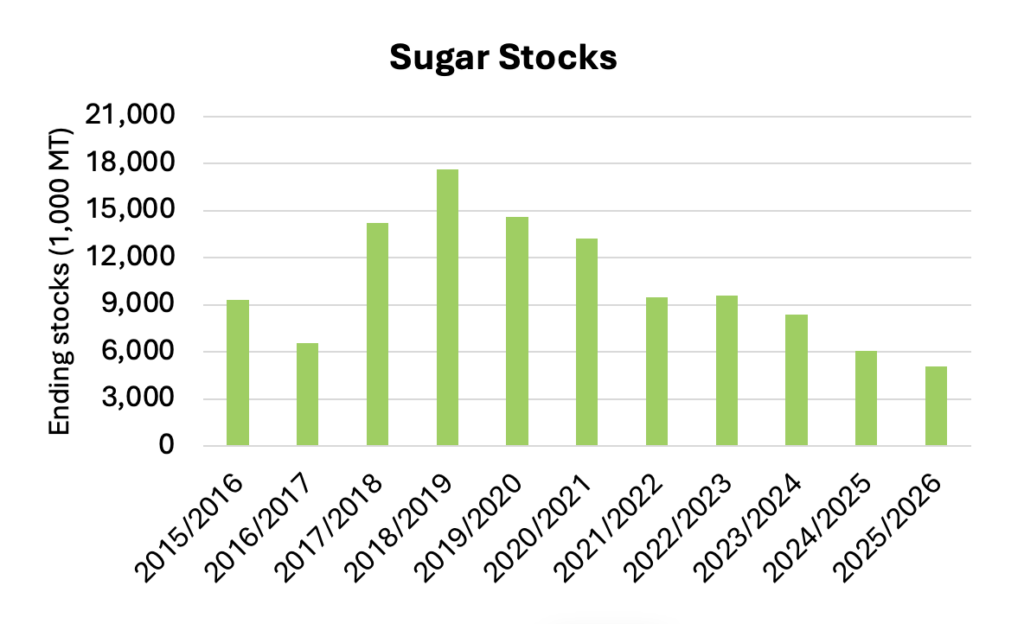
Maintaining domestic commodity stocks provides a key buffer against market fluctuations and is a critical tool for managing future prices. When commodity stocks are below 25% of demand, it becomes a concern for policymakers. Therefore, for India’s sugar market, it is a red flag when the stocks fall below 7.5 million MT. Yet such early warnings were ignored during the last two crop years, 2025 and 2026 (Figure 4). Now, record low stocks and a stock-to-use ratio of 0.12, well below the government-recommended benchmark of 0.28-0.29, are likely contributing to the retail sugar price spikes in 2026 in India.
Figure 4
Ethanol feedstock demand
Another major factor in current high prices is the use of sugar in ethanol production. In 2018, the government started allowing sugar mills to use sugar juice directly as ethanol feedstock. There were two justifications for this move. First, there was sufficient domestic surplus of sugar, and the increased ethanol output was expected to reduce India’s dependence on fossil fuels and lower emissions of greenhouse gases. Second, the government believed that the diversion of some sugar towards ethanol would help stabilize the income generated from sugar. At the time, India’s sugarcane production had skyrocketed; hence, such diversion of surplus sugar to ethanol production did not raise any concerns.
By 2025, around 65% of the total feedstock for ethanol production was sugar juice. Although the ethanol feedstock portfolio is being diversified, sugar juice remains the predominant feedstock for ethanol producers (Figure 5).
Meanwhile, however, sugar production had been falling since the 2023/2-24 crop year, making the continued diversion of sugar juice for ethanol a burden on sugar stocks.
According to the USDA FAS (2026) GAIN report, in 2025, around 20.7 million MT of sugar juice was allocated to ethanol production (Figure 5), a figure that was projected to rise to 23.1 million MT in 2026. At this point, an additional 2.4 million MT of sugar diverted to ethanol production could trigger a serious price spike.
Figure 5
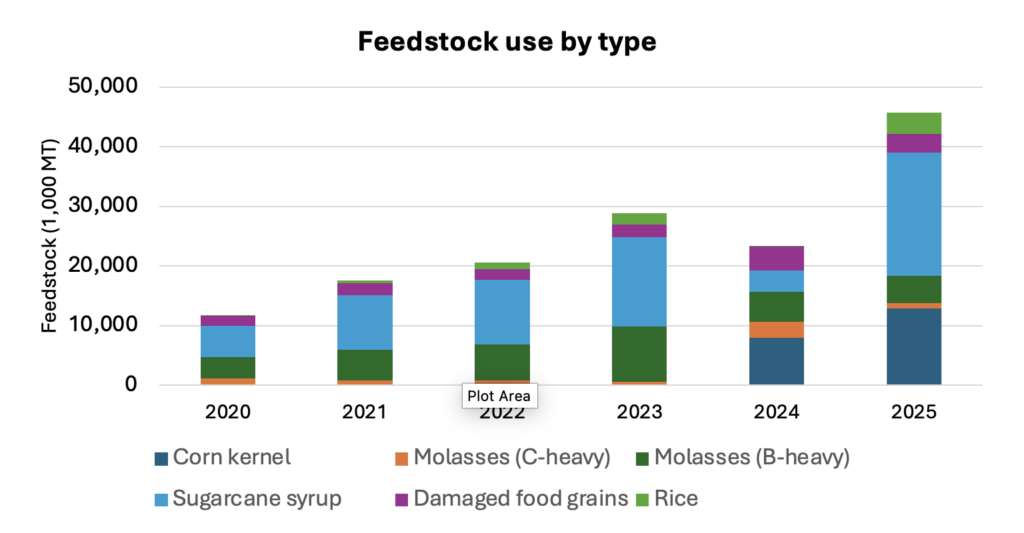
The feedstock composition of ethanol has shifted dramatically in response to these pressures. In December 2023, the government restricted sugar diversions to ethanol production. Within eight days, the ban was softened into a cap of 1.7 million MT of sugar diversion for ESY 2023-24. The cap was not renewed: it lapsed with that supply year, and diversion was unrestricted in ESY 2024-25 and ESY 2025-26.
In response, grain-based ethanol expanded rapidly: in ESY 2024-25, maize alone contributed 4.98 billion liters (48%) of the 10.4 billion liters supplied, while all sugarcane-based routes together accounted for only 3.21 billion liters (31%), of which direct cane juice/syrup was 1.65 billion liters.
Sugarcane has thus ceased to be the predominant ethanol feedstock—a diversification that occurred not through gradual market evolution but as a forced policy response to the sugar-availability pressures the country has faced. At the same time, however, amid rising ethanol production, sugarcane remains in heavy demand as a feedstock, contributing to upward price pressures.
Possible remedies
In hindsight, a modest substitution between feedstocks could have averted the price spike.
Had India diverted only 1.4 million MT to ethanol in the 2024-2025 season, rather than 3.4 million MT, closing stocks on September 30, 2025, would have stood at around 7.3 million MT rather than the actual 5.2–5.4 million MT. Against domestic consumption of about 28 million MT, this is a stock-use ratio of 0.26 rather than 0.19, above the 0.25 comfort threshold, and comfortably above the 5–5.5 million MT closing stock that the government itself regards as the normal minimum.
A buffer of this size would have been sufficient to bridge the 2025-26 production year, in which output of about 27.9 million MT fell only marginally short of requirements. India would have entered the festive season with adequate rather than scarce sugar stocks, signaling adequacy rather than scarcity.
While addressing the short-term sugar price hikes through such stock management and feedstock diversification approaches can work, more medium- to long-term solutions are needed to avert future sugar crises.
A rigid policy can deplete sugar stocks to sustain aggressive blending targets in a difficult year, risking a food price shock that would fall hard on low-income consumers. A flexible blending program able to respond to shifts in sugar production, consumption, and stocks is an approach that India should consider. This is an established policy option; both the United States (maize-based) and Brazil (sugarcane-based) have built successful ethanol programs around it.
More generally, India could aim to strategically increase the share of other feedstocks in the overall feedstock mix, particularly maize. As noted above, the national Ethanol Blended Petrol Programme has already acted on this front. However, switching completely to maize as feedstock will take time, as it depends on evolving technology.
Before such more ambitious reforms, India needs a dynamic regulatory system for sugar stock management that is responsive to emerging commodity market price scenarios. Managing stocks reliably depends on the sugar mills’ accurate reporting and the government’s ability to monitor and track stock-holding compliance.
To achieve that, India should work to improve its monitoring and estimates of sugar production. Confidence in those estimates remains low, as the process of data collection and aggregation relies on outdated assessment methods. More reliable approaches using satellite imagery corroborated by ground truthing can provide real-time estimates of sugar production.
Finally, sugar processing industries should invest in technology upgrades to increase their production efficiency.
Deepayan Debnath is Director and CEO of the Institute of Data Analytics, Kalyani, West Bengal, India; Parthapratim Pal is a Professor with the Indian Institute of Management, Kolkata; Suresh Chandra Babu is a Research Fellow Emeritus with IFPRI’s Director General’s Office and teaches at the Department of Food, Agricultural, and Resource Economics at Rutgers University, New Jersey. Opinions are the authors’.