


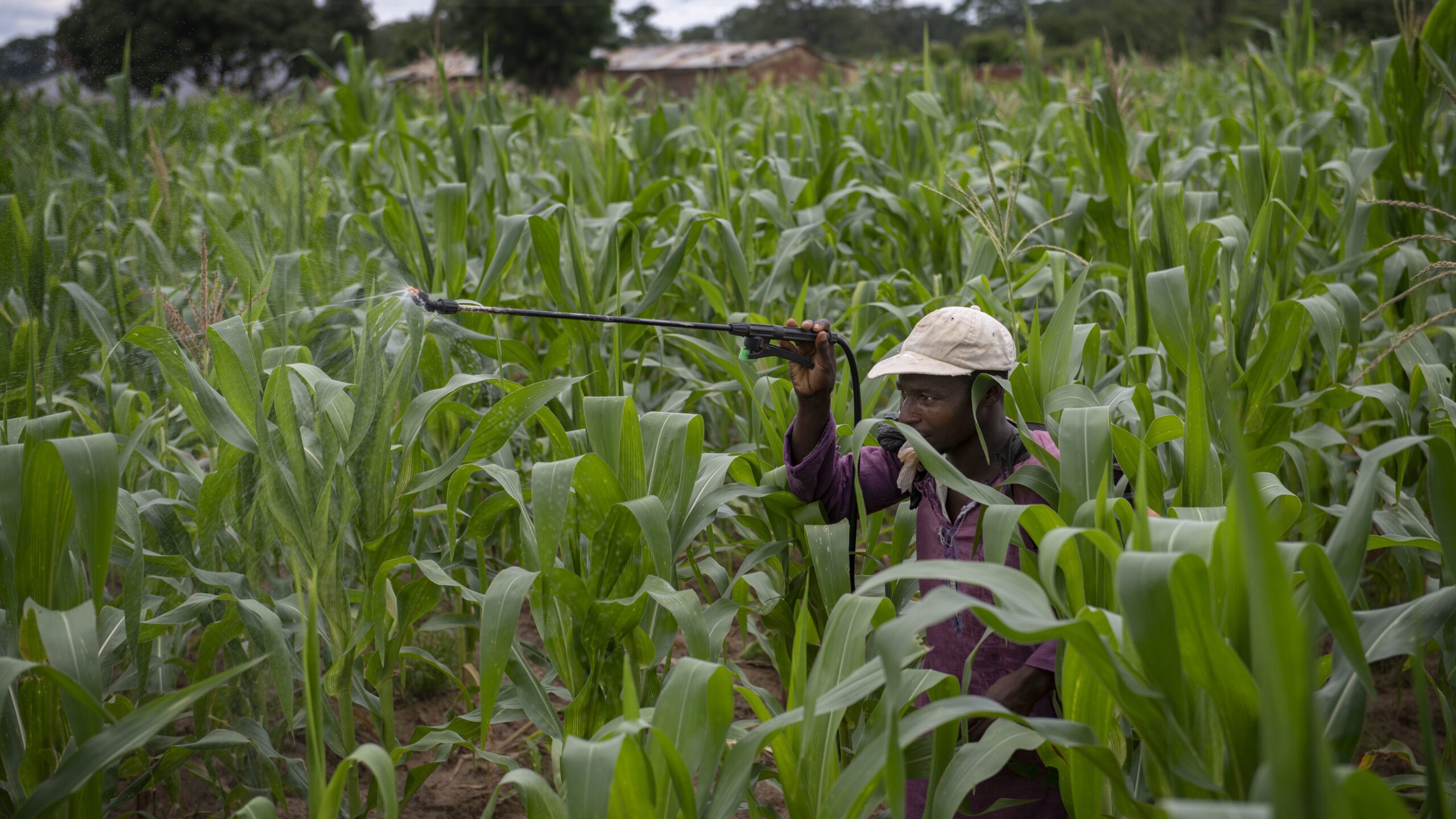
Many studies have demonstrated that low application of productivity-enhancing inputs such as inorganic fertilizer and improved seeds is a key constraint to low agricultural productivity in sub-Saharan Africa, including Nigeria. For instance, yields of maize, a major staple cereal in Nigeria, remain far below their potential, with smallholders averaging under 2 metric tons (MT) per hectare compared to up to a 6-8 MT/ha potential yield under good agronomic practices. A key lever recommended for narrowing this large productivity gap is the increased application of nitrogen-based fertilizer and improved seed varieties.
However, in environments with heightened security threats, such as the northeast regions of Nigeria—where farmer-herder clashes, the Boko Haram insurgency, banditry attacks, and forms of communal violence continue—protracted violent conflicts significantly alter farmers’ risk calculations, impede access to inputs, and lower returns from the inputs. This suggests that conventional input subsidy strategies may fall short of high productivity goals unless they explicitly account for the fragility and conflict conditions on the ground. Past studies rarely examined how spatial variation in conflict exposure influences input use, yield response, and the profitability of fertilizer investments.
A recent IFPRI study, focusing on northeastern Nigeria and published in Agricultural Economics, unpacks how conflicts: (a) influence the use of agricultural inputs and farm productivity in a high conflict setting, (b) affect the profitability of fertilizer, and (c) reshape the pathways through which input use decisions and profitability are affected.
The study merged nationally representative household panel data from the Nigeria Living Standards Measurement Study–Integrated Surveys on Agriculture (LSMS-ISA) with geo-referenced data from the Armed Conflict Location and Event Data (ACLED) project. We constructed annual conflict exposure measures for each household using three indicators: the number of violence against civilians (VAC) incidents, battles, and their aggregate.
ACLED defines a battle as “a violent interaction between two politically organized armed groups at a particular time and location,” and VAC as “an occurrence when any armed or violent group attacks civilians, including actions by rebels, governments, militias, and rioters.” These indicators were calculated within three spatial buffers (0-15 km, 16-30 km, and 31-45 km) to capture direct and indirect effects of conflict, while avoiding double-counting. We employed a fixed effects model on longitudinal data to examine the relationship between fertilizer application and maize yield under conflict conditions, while investigating the pathways through which conflict affects fertilizer profitability.
How conflict shapes input use and productivity
Our results reveal a clear message: conflict makes fertilizer less effective. When farmers apply more nitrogen fertilizer, maize yields generally increase. But this boost is much smaller for farmers living within 15 km of conflict events, whether general conflict, battles, or violence against civilians. As shown in Figures 1a-1c, farmers in peaceful areas see much steeper improvements in yield when they use more fertilizer. Those exposed to conflict, however, experience flatter responses, meaning the fertilizer simply doesn’t deliver the same benefits.
Figure 1

Overall responsiveness to nitrogen fertilizer (marginal physical product) in a conflict setting is modest (~6 kg maize per kg N), and only about 57 % of maize plots achieve the common profitability threshold (average value-cost ratio ≥ 2). This implies that a conventional understanding that a high fertilizer application automatically translates to a high productivity does not hold in a conflict-prone environment.
Higher proximity to conflict is linked to lower fertilizer productivity and lower overall fertilizer use. We find that exposure to violent conflict events within 0-15 km of a farm significantly reduces both fertilizer use and the yield response to fertilizer compared to conflict events beyond the 15 km radius, thus undercutting profitability. Further, conflict within 15 km lowers the likelihood of applying nitrogen by about 6%. Use of improved seeds and hired-labor access are also negatively affected in conflict-proximate zones.
Women-managed plots are disproportionately affected. Conflict reduces fertilizer returns more sharply when the plot-head is female, pointing to intersecting vulnerabilities of gender and insecurity.
Mechanisms at work
Conflict disrupts several parts of the agricultural system in ways that sharply reduce the profitability of nitrogen fertilizer. Insecurity elevates farmers’ risks, such as theft, displacement, or market collapse, which lowers the expected returns from investing in inputs. At the same time, supply chain disruptions raise input costs, limit access to quality fertilizer and seed, and prevent farmers from applying them on time. Conflict also causes labor shortages and delays in planting or harvesting, further reducing the agronomic and economic effectiveness of fertilizer. Importantly, these effects spill over beyond the immediate area: even conflict occurring 16-45 km away lowers fertilizer profitability, reflecting broader regional disruptions in markets and services.
Conflict-aware agricultural support
These findings have important agricultural policy implications. Below are some key recommendations to address the impacts of conflict:
Bundle productivity support with resilience building. Input subsidies alone are unlikely to sustain agricultural investment in environments characterized by elevated risk and uncertainty. Pairing productivity-enhancing interventions with resilience-building instruments can help stabilize farmer behavior and investment incentives. This includes integrating input support with social protection programs, such as cash transfers or consumption vouchers, to buffer income shocks in fragile areas, and introducing risk-transfer mechanisms—such as weather- or conflict-indexed insurance—to encourage continued investment despite uncertainty. Complementary investments in rural infrastructure, including roads, storage facilities, and market access, are also essential to maintaining input and output flows when insecurity disrupts local economies.
Promote gender-inclusive and conflict-aware interventions. Conflict alters gender roles, constraints, and exposure to risk, with important implications for agricultural participation and migration decisions. Women farmers in conflict-prone areas often face heightened mobility constraints and safety risks, limiting their access to inputs, extension services, and markets. Agricultural support programs should therefore explicitly prioritize women through conflict-aware design, including safe and localized input delivery, extension services that reduce travel requirements, targeted access to credit, and the use of women-led producer groups or digital platforms to sustain engagement under insecurity.
Strengthening data, monitoring, and adaptive management. Effective policy design in fragile contexts requires timely and integrated information. Building data systems that link agricultural outcomes with conflict exposure and market conditions can improve targeting and enable rapid program adjustment as conditions evolve. Continuous monitoring of input use, returns, and profitability across varying levels of conflict intensity is critical for refining subsidy design and scaling interventions that remain effective under fragility.
Rethink fertilizer policy in fragile contexts. Finally, policymakers must recognize that the standard paradigm equating increased fertilizer use with higher productivity may break down in conflict-affected settings. When supply chains are unreliable and risk is elevated, alternative soil fertility and production strategies—such as integrated soil fertility management, organic amendments, legume-based rotations, or less input-intensive cropping systems—may offer more resilient pathways. In high-risk zones, mixed cropping systems or crops with lower input requirements may outperform conventional fertilizer-intensive maize systems, underscoring the need for context-specific fertilizer and input policies in fragile environments.
Conclusion
Conflict fundamentally alters the environment in which agricultural policies operate, undermining key assumptions of uniform responsiveness to productivity-enhancing inputs such as fertilizer. This poses difficult challenges to efforts to improve agricultural production and otherwise support smallholders in conflict zones.
Beyond direct disruptions to production and markets, conflict may operate through behavioral channels, shaping expectations, risk perceptions, and aspirations, and thereby reducing willingness to invest or remain engaged in agriculture even when economic incentives persist. These effects are likely to be gender-differentiated, as men and women face distinct constraints, responsibilities, and coping strategies under insecurity, with potential implications for migration, labor allocation, and long-term livelihood trajectories.
Future work should examine the long-term effects of conflict on productivity, investment, and household decision-making, and explore interactions between conflict and other shocks such as climate variability or price volatility. Research should also investigate how conflict influences youth aspirations, migration, and gender dynamics within households. Understanding these interactions can inform the design of adaptive, conflict-sensitive interventions that maintain productivity gains under fragility. Building resilient agrifood systems in fragile settings requires explicitly integrating conflict sensitivity into agricultural policy design, including localized, risk-aware extension, improved geospatial conflict monitoring, and bundling input support with social protection, insurance, and peacebuilding interventions to sustain agricultural engagement under uncertainty.
Mulubrhan Amare is a Senior Research Fellow with IFPRI’s Development Strategies and Governance (DSG) Unit based in Washington, DC; Kwaw S. Andam is a DSG Senior Research Fellow and Country Program Leader of IFPRI’s Papua New Guinea Agriculture, Food, and Nutrition Policy Support Program, based in Washington; Bedru Balana is a Research Fellow with IFPRI’s Natural Resources and Resilience Unit and Acting Program Leader for the Nigeria Country Program, based in Washington; Steven Were Omamo is DSG Director and Director for Africa, based in Nairobi, Kenya, Opeyemi Olanrewaju is a DSG Research Analyst based in Abuja, Nigeria. Opinions are the authors.’
This work was supported by the CGIAR Science Programs on Policy Innovations and Food Frontiers and Security.
Reference:
Amare, Mulubrhan; Andam, Kwaw S.; Balana, Bedru; Olanrewaju, Opeyemi; and Omamo, Steven Were. Unpacking the effects of conflict on fertilizer use and maize yields: Empirical evidence From Nigeria. Agricultural Economics. Article in press. First published on November 13, 2025. https://doi.org/10.1111/agec.70078