





Nigeria is once again under economic pressure from a shock that originated far from its borders, as it faces high global fuel and fertilizer prices triggered by the closure of the Strait of Hormuz. For a country still recovering from the inflationary aftermath of the Russia-Ukraine war, the timing could hardly be worse. The shock is reaching Nigeria through three tightly linked channels, fuel, fertilizer, and food, and it threatens to reverse a hard-won decline in food inflation.
Yet Nigeria also benefits from the fuel and fertilizer price spikes, which sets it apart from a simple winner-or-loser story. As an oil producer with rapidly expanding domestic refining and urea capacity, the country stands to gain from higher export earnings. IFPRI Food Policy Model simulations, outlined in a new Policy Note, suggest Nigeria could even see net welfare gains where increased oil and fertilizer export revenues outweigh rising domestic prices. However, the situation is complicated: the economy still depends heavily on imported refined fuel and on imported potash, phosphate, and other fertilizer inputs.
That dual exposure makes Nigeria’s potential policy response to the crisis both a delicate and consequential challenge.
Food prices: A fragile recovery at risk
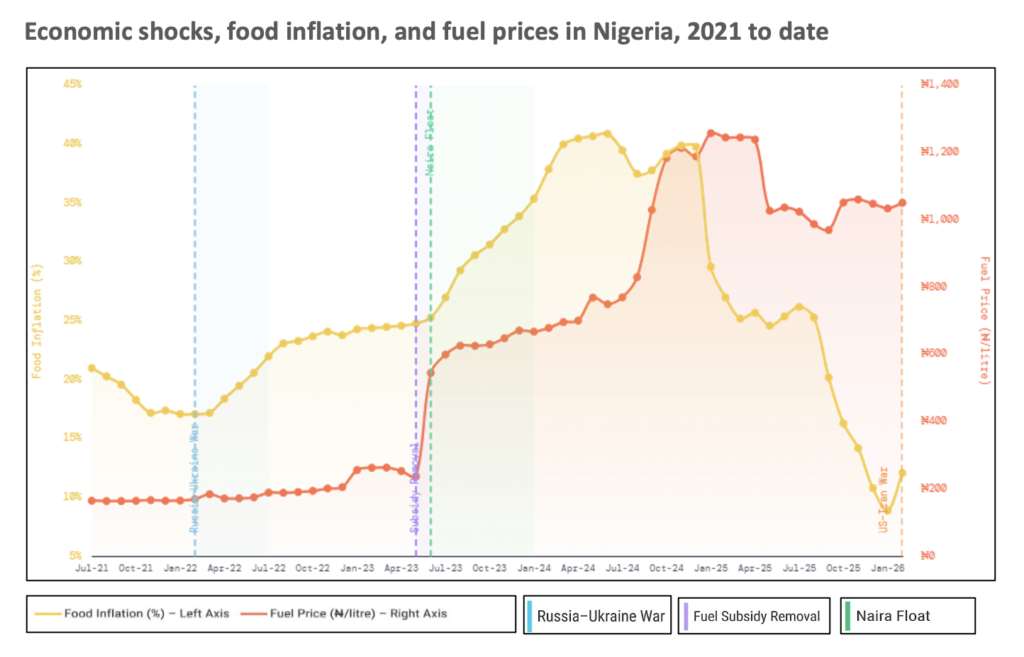
The link between external shocks and food inflation in Nigeria is by now well established. Food inflation surged after the Russia-Ukraine war disrupted global grain and fertilizer supplies in 2022, then climbed further when the government removed the fuel subsidy and floated the naira in 2023. While these measures were intended to strengthen fiscal sustainability and support a longer-term industrial transformation agenda by encouraging domestic production, investment, and more efficient resource allocation, their immediate effect was a sharp increase in energy and input costs. Pump prices rose significantly, contributing to food inflation reaching about 40.9 percent in June 2024 as higher transport, energy, and production costs spread throughout the food system.
Since then, conditions had been improving. According to the National Bureau of Statistics, food price inflation eased to around 21%-23% by mid-2025, helped by a more stable naira, tighter monetary policy, and better harvests in some regions. The fuel price increases now flowing from the Iran conflict put that recovery in jeopardy. Prices are rising not only because supply is tighter but also because costs are climbing at every stage of the value chain, a classic cost-push dynamic. Past episodes, from the 2008 food crisis to the COVID-19 pandemic to the Russia-Ukraine disruption, suggest such pressures can keep food inflation elevated for extended periods when energy and input costs stay high.
Figure 1
Fertilizer: A bigger producer, still tied to global markets
Nigeria’s fertilizer sector has been transformed over the past fifteen years. Between 2010 and 2025, annual domestic production rose from roughly 70,000 metric tons (MT) to more than 4.2 million MT, exports expanded from about 20,000 MT to nearly 3 million MT, and domestic consumption grew past 1 million MT. Nevertheless, imports remain a persistent and volatile part of supply. Blending of NPK (for nitrogen, phosphorus, and potassium, a common form of fertilizer mix) depends almost entirely on imported raw materials, diammonium phosphate (DAP), muriate of potash (MOP), and ammonium sulfate, combined with domestically produced urea. Potash and phosphate are not produced in the country at all.
That keeps the sector deeply integrated into global commodity markets and, therefore, squarely in the path of this shock. With about 40% of global urea exports originating in the Persian Gulf region, prices reacted fast, with urea jumping from an average of $490 to $780 per MT within a single month, a 59% increase. For farmers, the timing is especially difficult: the planting season for the key staples of maize, rice, and cassava runs from March through May and June. In 2024, more than 53% of Nigeria’s fertilizer imports arrived in the first half of the year, precisely the window now most exposed.
Higher prices directly influence farmer behavior. Smallholders operating under tight liquidity constraints are highly price sensitive: as fertilizer costs rise, they cut application rates, reduce planted area, or switch to less input-intensive crops. Rational at the household level, these responses collectively lower yields, tighten food supply, and push food prices up, deepening poverty and food insecurity. The disruption also revives a politically charged debate over fertilizer subsidies and voucher programs, which had receded after the 2023 subsidy removal but are likely to return to prominence as prices climb.
Fuel: More refining at home, but no shelter from world prices
Nigeria’s downstream energy picture has likewise shifted dramatically. In 2025, about 62% of the petrol consumed in the country, some 11.85 billion liters, was still imported. By February 2026, domestic refineries, led by the Dangote Refinery, were estimated to supply around 92% of daily petrol demand. The downstream reforms of 2023, including subsidy removal and price deregulation, created the commercial conditions that made large-scale local refining viable.
Yet more refining at home has not shielded consumers. Higher global crude prices raise feedstock costs for domestic refiners, so pump prices rise regardless of where the fuel is processed. Petrol has climbed from below 900 naira ($0.66) per liter before the escalation to as high as 1,600 naira ($1.18) in some states, with diesel following a similar path. For agriculture, this spike affects transport, irrigation, mechanization, and post-harvest processing. Because Nigeria relies so heavily on road transport to move food, energy costs act as a generalized cost-push factor, making the whole distribution system more expensive and less efficient.
The food security stakes are high. Nigeria already faces one of the world’s most severe food insecurity crises: per the UN Food and Agriculture Organization’s 2025 State of Food Security and Nutrition report, roughly 75% of the population, about 170.4 million people, experience moderate or severe food insecurity, conditions worsened by conflict and economic hardship in key food-producing regions. Where food is already the largest item in household budgets, further price increases risk putting nutritious, diverse diets out of reach, with lasting consequences for nutrition and human capital.
A strategic opening, if policy can keep up
The same disruption that raises costs also opens a door. Nigeria’s expanding refining and fertilizer capacity, anchored by the Dangote complexes, positions it more favorably than many African peers to turn a short-term shock into longer-term gains through export revenue, jobs, industrial growth, and a larger role supplying refined fuel and fertilizer across the continent.
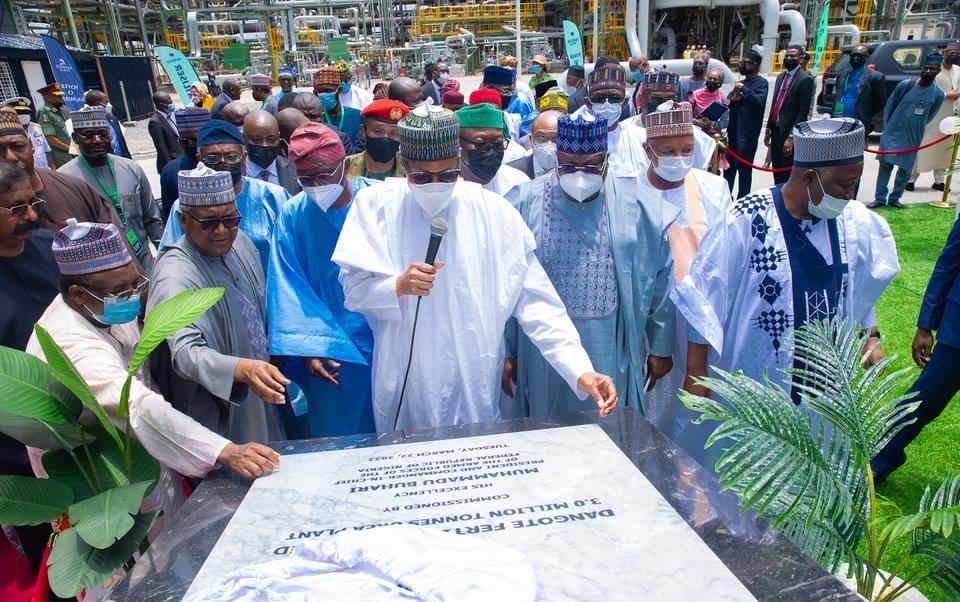
Dangote Fertilizer runs Africa’s largest granulated urea complex, with an annual production capacity of roughly 3 million MT of urea and ammonia, already serving Brazil, India, and the United States. As global prices rise and traditional supply chains falter, demand for Nigerian fertilizer is climbing across West, Central, and East Africa, where supply gaps are widening.
On the energy side, Nigeria produces an estimated 50-60 million liters of petrol a day, nearly a fifth of Africa’s total, and the Dangote Refinery has begun supplying refined products to Cameroon, Côte d’Ivoire, Ghana, and other import-dependent neighbors, cushioning some of the regional impact. Coordinated procurement, for instance among members of the Economic Community of West African States (ECOWAS), could further ease imports during a period of global shortage.
Figure 2
Still, these gains should be read with caution. A large share of Nigeria’s urea is still exported outside of Africa even as its application rates, and those across West and Central Africa, remain among the lowest in the world. This raises the question of how much production should be redirected toward regional food systems, which in turn would demand better logistics and last-mile delivery. And higher fertilizer prices, if they constrain access, could undermine the very productivity gains the country needs, hitting smallholders and low-income households hardest.
The Iran conflict, in short, is less a fresh problem than a multiplier of Nigeria’s existing structural vulnerabilities and, at the same time, a test of its emerging industrial strength. Whether rising fuel, fertilizer, and food prices erode hard-won gains or accelerate a more resilient, regionally integrated food and energy system will depend on the speed, coherence, and effectiveness of the policy response, on stabilizing input markets, on protecting vulnerable households, and on balancing export ambition against food security at home.
Oliver K. Kirui is a Research Fellow and Acting Program Leader for Nigeria with IFPRI’s Development Strategies and Governance (DSG) Unit, based in Abuja, Nigeria; Adetunji Fasoranti is a Monitoring and Evaluation Specialist for IFPRI’s Nigeria Strategy Support Program (NSSP), based in Abuja; Temilolu Bamiwuye is an NSSP Research Consultant, based in Abuja; Bedru Balana is a Senior Research Fellow with IFPRI’s Agrifood Innovation and Resilience Unit, based in Washington, D.C.; Joseph Glauber is a Research Fellow Emeritus with IFPRI’s Director General’s Office, based in Washington; Charlotte Hebebrand is Director of IFPRI’s Communications and Public Affairs Unit, based in Washington; Steven Were Omamo is DSG Director and Director for Africa, based in Nairobi, Kenya. This post cites research that is not yet peer-reviewed. Opinions are the authors’.
This work was supported by the CGIAR Programs on Policy Innovations and Scaling for Impact.
Reference:
Kirui, Oliver K.; Fasoranti, Adetunji; Bamiwuye, Temilolu; Balana, Bedru; Glauber, Joseph W.; et al. 2026. Effects of the Iran conflict on fuel, fertilizer, and food prices in Nigeria. NSSP Policy Note 58. Washington, DC: International Food Policy Research Institute. https://hdl.handle.net/10568/183398