


Key takeaways
- Women’s voice strengthens resilience. An IFPRI-led dialogue highlighted evidence that women in northern Nigeria need real influence over decisions, not just participation, to help communities prepare for and recover from crises.
- Research identifies practical pathways to change. Studies showed that advocacy training, facilitating collective action, bolstering women’s economic agency, and gender-responsive disaster planning can improve women’s influence and strengthen community resilience.
- Inclusion alone is not enough. Speakers stressed that programs should measure women’s actual influence on decisions, support locally led solutions, and ensure women help shape policies and interventions that affect their lives.
Resilience is often understood as the ability to withstand shocks. In Nigeria, women are already central to how households and communities cope with crises—sustaining livelihoods, caring for families, running businesses, and helping in recovery efforts. Indeed, a 2024 survey across four Nigerian states found that rural women spend over six times as much time as men on unpaid domestic and care work.
Yet how can communities become truly resilient when women shoulder so much responsibility but have limited influence over how those communities prepare, respond, or recover?
That question framed “Women’s Voice and Resilience in Nigeria,” an October 14, 2026 strategic dialogue co-organized in Abuja by IFPRI, the CGIAR Science Program on Food Frontiers and Security, and the CGIAR Gender Equality and Inclusion Accelerator. Researchers, policymakers, and practitioners explored how women can move beyond participation to influence decisions affecting livelihoods, social cohesion, and peacebuilding.
This conversation comes at a moment of mounting pressures on women in Nigeria. Speakers pointed to climate shocks, insecurity, and displacement; a persistent gender gap in political representation, with women holding fewer than 4% of the country’s National Assembly seats; and shrinking funding for gender equality work. Against this backdrop, evidence on what gives women influence over decisions is critical so that limited resources support approaches that work.
What does the evidence tell us?
Five research presentations, moderated by IFPRI Research Fellow and Acting Program Leader for Nigeria Oliver Kirui, revealed both promising interventions and persistent barriers.
Katrina Kosec, IFPRI Senior Research Fellow, presented findings from an ActionAid-implemented randomized evaluation of group advocacy training in 450 rural communities in Oyo, Ogun, and Osun States. Findings showed that trainings strengthened women’s participation in local governance and their ability to make effective requests of leaders; some gains persisted two and a half years later. Although training husbands as allies improved their gender attitudes, it did not further increase women’s participation; rather, backlash from other men appeared to constrain progress. The study also found that the trainings built trust in other citizens and leaders as well as entrepreneurship—factors that have been linked to communal resilience.
IFPRI Senior Research Analyst Lucia Carrillo previewed a forthcoming household survey tool for measuring women’s collective agency, or “power with.” By distinguishing confidence, participation, actual influence, and results, the tool can help policymakers identify where women’s voices are being lost—and whether programs change more than attendance statistics.
Charity Osei-Amponsah of the International Water Management Institute examined water vulnerability in Adamawa State, highlighting heightened risks for women-headed households and gaps in early warnings and assistance. Women’s cooperatives and collective action can strengthen resilience and participation in water governance, she emphasized.
IFPRI Research Analyst Opeyemi Olanrewaju examined gender gaps in agricultural asset ownership and household inequality in Nigeria. The analysis showed that women manage just 11% of household farmland, while women’s asset ownership was associated with lower income inequality. Importantly, control over income and agricultural decisions was strongly linked to equitable outcomes, underscoring the importance of women’s economic agency.
Finally, Kosec presented work with IFPRI Research Fellow Jordan Kyle on making flood anticipatory action gender responsive. Early warnings may reach men first, assistance may bypass women or miss their needs, and seats on preparedness committees do not necessarily translate into influence. Recommendations included registering women individually, tailoring assistance to their priorities, and investing in leadership and norm change between emergencies.
Turning research into action: Insights from the policy panel
The high-level panel, moderated by Kosec, explored what governments and development organizations should do differently.
Jennifer Orgle of CARE Nigeria described resilience as the ability to access resources and opportunities before a crisis vs. merely receiving assistance afterward. Women’s savings and other community groups are important channels for collective action, recognition, and influence. For programs with scarce resources, she urged prioritizing locally led approaches, sustained dialogue across communities, and partnerships that avoid siloed or duplicative parallel projects.
“When you empower a woman, you are not only lifting her up out of poverty, but you are … uplifting her household and community out of poverty. […] The difference that we see between women who are able to have some resilience to some of these shocks and those who are not [lies in] access to agency, to resources, to opportunities, to the relationships and support around her to be able to withstand the shocks during and after a crisis.” — Jennifer Orgle
Osasuyi Dirisu, Executive Director of the Policy Innovation Centre, Nigeria, focused on turning information and commitments into institutional change. Drawing on her work with national gender-based violence data systems, she stressed that collecting data is not enough: decision-makers must know what is happening, where, to whom, and what action is required. Just as importantly, women affected by policies must speak for themselves rather than be represented only by intermediaries. She called for convening the right actors, co-creating solutions, tracking commitments, and returning repeatedly to communities until promised changes materialize.
“When we started the Gender Summit, we started with representation in mind. … And then later we said, no, we need to bring those voices in the room. … Speak for yourself as opposed to somebody else speaking on your behalf … So if we’re having a conversation about a woman leading in her field, the woman is speaking for herself. … So the woman is speaking to the policymaker. So first of all, it’s ensuring that the problem is not coming third hand … But one of the ways we’ve reflected on how to move those commitments is ensuring that there is a tracker. We have the purple book that tracks those commitments. … When you make a commitment this year, we give you an opportunity to come back next year to tell us what progress looks like.” — Osasuyi Dirisu
Se-ember Emily Oteyi, Gender Advisor at ActionAid Nigeria, connected women’s voice to economic opportunity, social protection, and peacebuilding. Strengthening skills and livelihoods matters, she argued, but lasting resilience also requires collective action to challenge systems generating vulnerability. Women need a genuine place at decision-making tables, including as peacebuilders, alongside access to social services and healthcare. She also urged practitioners to ask who actually benefits from programs and to recognize differences among women rather than treating them as a single category.
Click for more voices from the dialogue.
“Women’s voice is not merely a gender issue; it is a governance issue, an economic issue, a peace and security issue, and ultimately a development imperative. […] Closing these [gaps in access to land, credit, technology, skills development, and markets] is not only a matter of fairness. It is smart economics. Research consistently demonstrates that economies grow faster and communities prosper when women have equal access to productive resources and opportunities. Women’s economic empowerment strengthens household resilience, improves children’s well-being, reduces poverty, and contributes to inclusive growth.” – Beatrice Eyong, Country Representative, UN Women Nigeria
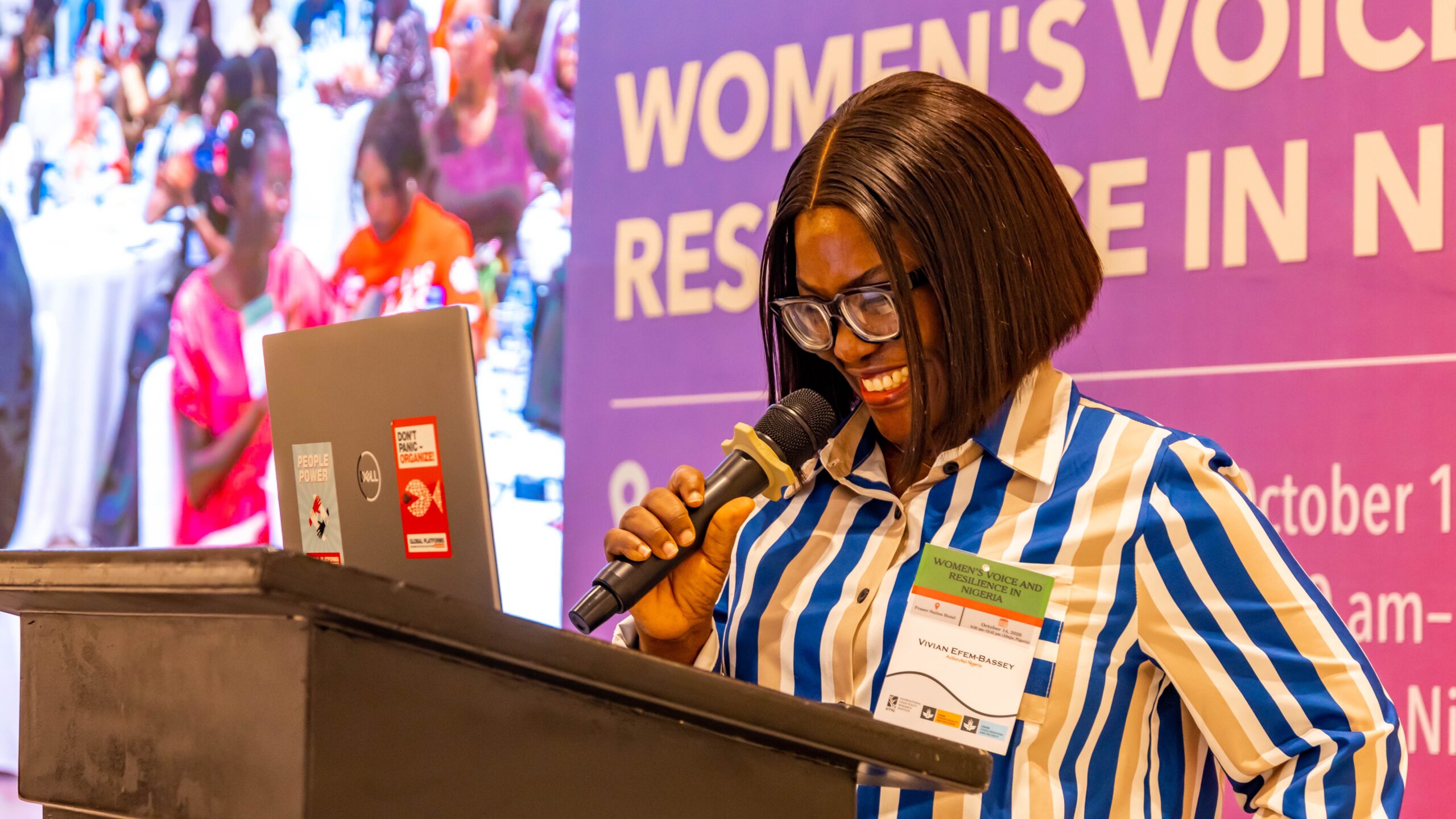
“The message today is clear: strengthening women’s voice is an investment in responsive institutions and resilient communities. Women must be able to influence the decisions that shape their livelihoods, safety, and future. Participation becomes meaningful when women’s priorities actually receive response. Economic hardships, climate shocks, and insecurity make this especially urgent.” – Vivian Efem-Bassey, Governance Specialist, ActionAid Nigeria
“The need to invest in women’s empowerment tells us that yes, this is one of the granular things we need to do to begin to change narratives, to begin to make sure that women in Nigeria are actually being seen and also seen achieving a lot. Because if you don’t empower Nigerian women, if you don’t empower them in real sense in terms of economy, in terms of policy engagement, in terms of visibility, we will not go anywhere.” – John Duru, Ministry of Women’s Affairs, Nigeria
Yetunde Adegoke, an international development and governance specialist and Vice President of the Nigerian Association of Evaluators, argued that researchers and implementers must design for learning from the outset. That means asking the right questions, sequencing interventions carefully, and measuring changes in women’s agency rather than simply counting participation. She cautioned that bringing powerful gatekeepers (e.g., elites or men) into a program without care can sometimes backfire by dampening women’s own contributions. Co-producing research with women’s organizations, creating safe spaces where women can express their priorities, and building trust with implementers are essential to adaptation and lasting change.
And so often in programs that’s the extent to which measurements … sex disaggregation recording only whether someone is male or female, reflects any gender programming. We need to move beyond that and begin to look at how we can actually measure the outcomes that are specific to women’s agency. … You wouldn’t just ask a woman, ‘Do you have input into decision-making?’ You might … say, ‘To what extent does she feel that she can actually make her own decisions?’ … We need to be flexible. We need to be adaptive in how we try to collect this information. There’s no one-size-fits-all remedy to this. — Yetunde Adegoke
Tying in agriculture, Hakeem Ayinde Ajeigbe of Bayero University Kano noted that women often adopt improved seed varieties and farming technologies at lower rates because access to inputs, high-quality land, and extension advice remains unequal; most extension agents are men. But the challenge is not only removing barriers to adoption. Women may prefer different crop traits and perform different agricultural tasks, and research still insufficiently captures that diversity. Gender-responsive innovation must therefore begin with women’s priorities—not simply measure how many women receive a technology.
From voice to influence
Together, the presentations and panel offered a clear challenge: stop equating inclusion with impact. Strengthening resilience requires women’s access to resources, sustained collective organization, genuinely responsive institutions, and evidence that their voices have changed decisions. The next step is to translate these lessons into partnerships, programming, and research that give women real influence before, during, and after crises.
Katrina Kosec is a Senior Research Fellow with IFPRI’s Poverty, Gender, and Inclusion (PGI) Unit; Lucia Carrillo is a PGI Research Analyst; Oliver Kirui is a Research Fellow with IFPRI’s Development Strategies and Governance Unit and Nigeria Country Program Leader.
This event and blog post were supported by the CGIAR Science Program on Food Frontiers and Security and the CGIAR Gender Equality and Inclusion accelerator.