





Key takeaways
•Reducing ozone pollution offsets negative impacts of climate mitigation: lower ground-level ozone cuts crop damage and offsets about 15% of the increase in hunger risk.
•Cleaner air boosts agricultural yields: reduced ozone improves plant growth and productivity, driving much of the food security gains.
•Accounting for ozone reduction shows that climate mitigation policies may have lower negative impacts on food security than previously estimated, though challenges remain.
Cutting greenhouse gas (GHG) emissions is essential for ensuring food security over the long run. Climate impacts such as rising temperatures, prolonged droughts, and extreme weather will limit the agricultural production needed to feed a growing global population.
However, climate mitigation measures can themselves undermine food security goals. For example, planting forests for carbon capture and using bioenergy from sources like maize will compete with the need for farmland to grow food in the coming decades. Studies have shown that policies to achieve the Paris Climate Agreement’s target of limiting the rise in global temperature to 1.5°C above pre-industrial levels tend to push up agricultural production costs, raise food prices, and leave more people at risk of hunger.
A new study in Nature Food clarifies that picture: it shows that those very same mitigation policies also reduce ground-level ozone pollution, a benefit that has been almost entirely missing from previous analyses. The study finds that ozone reduction could offset approximately 15% of the negative effects on global hunger associated with mitigation.
Ozone and food security
Ground-level ozone forms when methane, nitrogen oxides, and volatile organic compounds react in sunlight. These pollutants are routinely emitted alongside GHGs by vehicles, industrial sites, and other sources. Elevated ozone concentrations harm crops by interfering with photosynthesis and plant growth, leading to lower yields. Ozone pollution already costs the global economy tens of billions of dollars in production each year. When climate mitigation policies reduce GHG emissions, they also decrease ozone, resulting in healthier crops. This connection between ozone’s direct impact on crop yield and food security has not been fully assessed in previous analyses.
A multi-model approach
To fill that gap, the study team assembled six global agro-economic models (AIM-Hub, ENVISAGE, GCAM, GLOBIOM, IMPACT, and MAGNET) and used them to estimate the effects of climate change, climate mitigation policy, and ozone reduction on hunger risk through 2050. Running multiple models lets researchers see which conclusions hold up across different frameworks and which ones depend on modeling choices.
IFPRI’s IMPACT model (International Model for Policy Analysis of Agricultural Commodities and Trade) was part of this ensemble. We used IMPACT to link economic and biophysical components of the analysis. IMPACT tracks agricultural commodity production, demand, and trade across 158 countries and 62 commodities. This exercise translates real-world resource constraints into food security outcomes across different country contexts. Participating in multi-model exercises like this one is central to the goal of IFPRI’s modeling work to advance understanding of the food-climate relationship.
The analysis compared two alternative climate futures: a high-emissions, business-as-usual trajectory (SSP2-RCP7.0) and a stringent mitigation pathway in line with 1.5°C warming (SSP2-RCP2.6).
Key findings
In the business-as-usual scenario, the study projects climate change will put an additional 9.6 million people at risk of hunger globally by 2050 compared to a no climate change scenario (across median results of all models). Of this increase, 7.5 million is attributed to direct climate impacts, while 2.1 million results from elevated ozone levels that reduce crop yields, raising food prices and limiting food availability. Estimates from IFPRI’s IMPACT model, which provides greater regional and commodity-level detail, suggest even larger climate-related increases in hunger risk.
Under the stringent mitigation scenario, hitting the 1.5°C target requires measures including carbon pricing, agricultural land-use constraints, bioenergy expansion, and afforestation, all of which could drive up the cost of agricultural production. The effect, according to the modeling work, is roughly 61 million additional people at risk of hunger, a figure consistent with what earlier multi-model studies have found.1
Figure 1
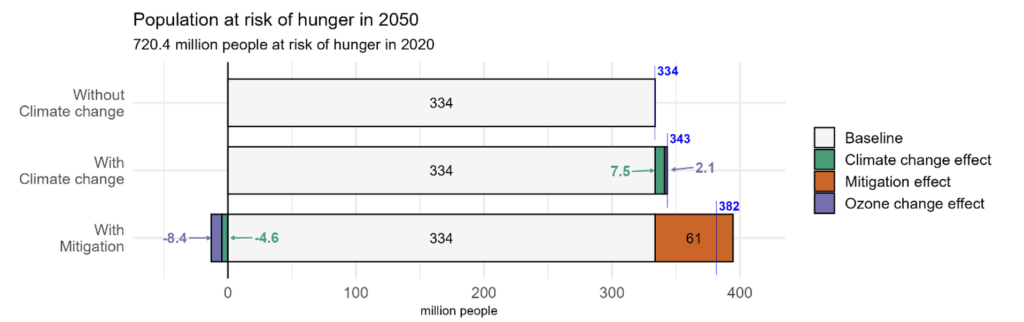
However, cutting the emissions driving climate change also slows warming and helps reduce ozone, both of which in turn boost crop yields (most noticeably for wheat). The study projects that by 2050, these effects reduce the population at risk of hunger by 13 million people, about two-thirds (8.4 million) due to the reduction in ozone, and negating roughly 15% off the negative impact of mitigation on hunger.
Sub-Saharan Africa and India together account for more than half of that gain. The hunger risk reduction in India due to ozone reduction could be attributed to substantial increases in wheat production, boosting calorie availability.
What does this mean for policymakers?
The study has important implications for climate and food policy as global temperatures continue to rise. First, it suggests that past assessments have likely overestimated the food security costs of ambitious climate action by excluding ozone from the equation. Co-benefits such as ozone reduction should be included in analyses focusing on what climate mitigation actually costs and delivers.
Second, even with ozone’s benefits counted, climate mitigation (while essential over the longer run) still adds net pressure to food security over the projection period. The ozone dividend is real but does not make up for these impacts. This means complementary action is not optional; agricultural productivity investments, efficient land-use allocation, cuts to food loss and waste, and stronger food distribution safety nets in the most exposed regions, as well as changes towards sustainable diets, all must be part of the picture to address climate change while ensuring food security in the future.
Abhijeet Mishra is a Research Fellow with IFPRI’s Foresight and Policy Modeling (FPM) Unit; Timothy B. Sulser is an FPM Senior Scientist; Keith Wiebe is an FPM Senior Research Fellow; Eleanor Jones is an FPM Project Manager. Opinions are the authors’.
Reference:
Xia et al. (2026). “Ozone pollution reduction partially offsets the negative impact of climate change mitigation efforts on global hunger.” Nature Food. https://doi.org/10.1038/s43016-026-01322-3
EurekAlert: https://www.eurekalert.org/news-releases/1119343
This work received funding from the CGIAR Science Program on Policy Innovations, Area of Work 1: Foresight and Prioritization.
1. For further discussion and analysis of the need for careful policies regarding stringent mitigation measures, see Wiebe and Sulser, 2018 and Hasegawa et al., 2018.